Records show a “property rights” group directed a Texas county’s fight against transmission lines


A Texas-based “property rights” nonprofit organization helped draft the policy that a two-county planning commission used to oppose a proposed 765-kV transmission line, according to emails obtained by the Energy and Policy Institute.
American Stewards of Liberty (ASL) guided local government officials in Erath and Somervell counties to establish a regional planning commission, provided legal support, and crafted resolutions, and talking points as well as edited demand letters for those elected officials, according to those records.
In a March 2026 email exchange, ASL CEO Dan Byfield told the chief of staff to Erath County Judge Brandon Huckabee, that he appreciated the judge “amending all of our recommendations and others into the ESSRPC policy.” ESSRPC is the Erath-Somervell Sub-Regional Planning Commission.
EPI obtained the records via requests under the Texas Public Information Act.
Erath County and Somervell County officials did not respond to questions from EPI about the nature of their relationship with American Stewards of Liberty. EPI also reached out to ASL regarding their relationship with Somervell and Erath county officials and involvement in ESSPRC and did not receive a comment. EPI confirmed no formal contract exists between Erath County official and ASL through a public records request.
Under Texas statute, local governments can form a regional planning commission to “make studies and plans to guide the unified, far-reaching development of a region, eliminate duplication, and promote economy and efficiency in the coordinated development of a region.”
Texas statute requires state agencies to coordinate with these regional planning commissions, which can make plans and recommendations. Ultimately planning commissions do not hold legal authority to approve or reject a project. Final decision making for transmission lines rests with the Public Utilities Commission of Texas (PUCT).
However, those planning commissions have been formed or proposed in Texas to oppose battery storage developments, renewable energy projects, and proposed transmission lines. American Stewards of Liberty advertises its own expertise in establishing those planning commissions on its website, particularly, in this instance, to oppose the 765-kV lines.
American Stewards of Liberty bills itself as a “property rights” organization, but its website, news investigations, and annual reports reveal a long-standing agenda to delist species protected under the Endangered Species Act; support selling parcels of federal lands to private interests; undermine conservation efforts on public and private land, and weaken environmental regulations for oil and gas production. The organization has promoted fossil fuel-funded non-profit organizations, such as the Committee for a Constructive Tomorrow (CFACT) and the Heartland Institute at ASL-hosted summits in 2022 and 2026.
ASL helped Erath County set up a 391 Commission
On December 11, 2025, a self-described “member of the anti solar, wind and battery brigade,” Erath County-based activist, Joanna Friebele, emailed Huckabee, the Erath County judge, along with two Erath County staffers, and Somervell County elected officials to set up a Zoom meeting with American Stewards of Liberty CEO Dan Byfield and executive director Margaret Byfield to discuss setting up a 391 Subregional Planning Commission.
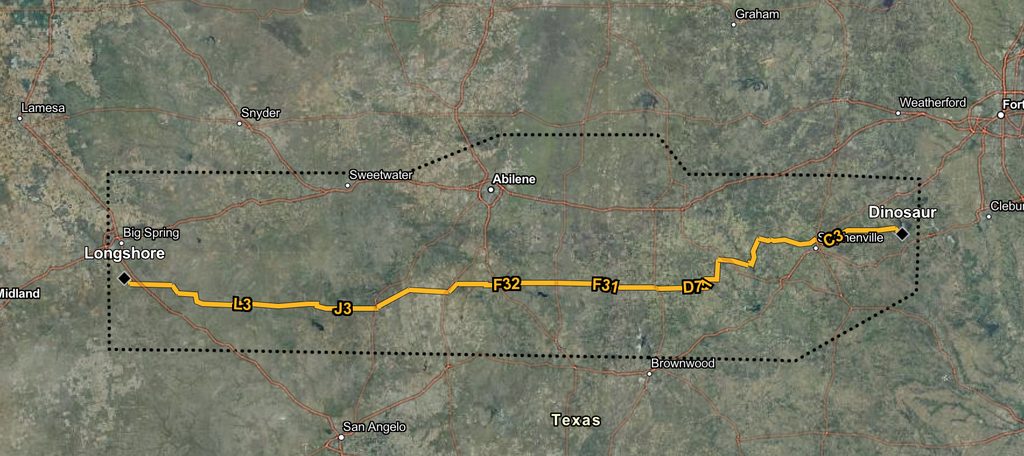
The Dinosaur-to-Longshore 765-kV line, proposed by Oncor Electric Delivery as part of its Dinosaur-to-Drill Hole 765-kV project, would travel through Erath and Somervell counties.
Huckabee, who serves as the head of the Erath County Commissioners Court, initially hesitated over working with American Stewards of Liberty.
“There are still several things that need to be talked about between the two counties before I would be comfortable moving forward,” he wrote in a Dec. 30 email to Friebele, “I also am not comfortable moving forward with the fact of legal work in the future being handled outside of our control and funded by someone that is not being disclosed. I am all about fighting this but my role and goal is to protect Erath County, not anything else.”
Subsequent public records show the married Byfields playing a key role in drafting the policy that the new planning commission later adopted to oppose the transmission lines, as well as helping to coordinate with state agencies and Oncor representatives.
A meeting was scheduled on January 7, 2026 to discuss “who is funding this group,” how outside legal counsel would work with ASL, and steps toward forming the regional commission, including proposed bylaws and agendas.
On March 3, 2026, the Erath-Somervell Sub-Regional Planning Commission held its first meeting, adopted bylaws and appointed Friebele, who owns property in Erath, to the board as the citizen representing Erath County. According to the meeting minutes, both Byfields discussed how the new commission could adopt a policy to help oppose the proposed 765-kV Oncor transmission line. On March 12, Dan Byfield sent an email to Huckabee and his chief of staff, Jocelyn Perez, suggesting additions to a draft policy the planning commission planned to pass. Byfield’s draft policy was based on an ASL filing at the Public Utility Commission of Texas. Erath County filed to intervene, but was later dismissed after failing to file a statement of position or direct testimony; however, its Historical Commission was admitted as an intervenor. Somervell county governments have not intervened in any PUCT proceeding regarding the transmission lines nor have any 391 Commissions. ASL has intervened in all five dockets on behalf of its members, according to PUCT filings.
Byfield wrote, “I’m sure you can review this document and pull out the important parts for you [sic] policy, but we will also help draft additions to your policy so your 391 can adopt these requirements. We will then be able to use them in your coordination meeting with the PUC and ONCOR. My guess is, we can get ONCOR to the table quoting this specific PUCA [PURA, sic] section and they will have to come and defend why they haven’t complied with the statute.”
The specific section under the Public Utility Regulatory Act which Byfield cited requires the PUCT to consider “community values; recreational and park areas; historical and aesthetic values; [and] environmental integrity.”
Byfield argued that Oncor’s proposal ignored those factors. The planning commission’s policy, adopted in April 2026, applied them to Dinosaur Valley State Park, the Paluxy River and historic cemeteries along the proposed routes. It concluded the transmission lines are not compatible with the region’s community values and environmental integrity. The policy also calls for “the development of locally sited transmission and dispatchable power generation, including natural gas,” and for “responsible development of dispatchable power generation within or near load centers.”
ASL makes the same case on its website where it says power generation “should be developed closer to where it is needed, not hundreds of miles away.” In its March 9 closing argument at the PUCT, ASL argued that local generation near the Permian Basin’s natural gas would address the region’s energy needs better than new transmission.
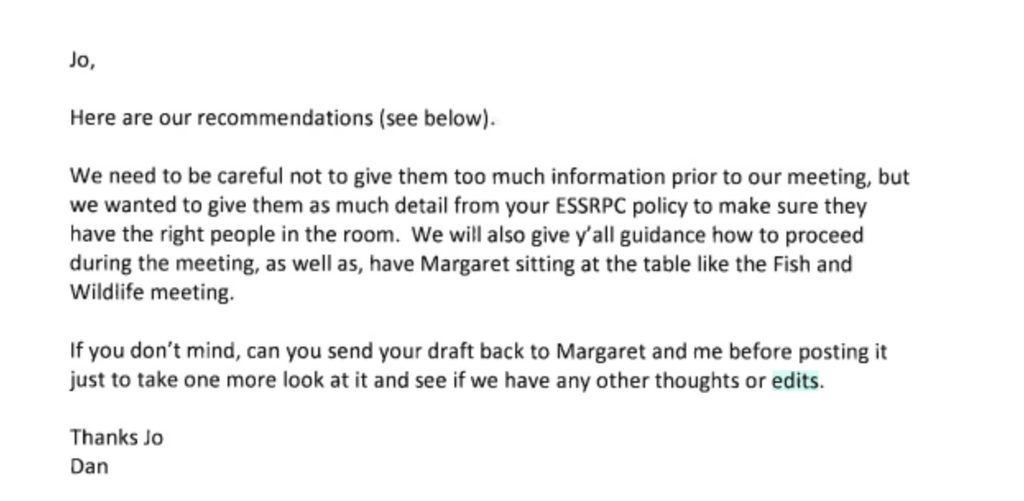
The Byfields continued to assist editing and drafting key letters, including demand letters to Oncor, the Texas Parks and Wildlife Department and the U.S. Fish and Wildlife Service. Dan Byfield wrote that he, Margaret Byfield, and the nonprofit’s attorney were “literally all” working on them before they were mailed. The editing and oversight extended to an agenda set for a meeting with Oncor on May 27th. “We need to be careful not to give them too much information prior to our meeting,” Dan Byfield wrote on May 20. Margaret Byfield wrote that she “[t]ook out some of your detail because it will be better to discuss in person and not give them a heads up.”
On July 23, Dan Byfield emailed Huckabee talking points for a July 29 hearing of the Texas Senate Business and Commerce Committee. One of the most important points Huckabee could raise, Byfield wrote, was that he chaired “the first 391 that was formed in Texas to fight the 765 transmission lines.” Byfield also wrote that ASL was working with Molly Vogt, state director of the advocacy group American Energy Works, to get Huckabee moved up the list of witnesses, and asked whether Rep. Shelby Slawson would call committee chairman Charles Schwertner to have Huckabee “moved to the top of the witness list.”
ASL Leads Fight Against 765 kV transmission lines
In 2023, the Texas Legislature passed HB 5066, which authorized the Permian Basin Reliability Plan, and was backed by the oil and gas industry and utilities, including two big Texas transmission and distribution utilities: Oncor and CenterPoint Energy. The conservative think tank, the Texas Public Policy Foundation (TPPF), registered in opposition.
The resulting plan from ERCOT called for building three major 765-kV transmission corridors split into five segments, which was ultimately approved by the PUCT in April 2025. The utilities Oncor, CPS Energy, AEP Texas and the Lower Colorado River Authority (LCRA) filed in late 2025 and early 2026 five certificates of convenience and necessity (CCNs).
However, the proposed 765-kV lines, which would be the first in ERCOT, drew fire from hundreds of impacted rural landowners, as well as organizations like ASL and TPPF, which argued the lines were a product of Texas’ rapid renewable energy development.
“The need for the 765-kV STEP is driven by an overbuilding of wind and solar across Texas, particularly in West Texas and South Texas, and the plan does not address the need to increase the supply of reliable generation,” TPPF wrote in a June 2026 article dissecting the economic impacts of the plan.
TPPF has attacked renewable energy development for years. In February 2021, it blamed wind and solar for the devastating power outages during the 2021 Winter Storm Uri despite frozen gas infrastructure largely contributing to the widespread grid failure that led to more than 200 deaths in Texas. A Guardian investigation revealed a TPPF policy expert edited portions of a 2023 bill that imposed new transmission costs on renewable energy development and required “fossil fuel” backup.
ASL has spearheaded the opposition to the large transmission lines. In a January press release trying to recruit landowners to intervene, American Stewards of Liberty objected to the statewide $33 billion price tag for the projects, and claimed the transmission lines would “threaten to condemn 4,000 linear miles of private property.” Instead, West Texas could “be generating their own locally with the natural gas found beneath their feet,” the release said.
ASL moved to intervene in all five cases between January and April 2026. Administrative Law Judges granted their motions to intervene in all five dockets, despite objections by Oncor in two of them. ASL filed motions to defer a decision on four of the segments in June until the fifth segment completed its administrative hearing and filed a motion to abate, i.e. pause proceedings, on all five of the proposed lines in August 2026.
Forty-three lawmakers joined an amicus brief in support of ASL’s motion to defer a decision in June, filed by TPPF attorneys at the PUCT. TPPF also filed a letter in support of ASL’s positions on the transmission lines from oil and gas producers and landowners, which included Jason Isaac of the American Energy Institute and Luke Dunn of CrownQuest Operating, West Texas billionaire Tim Dunn’s oil company; Luke Dunn is Tim Dunn’s son. In a PUCT filing, ASL lists Luke Dunn as one of its members affected by one of the transmission line routes.
In August, the PUCT approved two of the proposed segments and later conditionally approved the Howard-Solstice 765 KV project in September. However, the PUCT remanded two segments to the State Office of Administrative Hearings after the judges recommended rejecting both lines over concerns about the lack of due process for approximately 1,400 landowners and failure to establish whether the line was “necessary for the service, accommodation, convenience, or safety of the public” under the Public Utility Regulatory Act. The September order directed the administrative law judges to consider if the proposed transmission lines are “necessary to meet state or federal reliability standards,” as well as “congestion cost savings” to customers.
The PUCT voted in October to extend time to consider motions to rehear Oncor’s Dinosaur-to-Drill Hole route. On November 5, two days after the midterm elections which saw longtime incumbents Gov. Greg Abbott and Lt. Gov. Patrick lose their seats, the PUCT voted to do the same to the Howard-Solstice transmission line, the Texas Scorecard reported. On November 12, the PUCT told parties that commissioners had voted not to add the rehearing motions on both segments of the Dinosaur-to-Drill Hole line to any open meeting agenda. An attorney told the Texas Scorecard that the line’s approval is now set to become final.
Photo credits to American Stewards of Liberty and Oncor Electric Delivery.