Consumer Energy Alliance (CEA) likes to call itself “the voice of the energy consumer,” but it is an advocacy front group for some of the country’s largest fossil fuel corporations and trade associations. Its members page does not include nationally recognized organizations that advocate on behalf of consumers, low-income communities, senior citizens, and minorities, such as AARP, local citizen utility boards, the NAACP, and the National Consumer Law Center.
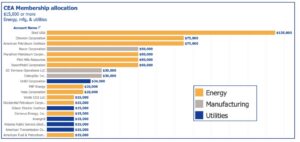
According to an internal budget document obtained by EPI, many fossil fuel, utility, and industry manufacturing corporations pay CEA tens of thousands of dollars, including Shell USA, Chevron, the American Petroleum Institute, ExxonMobil, GE Vernova, Unitil, the Edison Electric Institute, Avangrid, and Arizona Public Service.
Consumer Energy Alliance (CEA) likes to call itself “the voice of the energy consumer,” but it is an advocacy front group for some of the country’s largest fossil fuel corporations and trade associations. Its members page does not include nationally recognized organizations that advocate on behalf of consumers, low-income communities, senior citizens, and minorities, such as AARP, local citizen utility boards, the NAACP, and the National Consumer Law Center.
According to an internal budget document obtained by EPI, many fossil fuel, utility, and industry manufacturing corporations pay CEA tens of thousands of dollars, including Shell USA, Chevron, the American Petroleum Institute, ExxonMobil, GE Vernova, Unitil, the Edison Electric Institute, Avangrid, and Arizona Public Service.
Consumer Energy Alliance is operated out of the offices of the Houston-based public relations and lobbying firm HBW Resources. David Holt and Andrew Browning head HBW. Michael Whatley was a previous partner at HBW and chairman of the Republican National Committee after serving as the chair of the North Carolina Republican Party. Whatley announced his departure from the Republican National Committee in July 2025 as he launched his 2026 U.S. Senate bid in North Carolina. Whatley won the Republican primary in March 2026 and will face former North Carolina Governor Roy Cooper in the general election in November.
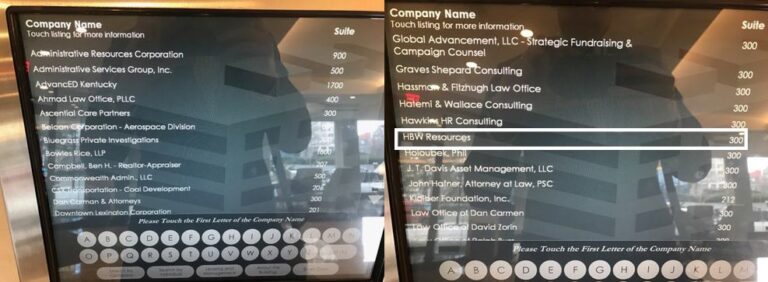
According to Consumer Energy Alliance’s IRS 990s, the front group has generated at least $46.9 million in revenue since 2010. CEA has then allocated $26.5 million, or 56%, of that revenue to HBW Resources. The 990s also reveal that CEA has no staff; nearly all the representatives listed on CEA’s website are HBW employees. A 2017 visit by a representative of the Energy and Policy Institute to CEA’s office in Lexington, Kentucky, revealed that the office instead belonged to HBW Resources.
Consumer Energy Alliance’s office is not found, but HBW Resources’ office is listed at CEA’s Kentucky address
CEA’s Board of Directors includes representatives from Nucor Corporation, the largest steel producer in the country; Caterpillar, a manufacturing company for construction and mining equipment, diesel and natural gas engines, and industrial gas turbines. Previously, board members have been from the Plaza Group, an international petrochemical marketing company, and from trade associations representing America’s airlines and convenience stores/gas stations.
Utility funding
In 2017, a CEA lobbyist was asked by an Indiana state legislator about the group’s funding structure during testimony on anti-solar legislation. CEA lobbyist James Voylessaid that utility companies are indeed members of CEA. Voyles also explained that the utility company sector is prohibited from providing more than 35% of CEA’s revenue in a given year, as their corporate charter states that at least 65% of the funding has to be from “energy consumers, companies like Nucor, companies like Caterpillar…”
Louisville Gas and Electric Company and Kentucky Utilities Company
South Carolina Electric & Gas/SCANA (now owned by Dominion Energy)
Xcel Energy
More recent CEA Board of Directors documents obtained by EPI show that the utility sector represents a robust area for CEA’s advocacy. According to a CEA budget planning document for 2025, the group allocated more than $900,000 to support utility advocacy in states including Arizona, Connecticut, Delaware, Georgia, and Maryland. This allocation also included dedicated funds for advocacy on behalf of the Edison Electric Institute, the utility industry’s national lobbying association.
Another internal CEA budget document shows that utilities accounted for 17% of CEA’s membership in 2024. According to the document, Unitil was CEA’s highest-paying utility member, paying $24,000, followed by Edison Electric Institute, Avangrid, Arizona Public Service, and American Transmission Company (an electric transmission company owned by several utility corporations, including WEC Energy), which each paid $15,000.
In 2024, Eversource and Avangrid joined the Consumer Energy Alliance as members. When asked for comment by the Boston Globe, an Eversource spokesperson pointed to CEA’S “diversified approach to renewable energy development.” At the same time, Avangrid said they joined because they “support their efforts to advocate for greater transparency and consumer education on energy bills.” The Avangrid spokesperson clarified their membership as not an endorsement of the group’s “entire platform.”
Creating front groups
Consumer Energy Alliance is among a handful of trade groups, including the American Gas Association and the National Propane Gas Association, that are advocating against state and local initiatives that reduce or prohibit gas use in buildings.
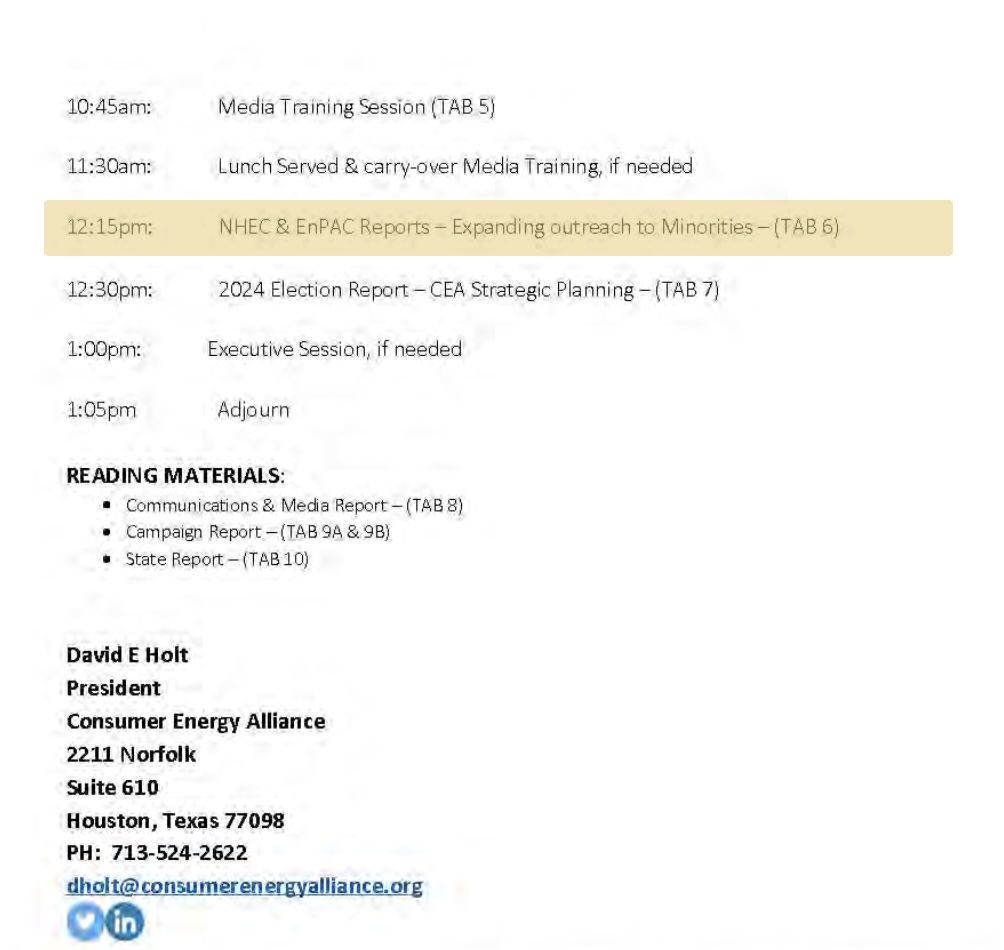
As fossil fuel companies, trade associations, and front groups advocated against measures to reduce pollution in homes and buildings, CEA noted it wanted to expand its “outreach to minorities.”
The Energy Poverty Awareness Center (EnPAC) and the National Hispanic Energy Council are two advocacy groups whose campaigns and agendas were launched and shaped by CEA. The Washington Post reported how the Consumer Energy Alliance helped launch EnPAC, led by former NFL player Gary Baxter, which is “dedicated to advancing the prosperity of minority communities through reliable and affordable energy solutions.” The Post also noted how CEA supported the National Hispanic Energy Council as part of, and how Black, Hispanic, and Asian Americans are “disproportionately exposed to deadly air pollution caused by the burning of fossil fuels, which also is driving climate change.”
CEA claims to be “pro-solar” but backs utility positions against rooftop solar policies
Consumer Energy Alliance has attacked policies supportive of solar energy, while deliberately misleading the public with claims that it is “pro-solar.” In September of 2016, CEA released a report criticizing solar tax credits and solar net metering, which compensates solar customers for the excess solar energy they sell back to their utilities. The report admittedly ignores the robust studies that quantify the values of solar power, which are substantial. The CEA report also confuses rebates offered by utilities with government policies and criticizes third-party solar ownership models. While CEA provides grist for attacks on solar policies, it cynically claims to be “pro-solar,” including a petition on its website with misleading language for the public to sign, including: “As American energy consumers, we call on policy makers to create policies that are pro-solar, pro-grid and pro-consumer.” Aside from that vague petition, all of CEA’s actual policy positions are in favor of fossil fuel investment. A microsite that CEA maintains, www.solarenergyfuture.org, offers no pro-solar advocacy, but instead thinly veiled utility attacks on rooftop solar companies. The strategy of appearing to promote solar while attacking it is straight from the utility industry’s playbook, both in terms of its revamped “pro-clean energy” messaging designed to confuse, and its political tactics. Florida Power & Light, which was a CEA member, was the leading funder of Amendment 1, a Florida ballot initiative with confusing “pro-solar” language, but which could cripple the already stunted solar market there. CEA also supported Amendment 1. In February 2018, Senator Sheldon Whitehouse (D-RI) spoke on the Senate floor to explain how lobbyists “created this fake consumer group” and noted how CEA had been promoting legislation in Kentucky to weaken the state’s net metering policy.
Watch @SenWhitehouse expose "fake consumer group" @CEAorg for creating a "fake initiative" in Kentucky called "Kentuckians for Solar Fairness." The group is supporting legislation – HB 227 – that would kill net metering in Kentucky and take away a homeowner's choice to go solar. pic.twitter.com/JdQdPcA2y1
CEA has been caught repeatedly submitting fraudulent letters
In 2014, Consumer Energy Alliance was caught submitting a fraudulent petition that attacked net metering and defended utility companies’ fixed-rate increase proposals in Wisconsin. CEA submitted the names of 2,500 of supposed customers of Madison Gas & Electric and WEC Energy’s We Energies that “supported” the utilities’ proposals. It was revealed that some of the signatories on the CEA petition were in fact opposed to the proposal. The PSC then dismissed the petition, saying it would not be included in the record. In September of 2016, a group of Ohio property owners asked the Postal Inspection Service and FERC to conduct a criminal review of CEA. CEA had sent 347 letters to FERC supportive of a pipeline proposed by Nexus Gas Transmission, using the names of local residents, including an Ohio man who has been dead since 1998. Spectra Energy, which has since been purchased by Enbridge, is a partner in the construction of the Nexus pipeline along with DTE Energy. Both are members of CEA. The complaint can be viewed on FERC’s websiteand includes affidavits from 14 Ohio residents who deny writing letters approving the pipeline as well as giving permission to the CEA to write letters on their behalf. In 2018, South Carolina lawmakers received “cookie-cutter” emails through the Consumer Energy Alliance that impersonated citizens. The emails were meant to pressure elected officials to support the Dominion acquisition of SCANA. Both Dominion and SCANA had been members of CEA. The House Speaker’s office contacted the Office of the Attorney General to investigate. The investigation is still ongoing.
The Consumer Energy Alliance, which includes @DomEnergyVA and @scchamber as members, crafted the form email for constituents to send to legislators.
But soon they began noticing that the same IP addresses were sending multiple emails pretending to be other people. #scpolhttps://t.co/QjB6MhTX3O
CEA worked to support Trump, help members increase fossil fuel production
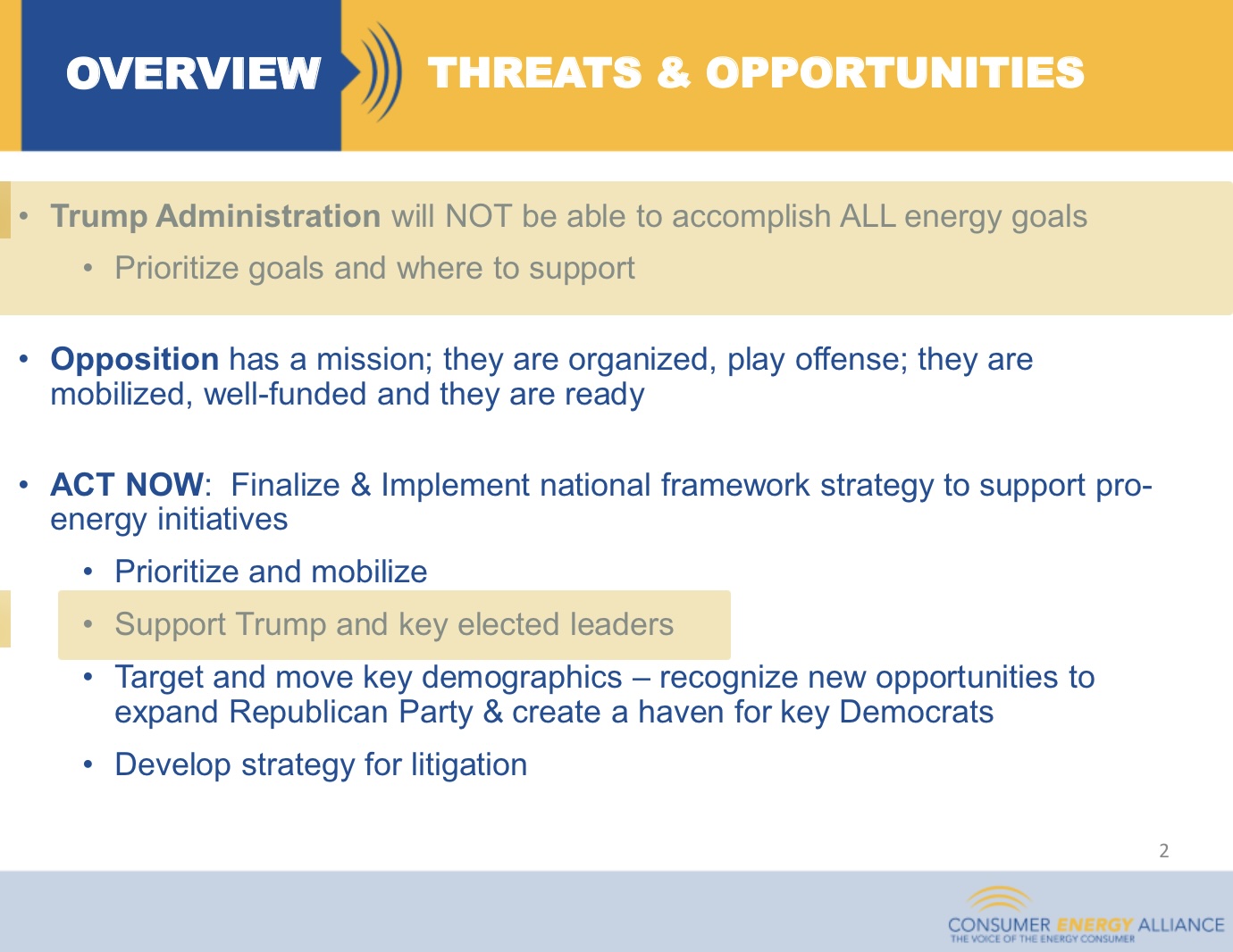
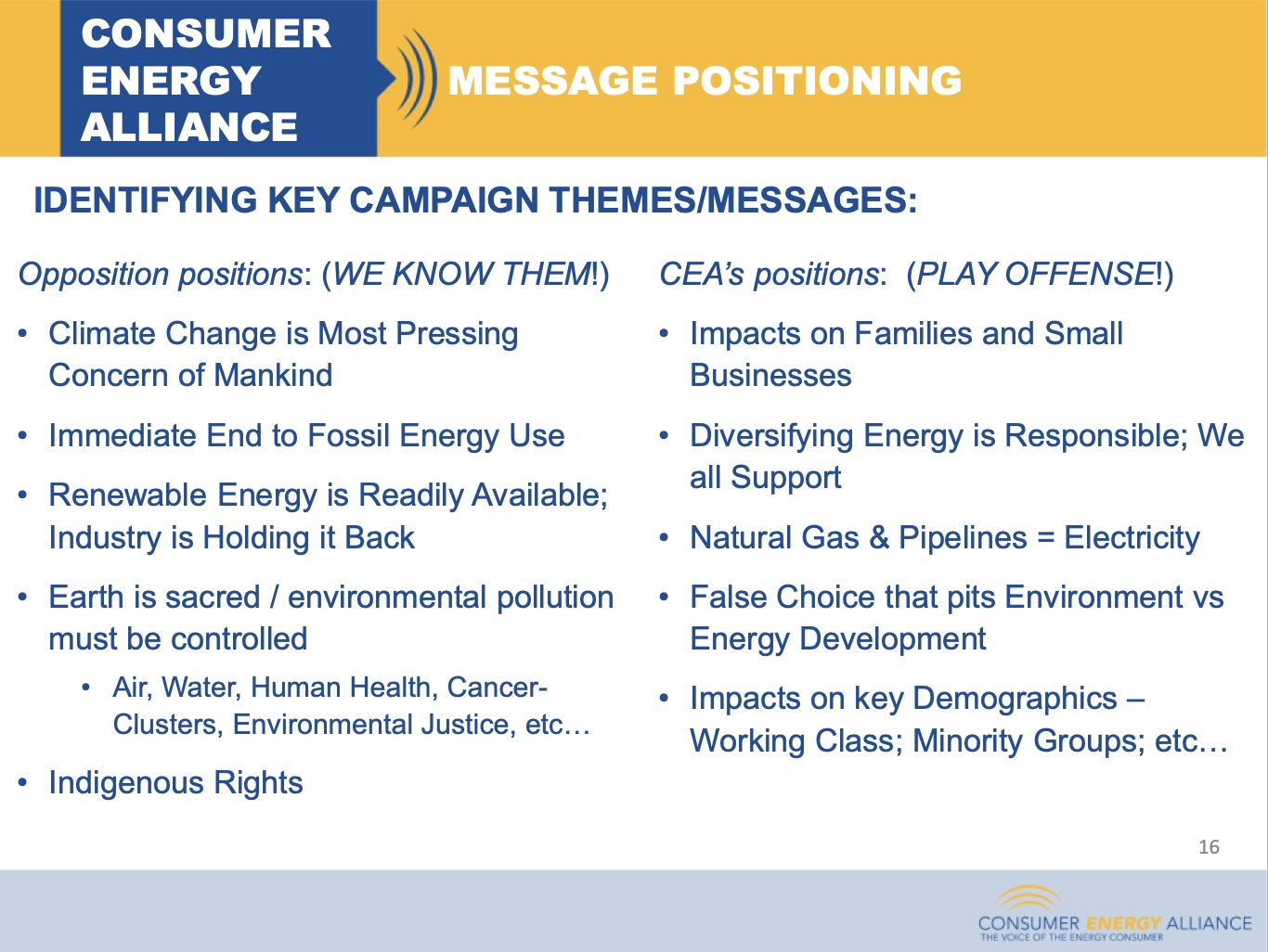
In a presentation to the American Public Gas Association (APGA), CEA President David Holt told the members that they need to support Donald Trump and his energy goals. Nucor Corporation, which has a representative on the CEA board, was a large contributor to Donald Trump’s 2020 campaign.
Holt then told APGA how his organization “knows the opposition,” and it plays “offense” to help with members’ pipelines, fracking, or offshore drilling priorities.
In a similar presentation, CEA Executive Vice President Michael Whatley told attendees of the Ohio Energy Management Conference that his group exists to partner with industry to help make sure energy infrastructure gets built.
In 2024, CEA pitched a collaborative campaign to the American Petroleum Institute (API) under its “Energy Voices” banner. According to a confidential draft of the proposal, the collaboration aimed at promoting “bipartisan thought leadership and strategic initiatives, and “[A]mplify state energy priorities, opportunities, and challenges and help “rebalance” the energy debate in favor of Energy Choice.” CEA offered to create an “Energy Leadership Commission,” a body consisting of government officials and industry representatives, so that “we can align on common goals and develop comprehensive solutions and messaging that reflect the needs and opportunities unique to each state.”
In 2019, CEA announced its “Moving Michigan” campaign to build support for Enbridge’s Line 5 pipeline. CEA spent at least $19,000 on Line 5 advocacy advertisements between August and September 2019 in Michigan, according to Federal Communications Commission filings.
CEA has pushed for numerous gas pipelines and LNG projects. The group filed an amicus brief with the U.S. Supreme Court in support of the PennEast Pipeline and asked the FERC to approve Mountain Valley Pipeline’s request for an extension of time to complete the project. CEA is also behind a front group promoting the Jordan Cove LNG facility in Oregon and its accompanying Pacific Connector Pipeline.
CEA also claimed to have worked with coalitions in Indiana, Kentucky, and Mississippi to enact legislation that prohibits cities from banning fossil gas in all new building construction as part of the effort to reduce greenhouse gas emissions.
Social media advertisements released this week by fossil fuel advocacy front group Consumer Energy Alliance (CEA) are boosting Arizona Public Service’s (APS) recently announced proposal to convert two units at its retired Cholla Power Plant from coal to methane gas. According to a CEA internal budget document obtained by EPI via public records request, APS...
A Virginia state lawmaker coordinated with an energy lobbyist to support a controversial gas pipeline, the Energy and Policy Institute has found. Delegate Les Adams, a Republican representing Henry and Pittsylvania Counties, coordinated his official letter to the federal government with an oil and gas lobbyist who works for the pipeline’s proponent. In September, Adams...
Electric utilities are backing a proposal to gut the Public Utilities Regulatory Policies Act (PURPA), a federal law that supports the growth of renewable energy and competition in electricity markets, and they brought their network of special interest groups and paid consultants to the fight. A Notice of Proposed Rulemaking (NOPR) backed by President Trump’s...