BGE’s prepaid FlexPay plan would waive disconnection protections – most backers have utility ties


Baltimore Gas and Electric (BGE) is seeking approval for a prepaid electricity program, FlexPay, that would require participants to give up key protections against disconnections—all while the utility may generate a profit from the program’s costs.
Of the eight letters supporting BGE’s FlexPay proposal to the Maryland Public Service Commission (PSC), seven have come from individuals or organizations that have received BGE or Exelon PAC money or work closely with the utility, as of Oct. 28.
An expert with the National Consumer Law Center, a leading nonprofit that advocates for low-income customers, has warned that the program would not make electricity more affordable and could lead to more frequent disconnections.
The proposal is part of BGE’s latest electric rate hike request, filed in July, in which it is seeking a $156.1 million increase from customers. If approved, the rate hike would add $8 to the average residential customer’s monthly bill.
BGE is also requesting a return on equity (ROE) of 10.4%, up from the 9.5% ROE the PSC approved in its last rate case. ROE is the return shareholders are allowed to earn on the equity they invest in the utility’s capital expenditures. Even small changes to the ROE can significantly impact customers’ bills over time.
This rate case comes as about 300,000 BGE electric customers are behind on their bills. In response to growing concerns about bill affordability, Exelon (BGE’s parent company) and Gov. Wes Moore’s office announced an initiative called the Customer Relief Fund in June 2025, and then expanded it in January 2026. The fund has allocated $17.5 million to one-time grants for BGE customers.
That bill relief represents about 4% of the $443 million that BGE earned in profits during just the first nine months of 2026. Those profits are up from $398 million during the same period in 2025.
FlexPay requires waiving key consumer protections
Expert witness John Frain, vice president of regulatory policy and strategy at BGE, described FlexPay as a tool that gives customers greater control over bill costs by prepaying for anticipated energy use and using BGE-operated digital tools to monitor their balance. When a customer signs up for service, they must make a $40 payment toward their prepaid balance to enroll, but are otherwise not responsible for security deposits, late fees, or reconnection fees, Frain says. The customer pays ahead for their energy and receives notifications from BGE when their balance is low and when it reaches zero. BGE says it will project how many days of service are left on a customer’s account using weather forecasts and the customer’s energy consumption data.
Under FlexPay, disconnection would occur the business day after a customer’s balance reaches zero. The utility claims that disconnections under FlexPay will be shorter, as customers can restore service by bringing their account balance to $15 or higher. For customers already behind on bills, FlexPay also serves as an arrearage management plan where 25% of a customer’s payment is applied to existing debt and the other 75% to future electricity use.
In exchange for participating in the program, customers must forgo many consumer protections that would normally protect against rapid disconnections. These protections include requiring at least 14 days’ notice before disconnection and, for households that have applied for energy assistance, a 55-day delay before disconnection for a past-due bill.
In direct testimony on behalf of Maryland’s consumer advocate, the Office of People’s Counsel (OPC), expert witness John Howat, a senior energy analyst at the National Consumer Law Center (NCLC), said that the FlexPay program would not help customers afford their bills, and would lead to more disconnections, albeit for shorter periods of time. In response to BGE’s framing of shorter disconnections as a FlexPay benefit, Howat said:
…Even a short disconnection is highly disruptive and can lead to disastrous results. Moreover, if a disconnection would not have otherwise occurred under conventional billing, the fact that it is relatively shorter does not make that disconnection a benefit.
Howat further argued that the FlexPay program features BGE describes as customer benefits are not inherently novel to the program, citing BGE’s responses to data requests. He noted BGE’s concession that customers can already “make payments at any time before a bill is due.” BGE also acknowledged that the energy usage monitoring tools available through FlexPay already exist—the main innovation, they claim, is “combin[ing] those capabilities” into one central tool available only to FlexPay participants.
Both PSC staff and BGE witnesses characterize the program as voluntary, even if a customer facing a looming disconnection or an unaffordable security deposit may have no practical alternative. Asked whether enrollment would be truly voluntary under these conditions and whether involuntary enrollment under some circumstances would change his recommendation, PSC staff witness David Hoppock responded: “A program that is voluntary per a utility tariff is a voluntary program.”
Regulators in California rejected a similar provision by San Diego Gas and Electric (SDG&E) in 2014. The California Public Utilities Commission (CPUC) found that customers in arrears may also be behind on internet or phone bills and therefore might not receive adequate prior notice before disconnection, which it deemed untenable. The CPUC ultimately found that requiring prepaid customers to forgo consumer protections “relies on inappropriate precedent.”
Comments supporting FlexPay came from individuals or organizations with documented BGE ties
Public comments submitted in the docket so far have been overwhelmingly negative, focusing primarily on the proposed rate increase and its effect on customers’ ability to afford their bills. The few positive letters, including some from public officials, endorsed FlexPay as a way to address affordability challenges without commenting on BGE’s overall requests for higher revenue or higher authorized profit margins on investors’ share of capital spending.
Democratic state Sen. Pam Beidle submitted one such letter on Sept. 9: “It keeps the protections that matter most, including no deposits, no late or reconnection fees, and the ability to leave the program at any time. And it gives customers a practical way to manage a bill that continues to rise.” Beidle chairs the Senate Finance Committee and serves on the Senate Spending Affordability Committee.
EPI obtained records through a Maryland Public Information Act request that show BGE asked Sen. Beidle to submit a letter supporting FlexPay. BGE sent her office an overview of the proposal and a letter she had submitted in support of the pilot in 2017. Beidle’s chief of staff then asked BGE to draft a new letter or “update the old letter as required” for submission to the PSC on Beidle’s letterhead. A prepaid utility vendor that said it was “working with BGE on this program” asked Beidle to consider their draft letter as well.
Democratic state Sen. Brian Feldman, who chairs the Senate Education, Energy and the Environment Committee, also submitted a letter in support of FlexPay.
As of Oct. 28, seven of the eight letters in the docket endorsing BGE’s FlexPay program came from individuals or organizations with ties to BGE or Exelon, including working relationships, board seats, campaign contributions from the utility-affiliated PACs, or grant money from Exelon Foundation.
| Supporter | Relationship to BGE |
|---|---|
| Berneitha McNair, CEO of Community Action Agency of Anne Arundel County, Inc. (AACCAA) | Listed as Anne Arundel County’s Local Home Energy Program administrator, meaning it processes government energy-assistance applications and regularly coordinates with BGE to apply grants and prevent shutoffs. |
Tracy Broccolino, President of Community Action Council of Howard County (CAC) | Listed as Howard County’s Local Home Energy Program administrator, meaning it coordinates with BGE to apply grants and prevent shutoffs. The organization is listed as a recipient of an Exelon Foundation grant in 2025. |
| April Bright, on behalf of Community Assistance Network (CAN) | Its website lists the state Office of Home Energy Program as an Indirect and Referral Service that it offers, implying that it connects individuals to energy assistance. The treasurer of its Board of Directors is listed as a senior financial analyst at BGE. |
Fuel Fund of Maryland | An independent nonprofit that works directly with BGE to resolve customer arrears and is actively promoted through BGE’s assistance channels. BGE matches $0.50 for every $1 donation the organization receives. It also has BGE executive representation on its Board of Directors. |
State Sen. Brian Feldman | The senator received $16,000 from Exelon and BGE PACs from 2019-2026. He currently serves as chair of the Maryland Senate Education, Energy and the Environment Committee, and previously served as chair of the Energy and Public Utilities Subcommittee. |
State Sen. Pam Beidle | The senator received $5,250 from Exelon and BGE PACs from 2021-2026. She currently serves as chair of the Finance Committee and is a member of the Spending Affordability Committee. A Maryland Public Information Act request showed that her office coordinated with BGE on the letter. |
Baltimore County Councilman Mike Ertel | The councilman received $375 from BGE’s PAC from 2023-2024. |
The letter from AACCAA shares many similarities with CAC’s letter, as they both describe large balances as a “crisis,” FlexPay as “different” from other assistance programs, and the ability to pay in “small increments” and in “real time.”
BGE did not respond to EPI’s question about whether it asked individuals or organizations to support FlexPay in the rate case.
Exelon companies have sought support from individuals and organizations during previous proceedings. Pepco, another one of Exelon’s subsidiaries operating in Maryland, solicited letters of support for proposals in the utility’s rate case from community organizations, as documented by EPI earlier this year. Pepco’s Amber Perry, vice president of governmental and external affairs, confirmed in an evidentiary hearing that the utility sent template letters to these organizations and encouraged them to participate in the public hearings.
BGE could profit from FlexPay
BGE estimates that the electric distribution share of FlexPay’s startup costs incurred in 2027 and 2028 total about $3.4 million in capital expenditures and $1.1 million in operations and maintenance (O&M) expenses. Utilities recover capital expenditures from customers over the life of an asset, and shareholders earn a rate of return on the portion not yet recovered. O&M expenses reflect day-to-day costs of running the utility and are passed through to customers with no profit. BGE witness Frain explains that these initial program costs include annual licensing fees to the prepaid vendor and enhancements to its IT system.
BGE is asking to include about $490,000 of FlexPay O&M costs in rates; it has not said when it would seek to recover the capital costs. Utilities typically recover the capital when it is added to the utility’s rate base, to begin earning a profit after the program goes into service. BGE also says it plans to expand eligibility to gas customers in a future filing.
Asked whether and when it plans to add FlexPay’s capital costs to the rate base, BGE did not respond.
Prepaid electricity’s troubled history
The New York Times examined the utility affordability crisis and put a spotlight on customers in Oklahoma and how they dealt with high bills this past summer, including those that switched to prepaid plans with the utility. The Times reported how a customer on the prepaid plan monitored her balance constantly and when her balance dropped below zero, the utility, American Electric Power’s Public Service Company of Oklahoma (PSO), disconnected her within a few days. Her mother-in-law, who stayed on the regular monthly billing cycle, described the possible anxiety of a disconnection from a prepaid program: “See, that would stress me out even more… It’s hanging over your head every minute.”
Federal data released earlier this year and analyzed by EPI and the Energy Equity Project revealed how PSO reported the highest disconnection rate among investor-owned utilities in 2024. For every 100 customers it served, PSO reported 58 residential electric disconnections for nonpayment that year. PSO has attributed the high rate primarily to its prepaid program, and told the Times that most of the shutoffs involved a small number of prepaid accounts and were reconnected within minutes after payment.
Prepaid metering has a long history. The modern prepaid electric meter was developed in South Africa in the 1980s. Meter manufacturers marketed the devices as a way to break township rent boycotts against the apartheid government. Meters installed after apartheid ended were concentrated in poorer, historically Black townships.
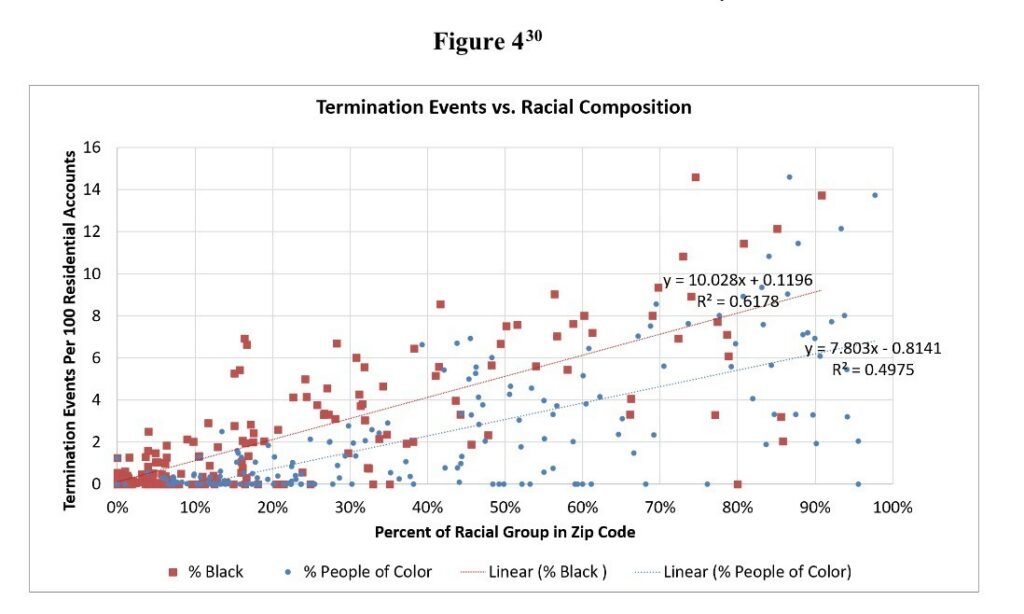
In Howat’s rebuttal testimony, he uses BGE disconnection data and census data to show that disconnections are already disproportionately concentrated in communities of color. Howat argues that BGE has not considered how FlexPay may exacerbate this trend.
BGE’s prepaid pilot shows low demand, high attrition, and more frequent disconnections
BGE conducted a prepaid pilot that launched in late 2019 and commissioned an independent research firm, APPRISE, to evaluate the outcomes. The pilot results provide little evidence of widespread demand or sustained interest in the program. Of the 250,615 customers invited to participate, only 0.2% enrolled. After BGE did not reach its desired level of participants, it allowed interested customers to enroll themselves. Total enrollment ultimately reached 527 customers. Of those customers who enrolled, 41% disenrolled over the course of the pilot.
More frequent disconnections were also a hallmark of the prepaid program, “as expected,” according to testimony from BGE’s witness. APPRISE reported a disconnection rate of 11% during the pilot. The study also noted that a disconnection moratorium issued during COVID-19 led to fewer observations in the data, so even the 11% disconnection rate may understate disconnections that would otherwise have occurred. Around 30% of pilot participants had at least one instance in which their account reached a negative balance that would ordinarily trigger disconnection.
APPRISE cautioned that the COVID-19 disconnection moratorium made it difficult to draw firm conclusions and said BGE would need to conduct another study under normal conditions. BGE asked the PSC in 2021 to reopen enrollment for another 12-month study period, but the PSC denied the request because the pandemic was ongoing.
Despite BGE citing the APPRISE evaluation throughout testimony, it has rejected requests by OPC to make the author available for questioning during evidentiary hearings in November.
Two more public comment hearings remain in BGE’s rate case on November 4th and November 18th. The PSC is expected to release a final decision in January 2027.