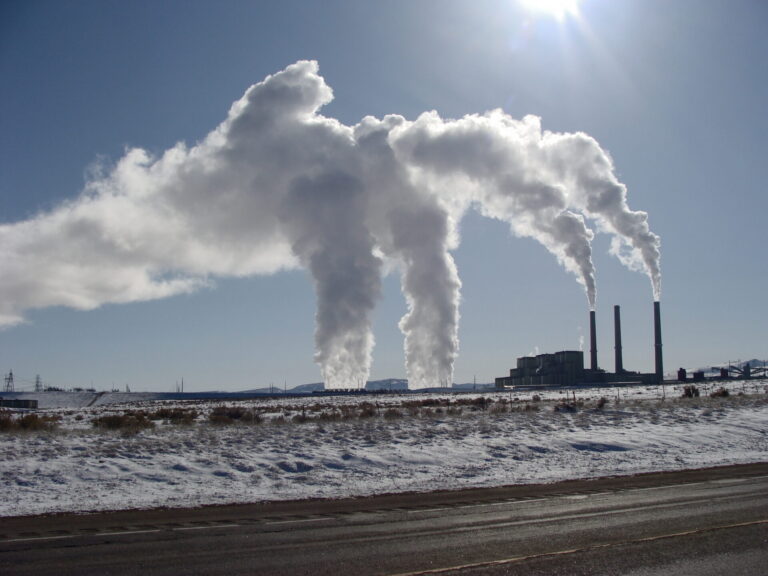
SWEPCO would raise Texas customer bills nearly 8% in “black box” settlement


Southwestern Electric Power Company, a utility serving more than 191,000 Texas customers, is set to increase monthly bills for a typical residential customer by 7.7% in a “black box” settlement agreement during its latest base rate case, according to an analysis by the Energy and Policy Institute. That increase excludes a surcharge that will allow SWEPCO to charge customers the new rates backdated to March 2026, as part of the settlement.
SWEPCO is a vertically integrated utility, which means that it sits outside of Texas’s ERCOT system and owns power generation assets, in addition to its transmission and distribution system. On October 14, 2025, SWEPCO filed a base rate case with the Public Utility Commission of Texas (PUCT), initially seeking a $95 million increase in base rate revenue, which would have raised monthly residential customer bills by approximately 12%, or $16.43, and sought to raise its authorized return on equity (ROE) to 10.75%. ROE is the profit rate regulators allow a utility to earn on the part of its capital investments financed by shareholders.
While not the only culprit behind customers’ rising utility bills, increasing ROEs in utility rate cases typically allows investor-owned utilities to increase their profits. SWEPCO’s parent company, American Electric Power (AEP), set a “Regulatory & Legislative Integrity” incentive for executives to “Achieve Plan Return on Equity (ROE)” of 9.375%; AEP reported 9.06% for 2025, below the 9.30% minimum to achieve the bonus, and the incentive did not pay out. Nonetheless, AEP’s overall bonus scorecard still paid out at 162.5% of target, and the AEP Board of Directors awarded CEO Bill Fehrman the highest executive compensation of any utility in the country in 2025, receiving $36.6 million.
AEP profits rose 48% between 2021 and 2025, according to its annual 10-K financial filings, which recorded a net income of $2.488 billion in 2021 that increased to $3.69 billion in 2025. SWEPCO, which also serves customers in Louisiana and Arkansas, saw profits rise 61% in the same time frame, with a net income of $242 million reported in 2021 that grew to $391 million in 2025.
In 2025, 17% of a SWEPCO customer’s bill went to the company’s shareholders in the form of profit, according to the Energy and Policy Institute’s profit calculator.
Texas utilities can file a comprehensive base rate case in addition to their annual requests to recover costs for transmission and distribution investments, which can raise customer rates even more. SWEPCO’s last base rate case was approved in 2022, which increased monthly residential customer bills by 8.48%.
In September, SWEPCO reached a “black box” settlement with PUCT staff and all intervenors on its current base rate case proposal. The agreement, which is now before the PUCT for approval, reduced SWEPCO’s net base rate increase from $95 million to $47.5 million, but still raised its authorized ROE from 9.25% to 9.53%.
A common engineering or computing term, “black box”, describes a system – such as algorithms or a device – that hides its internal workings so only what goes in and what comes out can be seen. So-called “black box” settlements in utility rate cases function much the same way.
“Black box” utility rate case settlements are common, and they allow the public to see only numbers in aggregate rather than a line-by-line justification for each change.
What the “black box” means for customers
SWEPCO calculated that residential customers using 1,000 kWh per month in Texas pay an average monthly bill of $135.28.
Under the settlement, SWEPCO residential customers using 1,000 kWh per month would see bills rise to $145.72, with the customer charge increasing to $10.92 to go alongside increases to per kWh usage charges. Summer rates increase to $0.11 per kWh; winter rates rise to $0.083 per kWh for the first 600 kWh and $0.068 for each additional kWh.
The settlement also permits SWEPCO to charge customers the new rate for costs back to March through a surcharge, partially offset by a $28.5 million refund owed from a previous case.
Customers would also pay for $10.6 million in rate-case legal expenses over two years, which includes $1.6 million for Cities Advocating Reasonable Deregulation (CARD), a coalition of municipalities served by SWEPCO; these are costs consumers would pay for SWEPCO’s lawyers and expert witnesses who argued on behalf of the rate increase as well as intervenors, such as CARD.
The settlement does not disclose whether it will allow SWEPCO to recover “legislative monitoring” expenses, EEI dues and the expenses listed under “Civic and Political Activity” listed in the utility’s original application.
One point of contention arose over whether SWEPCO should be allowed to recover $463,938 in industry association dues to investor-owned utility trade group Edison Electric Institute. Mark Garrett, testifying on behalf of CARD, said the utility appeared not to distinguish between the dues allocated toward public good and those allocated for investor interests, recommending those dues be denied recovery.
SWEPCO’s Director of Regulatory Services, Peter Kimani, defended the inclusion, saying they were allowed under prior PUCT decisions. “While EEI does engage in advocacy, SWEPCO has already excluded or adjusted for the portion of dues attributable to lobbying, consistent with established regulatory practice and tax disclosure requirements,” Kimani said.
EEI engages in policy advocacy in a host of ways outside of the definition of lobbying that it provides.
PUCT rules governing utility cost recovery forbid electric utilities from recovering costs related to legislative advocacy expenses, including those embedded in trade association dues. However, electric utilities can recover up to three-tenths of 1.0 percent of their gross receipts related to “ordinary advertising, contributions, and donations.” SWEPCO calculated the maximum it could charge customers at $4,935,162. It seeks to recover $1,796,659 of those advertising costs, contributions and donations, including $902,964 in membership and association dues.
Texas utilities are required to file annual reports detailing those expenditures to the PUCT under Rule 25.77, including expenses for “legislative matters” and for representation before government agencies.
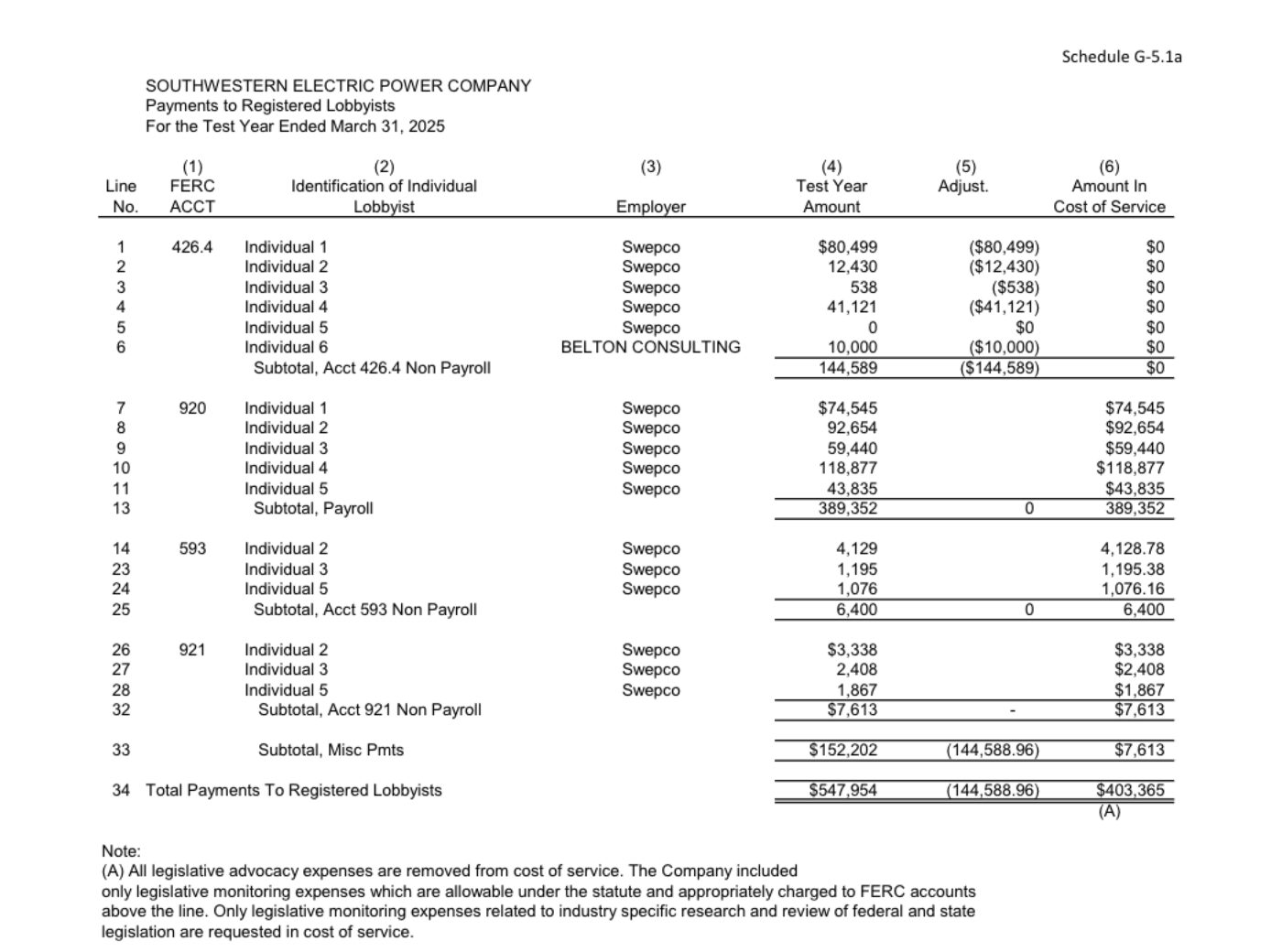
SWEPCO did not disclose any spending related to “legislative matters,” including advocacy and regulatory affairs, in those required PUCT filings. However, the company reported in its rate case that it spent $890,851 in legislative advocacy, and $315,787 in “non-deduct lobbying per IRS” for its test year ending on March 31, 2025, but did not seek to recover those costs. SWEPCO also reported $547,954 on payments to registered lobbyists, and has sought to recover $403,365 of those payments, including almost $400,000 in payroll for five SWEPCO employees registered as lobbyists.
SWEPCO’s application claimed customers should pay for some of its lobbyists as part of its “legislative monitoring” costs. SWEPCO Vice President of External Affairs William Bradford said in his testimony the utility is permitted to recover such personnel expenses based on precedent set in a 1995 base rate case involving Central Power and Light Company, now known as AEP Texas. According to Bradford, the Commission defined “legislative monitoring” as “the review and analysis of legislation to determine the impact on the utility and to prepare for any changes in the law and compliance with those changes” while legislative advocacy “focuses on affecting the outcome of the legislation.”
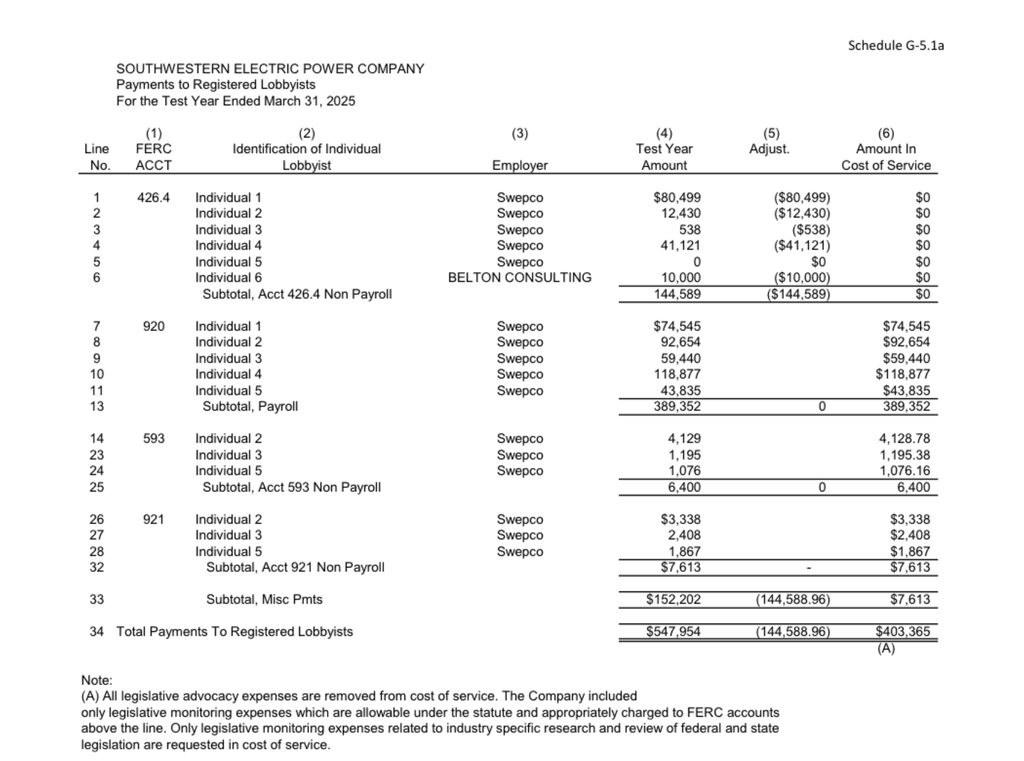
Of the five SWEPCO employees on the lobbyist payment schedule, one is registered as a lobbyist in Texas, three in Arkansas, and one in Louisiana.
SWEPCO also spent $575,064 on “Civic and Political Activity,” and sought to recover $88,860 of those expenses in its initial application.
The settlement is pending approval at the PUCT.