Customers saving millions in states that banned utility political costs

In recent years, a number of states have passed laws prohibiting utilities from using money they collect from customers to fund the companies’ political activities and extravagant expenses.
Now, ratepayers in these states are already seeing savings in the millions of dollars.
Increased savings in CT
Recent utility accountability legislation in Connecticut has saved gas and electric customers from footing the bill for nearly $14 million of their utilities’ spending on political influence and advocacy activities and Board of Directors’ perks in the past year. This marks an increase from the previous year, where customers saved over $9.7 million.
The legislation, which went into effect in June 2023, prohibits utilities from using money they collect from ratepayers for lobbying, advertising and marketing, and contributions to trade associations and groups incorporated under Section 501 of the Internal Revenue Code.
Additionally, the law bars the recovery from ratepayers of perks and extravagant spending for the companies’ Board, corporate aircraft expenses, and the costs of investor relations. The law also prohibits charging ratepayers for costs associated with utilities’ attendance and participation in any rate proceeding before the state regulator, the Public Utilities Regulatory Authority (PURA), such as when a utility files for rate hikes.
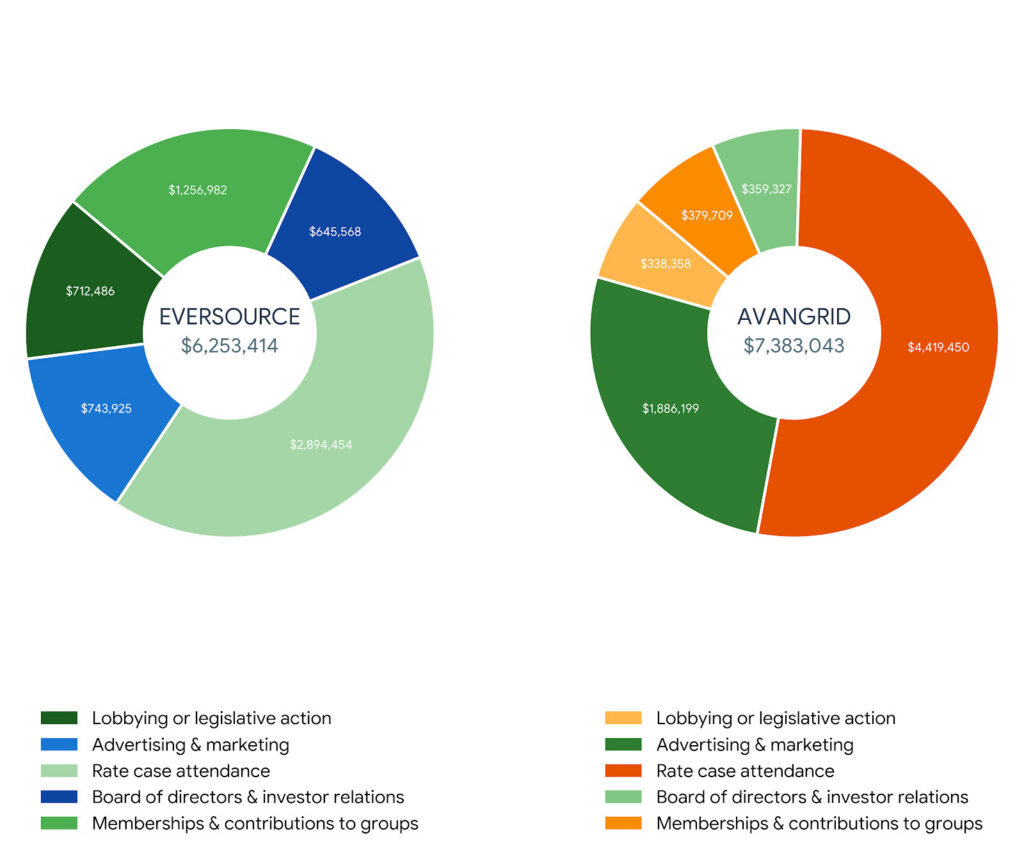
Recent disclosures by Eversource and Avangrid, the state’s investor owned utilities, show that the utilities spent a total of at least $13,811,119 on the costs prohibited from recovery from October 2024 to September 2025, according to an analysis by EPI. This marks an increase of 41% from the at least $9,738,302 ratepayers saved in the previous reporting period (June 2023-September 2024).
Since the law went into effect in June 2023, Connecticut’s ratepayers have saved a total of at least $23,549,421 on these costs, according to the utilities’ disclosures.
The law requires utilities to file the annual, line-item disclosures of these expenses. Eversource’s disclosures do not include the entire sum, since the company redacted the salary figures of its internal employees’ labor on rate cases, lobbying, advertising, and investor relations, and instead provided only the hours they spent on these tasks. According to Eversource’s tally, their employees spent a total of 19,994 hours on these four activity categories in the past year.
It’s not certain that the utilities would have sought to recover all of these costs in rates, absent the state’s landmark 2023 law. But the law prohibits them from doing so and requires the utilities to disclose the expenses in detail.
These latest disclosures detail a myriad of costs that do not benefit ratepayers. Yankee Gas, Eversource’s gas subsidiary in Connecticut, spent over $7,000 on a Board of Directors meeting in Wequasset Resort, a five-star accommodation in Massachusetts. Other notable Eversource expenses in Connecticut include:
- Yankee Gas paid Boathouse Group, Inc, a Massachusetts-based marketing agency, nearly $240,000 for “Strategic Corporate Advertising Campaigns/Services”
- Connecticut Light & Power (CL&P), Eversource’s electric company in the state, paid over $1 million to various trade associations and charities, including $242,283 to the Edison Electric Institute, $50,238 to the Connecticut Business & Industry Association, and $41,865 to the MetroHartford Alliance. These business groups conduct political influence or lobbying activities on behalf of their member companies.
- CL&P spent $197,700 under the category “Benefits Overheads” for internal lobbying.
Avangrid spent $216,345 under electric subsidiary United Illuminating’s category of “Regulatory Appeals & Litigation” and $73,920 for UI’s 2024 rate case appeal to the Connecticut Supreme Court. Other notable Avangrid expenses in Connecticut include:
- Over $379,000 to various trade associations and charities, including $45,750 to the Connecticut Business & Industry Association, and $47,000 to the Bridgeport Regional Business Council.
- Over $104,000 to Garrand Moehlenkamp LLC, a Portland, Maine-based branding agency.
- Over $174,000 on corporate aircraft costs.
Connecticut’s regulator, PURA, and intervenors in the companies’ rate cases, can use the annual data to ask the utilities questions about any irregularities or signs that the company may be charging customers for activities prohibited for cost recovery.
Savings in Colorado and Maryland
Customers in other states that recently passed accountability legislation on utilities’ political spending are seeing a difference as well.
The Colorado Public Utilities Commission disallowed more than $775,000 in annual costs for lobbying fees, trade association dues, and investor relations that Xcel Energy tried to recover in a gas rate case in 2024. The PUC made clear that these costs were prohibited for recovery under the accountability law and also criticized Xcel for applying its lobbying prohibition too narrowly.
In Xcel’s most recent gas and electric rate cases, which are ongoing, the utility announced it removed from rate recovery a total of $7,969,201 in costs prohibited by the law, including the following categories:
- Entertainment or Gift Expenses: $36,639
- Investor Relations Expense: $530,783
- Organizational and Membership Dues: $1,113,356
- Advertising and Public Relations: $3,536,616
- Board of Directors Expenses: $478,961
- Aviation: $1,745,632
- Board of Directors Compensation: $518,107
- Lobbying: $9,107
In Maryland, utility reform legislation enacted last year—including provisions from the Ratepayer Freedom Act (HB 960) introduced by Del. Andre Johnson—led Pepco to exclude $1 million in industry contributions and jet-related costs from its current rate increase filing. The law also prevented Washington Gas from seeking recovery of roughly $400,000 in trade association expenses in its ongoing rate case.
California is the most recent state to pass a comprehensive bill prohibiting investor-owned utilities from using customer money to support utility political activities, promotional advertising, and dues for trade associations that conduct political activities. Signed into law in September 2025, the legislation is the first of its kind to mandate that the utility regulator enforce financial penalties on utility companies that violate the law.