Utility-linked PACs provide bulk of funding for two Alabama utility regulators

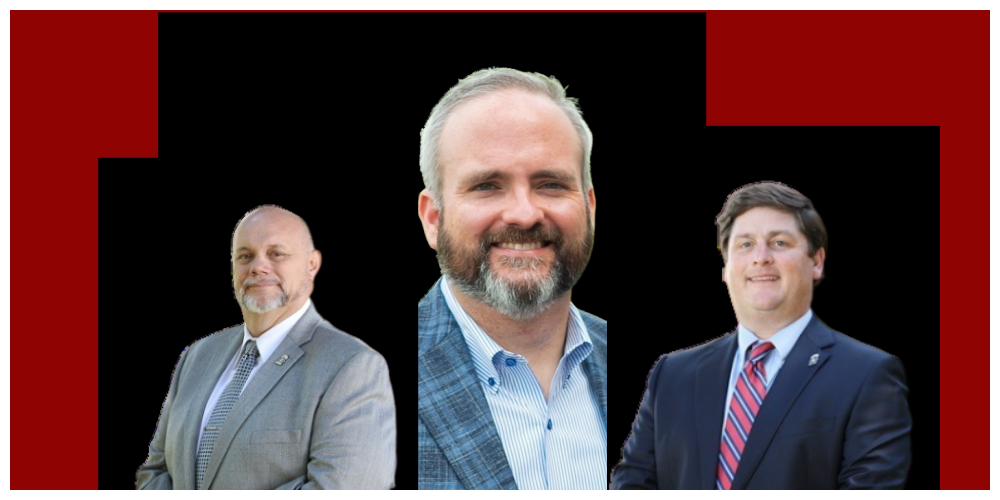
Two incumbent candidates for the Alabama Public Service Commission received the majority of their donations from three state political action committees that draw a sizable share of their money from utility-related interests, an Energy and Policy Institute review of Alabama campaign finance records found.
The fundraising pattern for candidates Jeremy Oden and Chris Beeker III comes as the Public Service Commission (PSC) faces heavy scrutiny due to Alabama Power customers’ rising electric bills. In the midst of the intensifying debate over electricity costs, the Alabama Legislature passed a controversial bill, HB 475, expanding the PSC to seven seats, with a Governor-appointed official overseeing the regulatory agency. The bill stopped short of requiring a rate case, something that has not been conducted in Alabama since 1981. Governor Kay Ivey signed the bill on April 2.
The Alabama Public Service Commission (PSC) approved every rate increase proposed by Alabama Power between 2020 and 2025, including at least six rate increases in the past three and a half years, according to PSC minutes. During the same period, data from the Energy Information Administration shows Alabama Power residential customers saw their monthly electric bills rise 23% from $153 in 2020 to $189 in 2025.
How utility-associated money reaches PSC candidates
Three PACs – Pride PAC II, T-Town PAC II, and Alabama Development PAC – donated the majority of campaign contributions received by Beeker and Oden from January 1, 2025 to April 2, 2026, according to EPI’s review. From January 1, 2024 through April 2, 2026, utility-related interests contributed 30% of money donated to T-Town PAC II, 33% to Pride PAC II, and 12% to Alabama Development PAC.
Oden’s campaign reported that nearly 85 percent of his contributions came from these three PACs and no individual person donated to Oden’s campaign during the time frame reviewed by EPI. Beeker’s campaign reported that 75 percent came from the same three PACs and 3% of his contributions were from individuals.
In 2025, Republican primary challengers to Oden and Beeker Matt Gentry (R-Place 1) and Brent Woodall (R-Place 2), respectively, reported fundraising that was primarily from individual contributors and corporations. Jim Ziegler (R-Place 2) reported 47% of his contributions from individuals and 53% from PACs.
Additional candidates Sheila McNeil (D-Place 2), Jeff Ramsey (D-Place 1), James Gordon (D-Place 1) and Priscilla Andrews (R-Place 2) reported fundraising primarily from individual and self-contributions, with no PAC or regulated entity-associated funding as of April 2, 2026.
The pattern continued into 2026. Beeker received $120,000 from the three PACs in January: $80,000 from Alabama Development PAC and $40,000 from T-Town PAC II. Oden received an additional $20,000 from Pride PAC II and $10,000 from T-Town PAC II in 2026.
On March 31, Beeker and Oden also received $15,000 each from Global Rental Co,, a subsidiary of Altec, a utility equipment and services company based in Birmingham. In addition, Oden received $15,000 from coal producer Drummond Company and Beeker reported $10,000 from the Electric Cooperatives of Alabama PAC.
In a statement to EPI, an Oden campaign spokesperson said “My campaign is in full compliance with all Alabama campaign finnce [sic] laws that govern candidates and elections, and we will continue following those laws in all cases. Every contribution we accept is fully reported along with every expenditure, and we provide the full transparency that the law demands from every candidate for public office across Alabama.” Oden did not address questions about utility influence, discussions with PAC donors, or recusal commitments.
Neither Beeker nor Alabama Power responded to requests for comment.
Jim Ziegler, a Republican challenging Commissioner Beeker for Place 2, reported $2,500 from Pride PAC II in February 2026. Pride PAC II filings showed it contributed $15,000 to challenger Matt Gentry’s campaign for Place 1 in March 2026; Gentry’s campaign filings from the same timeframe did not disclose the contribution. Gentry did not respond to a request for comment.
Opaque donors to utility interest-funded PACs
Two mysterious LLCs with no discernible public presence on the Internet, BWR LLC and DC Company LLC, also contributed to the utility interest-funded PACs, giving the same amounts on the same dates twice. BWR LLC claimed an address in Mobile, Alabama in campaign finance records, but is actually incorporated in Delaware. DC Company LLC reported both Delaware and Alabama addresses in campaign finance filings with the Alabama Secretary of State. EPI was unable to locate definitive incorporation documents for DC Company LLC. Internet searches did not reveal either company’s business activities..
On May 2, 2025, DC LLC gave $11,250 to T-Town PAC II, and BWR LLC gave $11,250 to Pride PAC II. On October 20, 2025, each LLC gave the same $11,250 again to the same PACs, respectively.
PAC management overlaps with campaign operations
The three PACs are chaired by the same person: Joshua Taylor of Echols, Taylor and Associates, according to filings with the Alabama Secretary of State. Taylor is also listed as the “Dissolution Designee” and “Designated Filing Agent” for Beeker’s PSC campaign account.
Taylor has previously directed campaign committees for candidates that have used Matrix LLC, a political firm mired in legal controversies, including the “ghost-candidate” election scandals in Florida and the North Birmingham bribery scandal in 2018. Alabama Power paid Matrix to “monitor the policies of” existing environmental groups, regulatory agencies, and to watch for the creation of new environmental groups, according to a series of contracts later published online.
Campaign finance records show candidates who have used Echols, Taylor and Associates as the agent for their campaign accounts while also contracting with Matrix include: PSC President Cynthia Almond, Tuscaloosa Mayor Walt Maddox, Representative Bryan Brinyark, Representative Norman Crow, Tuscaloosa City Councilmember Joseph Eatmon and Tuscaloosa Circuit Court Judge Dennis Steverson Sr.
Previous PACs run by Echols, Taylor and Associates have come under fire for contributions that appeared to be from corporations or companies with no physical or internet presence that donated hundreds of thousands of dollars. In 2014, Matrix donated directly to some of Josh Taylor’s PACs, including T-Town PAC II.
In a statement to EPI, Taylor said that all PAC contributions and expenditures “are properly disclosed in compliance with the Alabama Fair Campaign Practices Act and are public record available from the Alabama Secretary of State.” Taylor did not respond to specific questions about the PACs’ purposes, donor consultation, coordination across the three PACs, or any written policies on contributions from regulated utilities.
Methodology
The Energy and Policy Institute analyzed contributions to each Republican and Democratic candidate for the Alabama Public Service Commission to check for ties to regulated entities, examining the period from Jan. 1, 2025 to April 2, 2026, the date of the most recent filings.
Regulated entities are those who have rates set by PSC proceedings, whose operations are subject to PSC oversight, or have business before the PSC. EPI counted the following as “associated” with a regulated entity:
- Law firms and employees of law firms representing regulated entities
- Lobbyists registered to represent regulated entities
- Executives, employees, and retirees of regulated entities
- Companies, and the people who work for them, with financial ties to regulated entities or their affiliates
- Corporations with no public profile that are owned by or associated with people from or representing regulated entities
EPI also evaluated the contributions into the three PACs that made up the majority of funding provided to the incumbent candidates for the PSC over the period from Jan. 1, 2024 to April, 2026. As with contributions directly to campaigns, EPI used the same criteria to determine whether a contribution to a PAC was considered “associated” with a regulated entity.
Some contributions did not contain sufficient information to ascertain the nature of the contributor. EPI treated those as contributions as not being associated with a regulated entity.
All figures are based on public filings, current as of April 2, 2026. To view the original source data and EPI’s classification of each contribution, please visit these links.
Header image source: Alabama Public Service Commission, LinkedIn