Maryland PSC delays key Future of Gas rule after utility-linked opposition campaign

A campaign by Maryland gas utilities to manufacture opposition to a proposal that would lower utility bills by eliminating a key subsidy for new gas hookups appears to have succeeded, at least for now. At its May 8 rulemaking session, the Maryland Public Service Commission returned proposed regulations ending line extension allowances (LEAs) to commission staff for additional analysis, delaying implementation indefinitely. The decision came under newly appointed Chair Kumar Barve, who replaced Frederick Hoover as the Chair in January.
An EPI analysis of filings in the rulemaking docket found that eight comments opposing the proposed regulations were authored or submitted by utility employees, lobbyists, or attorneys, despite being filed in the names of other entities. As many as 14 comments opposing the regulations featured identical or similar language. Public records obtained by EPI also show utility representatives solicited opposition to the proposed rules from public agencies and elected officials — and, in some cases, drafted the comments for them.
Line extension allowances are accounting mechanisms that require all ratepayers to foot the cost of extending methane (or natural) gas distribution pipes to new buildings, rather than the building developers, raising existing customers’ bills. By incentivizing new gas infrastructure buildout, LEAs increase utility profits, which are tied to capital expenditures.
The utility campaign may have created a false impression of broad public opposition to a reform that would eliminate the subsidies and help address rising utility bills.
Eliminating ratepayer-funded LEAs would reduce Baltimore Gas and Electric’s (BGE) cumulative revenue requirement by $620 million and Washington Gas’ (WGL) by $332 million over the next decade, avoiding nearly $1 billion in rate increases for existing customers, according to Maryland’s Office of People’s Counsel. But even a one-year delay in ending the subsidy can impose long-term costs, because utility capital spending is recovered from customers over decades, along with financing costs, taxes, and other expenses — including profits for the utilities. For example, OPC estimated that WGL’s $56.25 million in projected 2025 spending on new expansion projects would ultimately cost customers $238 million through 2088.
The PSC’s delay marked a retreat from Order 91683, issued in June 2025 under Hoover, in which the Commission stated it was, “persuaded that new natural gas customers should pay the full cost of extending service to them, thus minimizing any future potential for stranded costs with respect to new extensions, and reducing any subsidization of gas extensions.”
PSC staff released proposed LEA regulations in December, opening Docket #9707-RM92. On January 12, reportedly under pressure from Governor Wes Moore, Hoover resigned as Chair, and Moore nominated Commissioner Kumar Barve as his replacement. (Though no longer Chair, Hoover remains on the Commission.) Two weeks later, the Commission canceled a scheduled January 28 rulemaking session for the proposed regulation, leaving the proposal in limbo until the May 8 session.
Metadata in docket files connected to gas utilities, front group
EPI identified three types of records connecting utilities to opposition comments filed in the docket by other entities: docket filing information, PDF document metadata, and contacts on the docket’s service list.
For example, file #10 in the docket, a letter signed by the Washington County Chamber of Commerce, initially listed “Columbia Gas of Maryland, Inc.” as the filing party in the docket’s “Subject” field. This field was subsequently updated to “Washington County Chamber of Commerce” and the text of the filing remained unchanged.
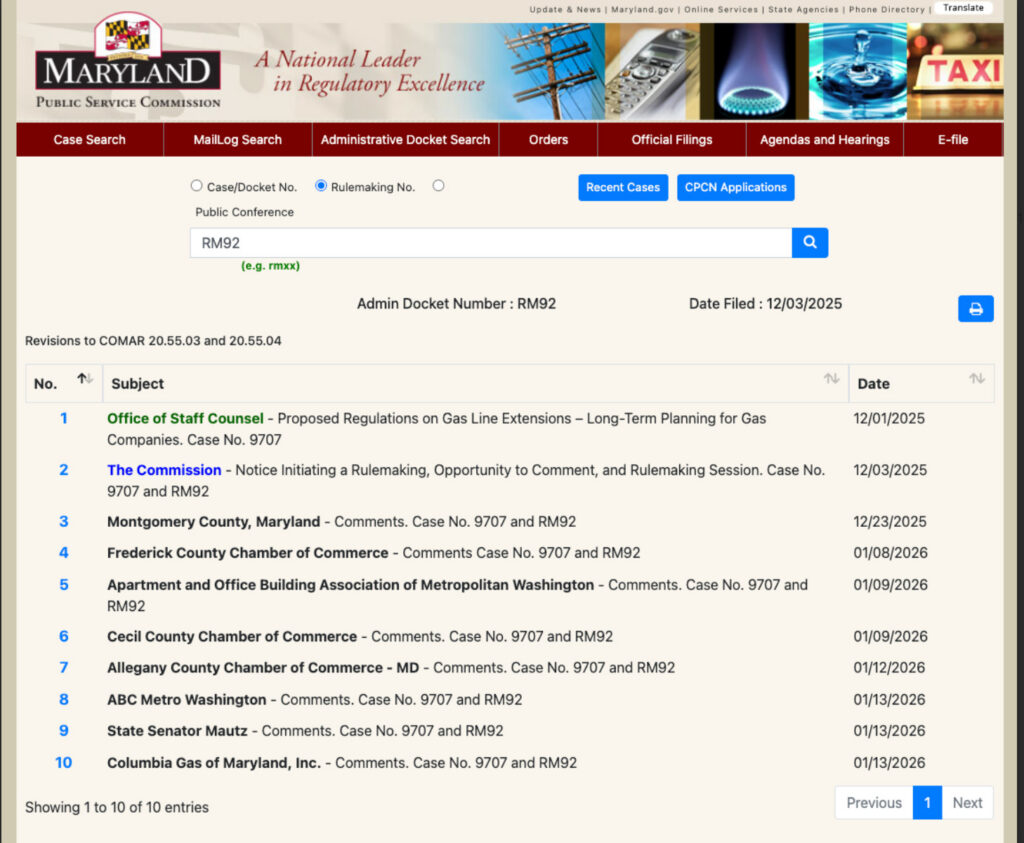
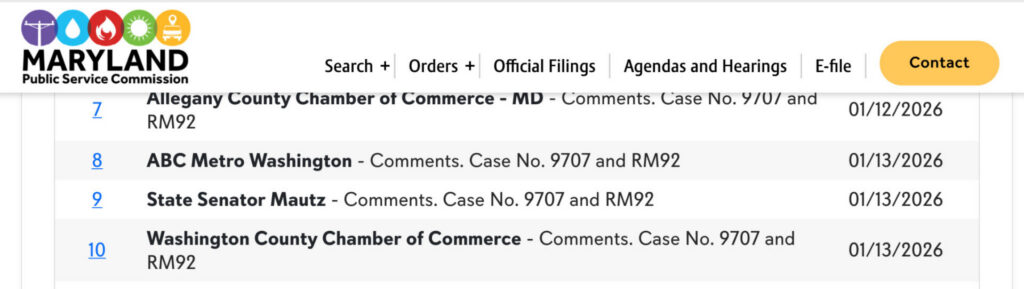
Screenshots of Docket RM92 from January 13 (top) and February 4 (bottom) showing file #10’s modified “Subject” field.
Metadata listed “Sara, Ivana,” an advocacy specialist at WGL, as the “Author” of the comments filed by the Utilities Workers Union Local 419, the utility contractor InfraSource, and the Maryland REALTORS.
WGL named Sara on two online “Maryland Policy Updates” about LEAs. On the first of these webpages, the utility boasted that it had “mobilized dozens of industry associations, businesses, labor organizations, and community partners to submit public comments” following Order 91683. The utility’s pages urged “builders and developers” to turn out in opposition at the January 28 and May 8 hearings, directing anyone who wanted “to get involved in ongoing advocacy efforts over the line extension regulations” to “contact Ivana Sara at ivanasara@washgas.com.”
On Docket #9797-RM92’s service list, “E-mail: ivana.sara@washgas.com” is also listed as the point of contact receiving docket updates on behalf of the following non-utility parties:
- Utilities Workers Union Local 419
- InfraSource
- Frederick County Building Industry Association
- Maryland Coalition for Inclusive Energy Solutions
The Maryland Coalition for Inclusive Energy Solutions (MCIES) is a utility front group that promotes the interests of gas utilities, including defending and increasing the use of methane gas. The group’s executive director, Sarah Peters, is a registered lobbyist for Columbia Gas of Maryland, and its board includes employees of Berkshire Hathaway Energy, Chesapeake Utilities, Washington Gas, and NiSource (Columbia Gas of Maryland’s corporate parent), according to IRS filings.
The service list also directs emails for the Cecil County Chamber of Commerce and the Cecil County Economic Development Commission to “bquinn@venable.com.” Brian Quinn is a Maryland-based regulatory attorney for Venable, LLP, and his clients include BGE, Chesapeake Utilities, and WGL. Emails from 2022 obtained by EPI reveal how Quinn invited county officials to the launch event for MCIES, which he described as a new “grassroots campaign.”
Chesapeake Utilities employees solicited and drafted opposition letters
Columbia Gas and WGL were not alone in working to generate opposition to the PSC’s move to end line extension allowances. Chesapeake Utilities employees also solicited opposition from public officials and agencies and, in several cases, provided draft language for them to submit, according to emails obtained by EPI via public records requests.
Just after midnight on January 9, Chesapeake Utilities Regional Engagement Manager Derrick Craig emailed officials at Worcester County, the Wicomico County Council, and the Somerset County Economic Development Commission “asking for letters of opposition to this proposed [LEA] regulation.” Craig’s email to Worcester County included two .docx attachments: a “Stakeholder Fact Sheet” and a “Stakeholder Opposition Letter (Draft).”
The fact sheet’s metadata listed “NiSource Inc.” in the “Company” field and “Waitlevertch \ Scott” as the document’s “Author.” Scott Waitlevertch is a government relations manager at NiSource’s Columbia Gas of Pennsylvania and Maryland. Metadata for the draft opposition letter listed “Baccino, Steve” as the draft letter’s “Author.” Baccino is Chesapeake Utilities’ director of state affairs & regional engagement.
Baccino also sent the draft letter and fact sheet to Maryland Senator Johnny Mautz, asking “Would you be willing to submit public comments supporting the natural gas industry?”
Mautz then asked Baccino to “send a statement that I can use to submit,” and Baccino replied with a “draft for your signature.” Senator Mautz’s chief of staff responded to Baccino, confirming she had “applied your entire letter to the letterhead.”
A third Chesapeake employee, Natural Gas Sales Account Manager Vincent Fiorelli, who is also an appointed member of the Cecil County Economic Development Commission, used his Chesapeake email account to ask the development commission’s chair for a “small favor” — apply his signature to the “attached letter” opposing LEA regulations. A few days later, Chair Michael Ratchford sent Baccino and Fiorelli a copy of “the requested letter” with his signature. Baccino replied, “Appreciate the position of the Cecil County EDC! We will get this filed.”
Opposition comments share language, copy utility talking points
As many as 14 comments opposing the proposed regulations contained phrases, sentences, or paragraphs of identical or highly similar language. A full annotated repository of these comments is available here.
For example, the filing attributed to the Washington County Chamber of Commerce — which initially listed Columbia Gas of Maryland, Inc. as the filer — is almost identical to the comments of the Allegany County Chamber: two paragraphs are copied verbatim, while four more differ by six words or fewer.
Both comments also share language with other filings — including some connected to utilities through metadata or the docket’s service list. One paragraph in particular appears word-for-word in comments of the Allegany, Washington, and Montgomery County Chambers of Commerce, as well as those filed on behalf of Local 419, which both metadata and the service list connect to WGL’s Ivana Sara:
Under existing policy, the costs of extending natural gas infrastructure are shared among customers, making new connections feasible for businesses and homeowners alike. The proposed regulations would instead require individual customers to pay the full cost upfront, making access to natural gas financially out of reach for many.
The concluding paragraphs from the Allegany and Washington County Chambers are also identical to the final paragraph filed by utility front group MCIES: “[The Chamber/MCIES] respectfully urges the [Maryland Public Service Commission/Commission] to preserve the existing line-extension framework, maintaining affordability and reliability, and protecting access to essential energy services that support Maryland’s economic vitality.”
Other comments contain language identical to the “Fact Sheet” and “Stakeholder Opposition Letter” documents that Chesapeake Utilities sent to public officials. The Cecil County Chamber’s comments, for instance, are word-for-word identical to the “Stakeholder Opposition Letter” — except for the Chamber’s second paragraph, which closely tracks the “Fact Sheet.”
Senator Mautz’s filing reproduced three sentences from the “Opposition Letter” template word-for-word, and three more with only cosmetic edits — incorporating content from five of the template’s seven substantive paragraphs.
Shared language alone does not prove that filings were ghostwritten. However, the extent of the similarities between filings contributes to the evidence of a coordinated utility campaign to create the appearance of organic opposition to the proposed regulations.
Comments at May 8 hearing reference manufactured opposition, echo utility-linked talking points
At the May 8 hearing, utility representatives explicitly referenced the volume of negative comments as a reason for the Commission to delay or reject the proposed LEA regulations.
Chesapeake Utilities’ lawyer told commissioners, “I was going to list the number of stakeholders from the Eastern Shore that filed comments, but it would take too long, all in opposition to this regulation.”
BGE’s counsel suggested public opposition had informed BGE’s antipathy to the proposal, rather than the reverse, testifying that “we have taken to heart the comments filed by a diverse group of organizations and individuals, you know, you have trade organizations, you have elected officials, you know — even had the Montgomery County Chamber of Commerce expressing concern about the impact of these regulations on the state and its economy.”
The utility representatives failed to disclose that filings cited as evidence of broad opposition contained utility-provided language or were written by industry representatives.
Chair Barve justified delaying the proposed regulations by calling for a “comprehensive assessment of what costs and opportunities and unintended economic consequences there would be to … fully implementing the reg[ulation]s as they are currently written.”
Barve’s stated rationale echoed arguments made repeatedly by utilities and utility-linked commenters, who warned of economic consequences and urged further study. It also marked a retreat from Order 91683, issued less than a year earlier, in which the Commission had already concluded that new gas customers should pay the full cost of extending service to them in order to reduce subsidies and limit future stranded-cost risk.
WGL, BGE’s parent company Exelon, Chesapeake Utilities, and Columbia Gas of Maryland did not respond to a request for comment from EPI.
Photo credit: Benzoyl, Wikimedia Commons, licensed under the Creative Commons Attribution-Share Alike 2.0 Generic license.