Salt River Project customers pay to support political work

Employees fund PAC’s direct contributions, but ratepayers are paying twice as much to ‘administer’ fund
Salt River Project (SRP) ratepayers are paying at least $500,000 annually to support the administration of SRP’s political action committee, which works to support and oppose political candidates in Arizona and nationally. The political action committee (PAC) is called SRP’s Political Involvement Committee (PIC). Contributions in support of political campaigns from the PIC are funded by employees’ contributions, typically deducted from their paychecks. But the PIC also has administrative costs, which SRP customers fund through their water bills, according to SRP’s response to questions from the Energy and Policy Institute (EPI). Those ratepayer contributions have exceeded the employee contributions on an annual basis in recent years, according to internal budgets provided by SRP to EPI in response to Arizona public records requests. The PIC’s recent goal is to raise around $566,000 to contribute over a two year election cycle, meaning that customers are paying almost twice as much to administer the PIC as SRP employees are funding in political contributions.
SRP is comprised of two organizations, the Salt River Valley Water Users’ Association, a private water company, and the Salt River Project Agricultural Improvement and Power District, a political subdivision of the State of Arizona, and serves approximately two million power and water customers. SRP formed the PIC in 1976 through the Salt River Valley Water Users’ Association, the private water corporation. SRP’s PIC contributes funds toward candidates for federal, state and local office, as chosen by SRP employees who comprise the PIC Advisory Committee. Employees who contribute to the PIC come from both the power and water sides of SRP. PIC Advisory Committee members are also a mix of employees who work for both sides of the organization.
According to documents obtained by EPI in response to public records requests, SRP’s PIC “is an essential part of SRP and Public Affairs’ engagement strategy.” As of 2023, approximately 19% of SRP’s employees participated in the PIC, “which is 6 points higher than PIC’s peer benchmarking group according to [the] Public Affairs Council’s 2021 PAC Benchmarking Survey.”
SRP has increased the suggested contributions and incentives for employees to contribute in recent years
To fund the PIC, employees choose a contribution amount to deduct from each paycheck. Between 2012 and 2024, the PIC suggested contribution amounts of $20 per pay period for the President’s Club ($520 annual contribution) or $9 per pay period as a Sustaining member ($234 annual contribution). Records obtained by EPI show that at the end of 2023, SRP’s PIC Manager Christina Worden proposed updating the membership and contribution levels, including larger suggestions for employees in leadership or management roles. Worden proposed a suggested contribution schedule as follows:
| Position | Annual contribution amount | Per pay period contribution amount |
| General Manager Staff | $2600 | $100 |
| Senior Director | $1560 | $60 |
| Director | $1014 | $39 |
| Manager | $792 | $27 |
| President’s Club Member | $650 | $25 |
| Sustaining Member | $286 | $11 |
At the time the PIC proposed increasing employee funding, it was distributing just under $450,000 in a two year election cycle, but had a goal to distribute approximately $566,000 in a cycle. Worden noted in her presentation materials that Arizona’s elections have become more competitive and expensive. She also highlighted the growth in spending by other PACs such as Pinnacle West, parent company of Arizona Public Service, which grew its spending from around $614,000 in 2012 to around $913,000 in 2022.
Worden also proposed incentives to increase participation in the PIC’s new funding levels. These incentives included participation in the ‘76 Club for individuals who are ”early adopters” and recognition at a special event, such as a luncheon with the CEO and President of SRP. Another suggested incentive is to provide a one-time match “with SRP administrative funds” to an individual’s charity of choice, mirroring the person’s contribution to the PIC. EPI asked SRP for comment on the total amount of SRP administrative funds, which are funded by ratepayers, contributed toward the match incentive. SRP stated that in FY 2025, $55,000 of SRP administrative funds were spent toward this match incentive.
SRP PIC administrative costs lack transparency for ratepayers
SRP offers many perks and benefits for employee participants in its PIC. The PIC regularly sponsors lunches, coffee chats, outings to sporting events, picnics, and dinners for employees who contribute to the PIC. Members of the PIC advisory committee, which makes decisions about which candidates receive contributions from the PIC, may also attend a multi-day leadership retreat in Washington, DC. Records obtained by EPI show that in recent years, the PIC sponsored a dozen or more activities for employee contributors annually.
Since 2023, funding for PIC sponsored events has come from SRP’s administrative funds, which are funded by ratepayers. Until fiscal year 2023, SRP did not have a budget for expenses for PIC sponsored events. In fiscal years 2023, 2024, and 2025, SRP allocated $500,000 per year for the PIC’s budget. The budget document provided by SRP in response to EPI’s record requests reports that in fiscal years 2023 and 2024, the entire budget was spent in the category “Professional Development – Memberships/F”. In fiscal year 2025, “Professional Development – Memberships/F” is allocated $2,000 of the budget. The rest of the budget for fiscal year 2025 breaks out into 15 other categories, including “Meals and Entertainment – External Meals,” which is allocated $240,000 of the total budget.
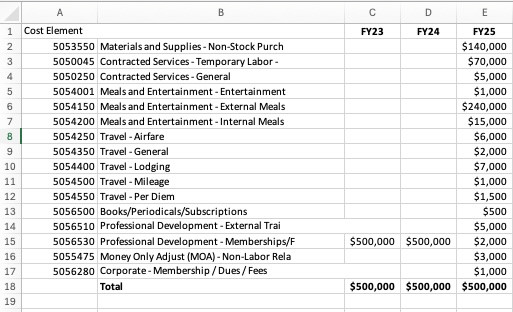
Several of the categories include cut off words, and it is unclear what types of expenses are included in certain categories. The limited detail in the budget and the relatively recent use of a budget at all underscores the lack of transparency around what SRP customers are paying for to support the PIC.
SRP’s PIC contributes in Arizona and across the country
SRP’s PIC contributes to the political campaigns of local, state, and federal candidates in Arizona, as well as state and federal races in other parts of the country. The PIC regularly contributes to Republican and Democratic party offices, candidate affiliated PACs, and PACs for groups such as the Arizona Chamber of Commerce. The contributions are voted on by PIC Advisory Committee members at their monthly meetings.
Contributions in 2026 include $10,000 each to Deb Haaland’s campaign for Governor of New Mexico and the New Mexico House Democratic Campaign Committee; $5,000 each to the Arizona Chamber PAC, Greater Phoenix Chamber PAC, Republican Arizona Congressman Eli Crane’s PAC, Eli Crane for House, and Republican Arizona Congressman Juan Ciscomani’s PAC, among others; and $2,500 to controversial US House candidate Mark Lamb in Arizona. SRP’s PIC has contributed to local races such as city or town council races in Gilbert, Glendale, and Peoria, as well as US Senate and Congressional races in California, Colorado, Idaho, Massachusetts, Pennsylvania, Tennessee, and Utah, among other states.