Regulators Roundtable: Documents reveal GOPAC’s secretive influence network for utility commissioners

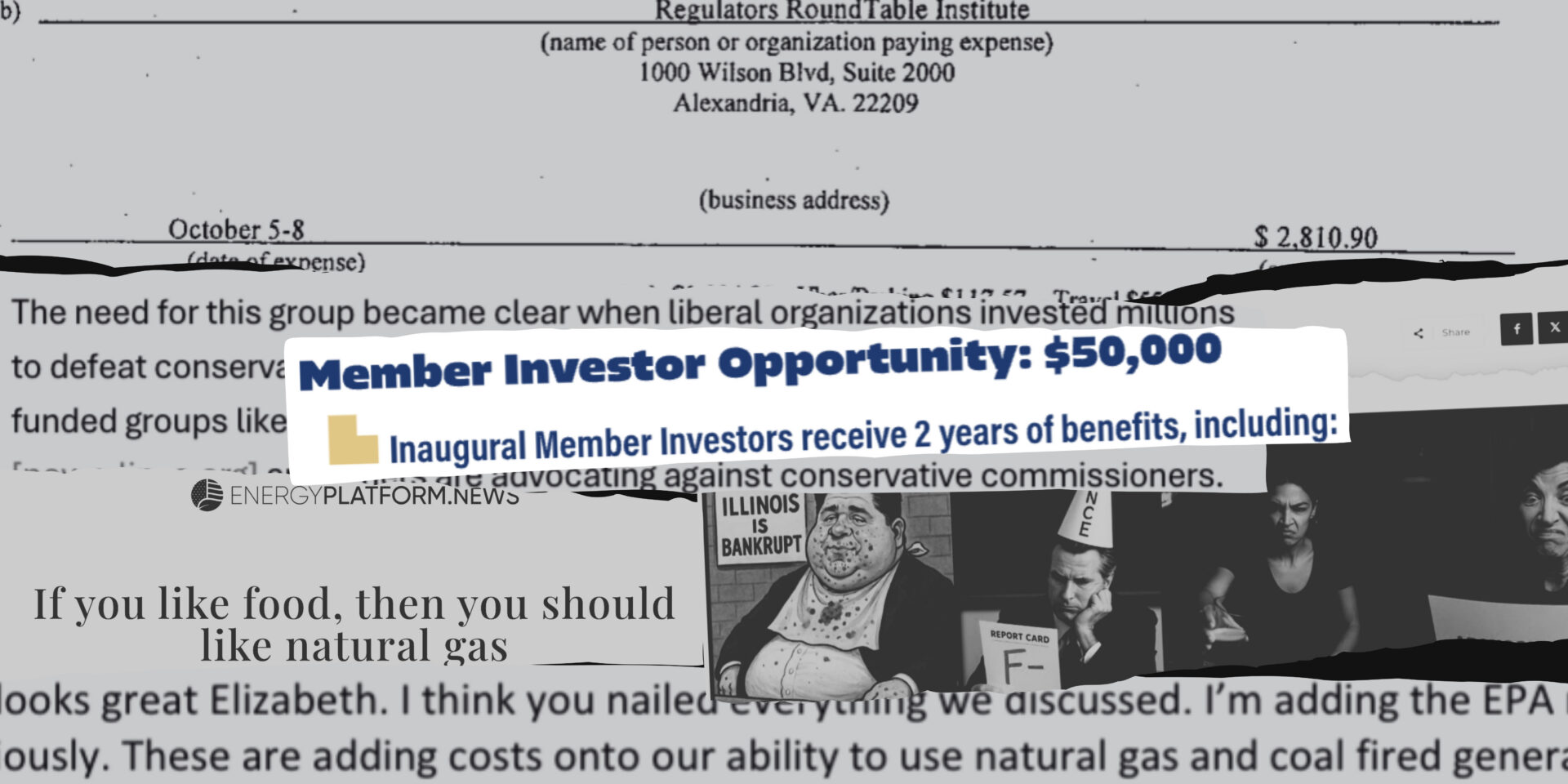
A recent Washington Post investigation brought new attention to the Regulators Roundtable, a little-known organization that connects Republican state utility commissioners with companies and trade associations that have interests before the regulators, and raises money from those companies and groups.
The Energy and Policy Institute provided records to the Post revealing how the organization solicited utilities and industry groups to become “investors” during its early formation. Some regulators and industry representatives told the Post that the group exists for educational purposes.
The records show that the Regulators Roundtable is more than a forum for exchanging ideas. EPI has filed more than 200 public records requests seeking to understand the Regulators Roundtable’s operations and structure, its relationship with GOPAC, the Republican organization that houses it, and its work on energy policy.
Since 2025, the Regulators Roundtable has built a network of entities, including a political action committee to defend Republican commissioners in elections and an affiliated media platform that publishes utility and energy-related articles and op-eds. It has organized private meetings between regulators and corporate “investors,” helped commissioners communicate with the Trump administration, drafted policy comments, provided political and communications training, and advanced the interests of incumbent fossil generators and monopoly utilities.
A new “subgroup of GOPAC”: the creation of the Regulators Roundtable
GOPAC is a Republican down-ballot political training organization founded in 1978 that describes itself as “the Republican Party’s premier organization for educating and electing a new generation of leaders.” The group operates a network of entities, including a political organization known as a “527” group, which can raise and spend unlimited funds to influence elections.
GOPAC launched the Regulators Roundtable in January 2025. Roundtable President and GOPAC board director Elizabeth Gianini later explained to North Carolina Utilities Commissioner Tommy Tucker that the idea came from Oklahoma Corporation Commission Chair Kim David, who had been active in GOPAC as a state senator and “felt like there is not a place where conservative commissioners could get to know each other, share best practices and hear about current and cutting edge technology from a business perspective.”
David, who had served on GOPAC’s Legislative Leaders Advisory Board since 2017, was the Regulators Roundtable’s 2025 advisory board chair.
On January 10, 2025, three days before Gianini’s start date at the Roundtable, GOPAC Chairman David Avella emailed Gianini and David a “roster of Energy CEOs in Oklahoma as a resource for your fundraising.” Gianini replied that her priority was to “get a name and a mission statement for the organization.”
The organization eventually took shape through several entities: the 501(c)(3) Regulators Roundtable Institute; the 501(c)(4) Regulators Roundtable Inc.; and the Regulators Roundtable Political Action Committee. A GOPAC-affiliated outlet, Policy Platform News, also launched a website with energy-focused articles and opinion columns, Energy Platform News.
By May 2025, then-Arizona Corporation Commission Chair Kevin Thompson described the Roundtable as a “subgroup of GoPAC.” Gianini also wrote to North Dakota Public Service Commissioner Jill Kringstad that she was “excited you wanted to join the Regulators Roundtable” and was “working with GOPAC to see when they are offering their next campaign training in DC, and get you scheduled to attend that too.”
Records also show that the Roundtable recruitment drew on Georgia Public Service Commissioner Tricia Pridemore’s position as president of the National Association of Regulatory Utility Commissioners (NARUC) at the time. Pridemore was an early Roundtable member, received emails addressed to members of the Roundtable’s Advisory Board in March 2025, and appeared on guest lists for an April dinner with potential “investor” companies. Gianini and David also appear to have used several NARUC conferences as opportunities to recruit regulators.
Pridemore also helped Gianini connect with potential new members. Gianini emailed Wyoming PSC Chair Mike Robinson in January 2026 “to follow up on a conversation with Pridemore, who shared that you expressed interest in joining a future Regulators Roundtable Institute meeting.” Gianini met with Robinson on the sidelines of NARUC’s 2026 Winter Policy Summit and later emailed to welcome him to the Roundtable.
At least 19 regulators from 12 states were listed in event materials as attendees of GOPAC or Regulators Roundtable events examined by EPI in 2025 and early 2026, while records connect several additional commissioners to the organization.
Investors receive access to commissioners, counter “liberal organizations”
While Gianini, Pridemore, Thompson, and David worked to recruit member regulators, the Roundtable representatives also sought funding from potential corporate donors. In April 2025, the Regulators Roundtable hosted a series of dinners on the sidelines of the Current Issues Conference, a utility industry gathering at New Mexico State University in Santa Fe.
Ahead of the conference, Gianini sent David a detailed briefing email identifying the “investors” and regulators scheduled for meetings, along with information about the prospective investors and an investor prospectus.
For $50,000, the “inaugural member investor” was offered access to commissioners at an “exclusive” two-night inaugural event in Phoenix, a two-day GOPAC energy workshop in Nashville that also included legislators, access to future meetings in 2026, and opportunities to submit content to the Energy Platform News website. The prospectus also said that, in fall 2026, donors who contribute over $5,000 to the 501(c)(4) group or the PAC would receive a fall election briefing with “key Commissioners on the ballot.”
Several companies with interests before regulators, or trade associations representing them, have supported or participated in the Roundtable. The Washington Post reported that the American Gas Association and the Nuclear Energy Institute were among its investors. Google’s head of state legislative affairs, Ron Barnes, sits on the Roundtable Institute board, and Gianini described Google in one email as a “great supporter from the start of our organization.”
Other board members across the Roundtable network work in lobbying, government affairs, or industries affected by utility regulation, according to documents obtained by EPI:
- Peter Horkan, a partner at the Caravel Group, a Nashville-based consultancy, who is also a board member of GOPAC’s 527 organization;
- Mike Huebsch, a former Wisconsin Public Service Commissioner who made headlines for approving projects proposed by Dairyland Power Cooperative before resigning and applying for the cooperative’s CEO position;
- Jimmy Glotfelty, a former chair of the Texas Public Utility Commission and current government affairs employee for Aalo Atomics, a company developing small modular reactor technology;
- Mike Nasi, a partner with Jackson Walker LLP and adviser for coal advocacy organizations Life:Powered and Energy Policy Network;
- Brian Sailer, a registered lobbyist for the firm Flywheel Government Solutions whose 2025 clients included Bloom Energy, a fuel cell manufacturer.
In an email inviting Southern Company executives to a Roundtable dinner, Gianini described one of the Roundtable’s objectives as countering “liberal organizations” that were “advocating against conservative commissioners,” such as incumbent GOP commissioners on the Arizona Corporation Commission.
A May 2025 member newsletter similarly said the Roundtable “exists to equip and support conservative, both elected and appointed, commissioners with the knowledge, strategy, and network they need to push back” on “liberal environmental groups pushing a 100% green energy agenda.”
The records also show that Roundtable officials paid close attention to state transparency requirements, and perceived them as a potential risk. In her email outlining the Santa Fe meetings, Gianini told David she was “getting nervous about the ‘noticing requirements’” in different states and asked whether those rules could make meetings open to the public or press. “State by state I need to resolve that before we have more than one from a state on the RR Advisory Board,” she wrote.
Gianini also told Kringstad that “due to your notice rules, you and Commissioner Haugen-Hoffart will have to most likely rotate coming to the meetings.”
The Roundtable also communicated with regulators via personal email accounts. In one case, Gianini obtained a personal email and cellphone number for Mississippi Commissioner Wayne Carr’s administrative assistant.
Gianini even asked Idaho PUC Commissioner Ed Lodge, the Roundtable’s 2026 chair, if he wanted to remove a list of new member states from an internal email “if you have a concern about FOIAs.”
Carrying a “PSC perspective” to the Trump administration
The Roundtable has also sought to give member commissioners a coordinated voice in federal energy policy–one that is outside NARUC’s existing committee structure for representing state regulators in Washington.
In July 2025, Gianini drafted a memo to Stephen Moore, a former economic adviser to President Trump and then an economist at the Heritage Foundation. Moore is now a senior fellow at the America First Policy Institute. The memo sought to convey a “PSC perspective” on policies intended to “move faster” to build new power generation.
Thompson, the Arizona regulator, asked Gianini to modify the memo to call for rolling back six categories of EPA regulations that he said were “adding costs onto our ability to use natural gas and coal fired generation.” All six of Thompson’s requested rollbacks appear in a later copy of the memo, which urged the administration to “revitalize coal,” treat natural gas as a “clean and strategic fuel,” extend incentives to gas infrastructure and expand pipeline capacity.
After securing Thompson’s approval, Gianini sent the memo to Oklahoma’s David, Louisiana PSC Commissioner Eric Skrmetta, and Nebraska PSC Commissioner Kevin Stocker. Stocker responded, “I really like the commonsense elements of this.”
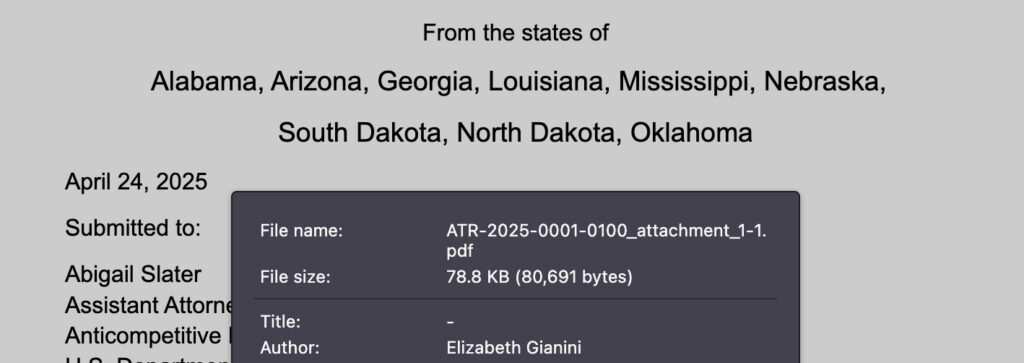
In another case, records indicate that Gianini and a lobbyist, Shawn Day, helped prepare and submit comments under the signatures of state commissioners to the Justice Department’s Anticompetitive Regulations Task Force docket. The comments urged the DOJ not to target the vertically integrated utility model. The final filings did not identify the Roundtable’s role.
Three versions were submitted to the docket, all of which list “Elizabeth Gianini” under the “Submitter Name” field on regulations.gov. Two included PDF files whose embedded metadata listed “Elizabeth Gianini” as the author. Metadata for a fourth version posted by GOPAC-linked outlet Energy Platform News listed Day as the author.
Pridemore, then president of NARUC, circulated the comments to other commissioners while making clear the effort was “not affiliated with NARUC.” She urged her colleagues to sign the comments to counter what she described as “grossly negative comments and pressure” regarding “our commissions and state utilities” from “NGOs trying to push us into full deregulation or worse.”
NARUC maintains a committee for engaging federal policymakers. Its Washington Action Program exists to provide a “framework for improving the credibility, visibility, and effectiveness of NARUC in Congress, the Executive Branch, the media, and other stakeholder organizations.” NARUC separately submitted its own comments in the docket, which Pridemore signed in her capacity as the association’s president.
The Roundtable has also facilitated access to current senior federal officials.
In November 2025, members participated in a virtual meeting with Peter Lake of the White House National Energy Dominance Council about potential federal rules governing the interconnection of large electricity users such as data centers.
Months later, the group hosted its second major Roundtable meeting at a luxury hotel one block from the White House. Commissioners and private-sector sponsors met with officials from the White House, Department of Energy, Environmental Protection Agency, and Nuclear Regulatory Commission. Lake also led a separate “commissioner only briefing” with the National Energy Dominance Council.
Communications support and shaping media coverage
At the October 2025 Roundtable, GOPAC Chairman David Avella led a communications session offered “exclusively to commissioners” to help raise their public profiles through social media and op-eds. The communication support extended to helping commissioners produce the content itself.
Records show that Gianini and lobbyist William Greener of Greener and Hook LLC drafted a pro-coal, anti-renewable op-ed for Nebraska PSC Commissioner Kevin Stocker. Energy Platform News later published a nearly identical version under Stocker’s name.
Another record revealed that Gianini drafted a document for Idaho Commissioner Ed Lodge to criticize renewable energy and defend vertically integrated monopoly utilities. The Idaho PUC’s public information officer told EPI that “Commissioner Lodge didn’t pursue [the op-ed] further or sign off on it.”
The Roundtable and Gianini promoted additional commissioner-bylined op-eds on social media, including pieces attributed to David, Thompson, Pridemore, Skrmetta, Georgia Commissioner Fitz Johnson, Mississippi Commissioners Chris Brown and Wayne Carr, and North Dakota Commissioner Sheri Haugen-Hoffart.
The Roundtable’s communications network also extended beyond Energy Platform News (EPN). The site, operated by Policy Platform News, described itself as an “independent U.S. media organization” without disclosing its ties to GOPAC. But Policy Platform’s parent organization, Policy Platform Inc., was incorporated at the same address and with the same registered agent as the Regulators Roundtable Institute, while records show Policy Platform staff using gopac.org email addresses.
A Roundtable newsletter described EPN as one of two media platforms the organization supported for conservative commissioners and identified Day, the lobbyist, as Policy Platform’s editor. Day is a registered lobbyist for an LS Power subsidiary. He was also listed as the media contact for the Mountain Valley Pipeline, which EPN covered favorably.
One of Day’s colleagues at his Richmond-based firm, Capital Results, partner Wayne “Jabo” Covert, sits on GOPAC Inc.’s board. The firm also lobbied in 2025-26 for energy companies, including EQT, Colonial Pipeline, NextEra Energy, Old Dominion Electric Cooperative, and Washington Gas.
The Roundtable offered corporate investors access to the publication. Its investor prospectus said companies contributing $50,000 would receive opportunities to submit material to Energy Platform News during 2025 and 2026.
The site published a number of articles and editorials that offered favorable coverage of the gas industry, including an op-ed titled “If you like food, then you should like natural gas” by Pickering Energy Partners’ Dan Romito.
Other headlines included “American coal is cleaner than Chinese wind and solar,” “Lay all Biden energy credits on the chopping block,” and “Net zero does not facilitate return on investment,” as well as at least two columns from Alex Epstein, who denies the dangers of climate change.
EPN published a three-part exclusive interview with Energy Secretary Chris Wright focused on the Trump administration’s energy policies, including its efforts to end DEI initiatives, expand private energy development, and reverse climate policies. Wright was interviewed by Dan Haley, a former CEO of the Colorado Oil and Gas Association whom EPN identified as a Policy Platform board member.
EPN also published at least five other editorials by Roundtable member commissioners, including three members of the Arizona Corporation Commission.
Sometime between August 3 and August 15, 2026, all content was removed from Policy Platform’s and EPN’s websites. The Washington Post ran its story on the Roundtable on August 12.
A political arm to support member commissioners
Unlike NARUC and other organizations that bring state regulators together, the Regulators Roundtable has a component explicitly for spending on electoral politics.
The Regulators Roundtable PAC endorsed candidates for elected utility commissions, contributed directly to their campaigns, and provided political training.
Gianini told Southern Company representatives, including then-Senior Vice President of Federal Regulatory Affairs Noel Black, that the group aimed to counter organizations opposing conservative utility commissioners.
Gianini told Wyoming PSC Chair Mike Robinson in June 2025 that the PAC was focused on defending Georgia Republicans and “strong pro-business” incumbents in Arizona.
After Republicans lost two Georgia Public Service Commission seats in November 2025, Gianini told Roundtable member commissioners: “We lost 2 great PSC members last week, and cannot afford to lose anymore!” She also wrote an EPN op-ed arguing that the results represented a “strategic breakthrough” for the “Green New Deal movement,” as “groups tied to the League of Conservation Voters, EarthJustice, Michael Bloomberg’s Carbon Fund, and Hollywood activist Jane Fonda spent millions of dollars… campaign[ing] with feelings, not facts.”
Days after the Georgia PSC election, the Roundtable’s 501(c)(4) group posted a job advertisement for a full-time finance director who would work “under … the GOPAC Network Finance Director.”
The Regulators Roundtable PAC subsequently became active in several states with elected utility commissions, with contributions to candidates in Georgia and North Dakota, and endorsements of candidates in both states, as well as Arizona, Alabama, Louisiana, Montana, Nebraska, Oklahoma, and South Dakota.
The PAC’s website also published an attack ad, paid for by Conservative Grassroots Network Election Fund, targeting Arizona Corporation Commission candidate Ralph Heap, who challenged Thompson and Myers in the Republican primary. The week before the primary, Thompson posted a photo of himself and Myers attending GOPAC- and Roundtable-sponsored events in Florida. Heap defeated Myers in the primary.
Campaign finance filings show money moving in both directions. Ahead of the 2025 Georgia PSC election, the Regulators Roundtable PAC received a $25,000 contribution from “Gas South PAC Inc.,” the PAC of a Georgia-regulated gas marketer. In March 2026, after Pridemore announced a run for Georgia’s 11th Congressional District, her state campaign committee, Georgians for Pridemore Inc., donated $197,194.82 to the Regulators Roundtable PAC. (Pridemore was legally barred from transferring funds from her PSC campaign, a state committee, to her federal campaign for the U.S. House.)
The GOPAC Election Fund later endorsed Pridemore for Congress. The fund spent a total of $289,960 on independent expenditures to support her federal campaign. The fund also reported $14,000 in “printing/canvassing” independent expenditures supporting Kim David’s 2026 congressional campaign. Both Pridemore and David failed to advance to the runoff in their respective GOP primaries.
Following the January 2026 Washington, D.C. meeting, Regulators Roundtable PAC hosted a “campaign school” for member commissioners. Sessions covered fundraising, polling, campaign messaging, grassroots organizing, media strategy, and the use of artificial intelligence in political communications. Presenters were largely national Republican political operatives, including veterans of Americans for Prosperity and the Republican Governors Association, as well as a representative from YouTube, a subsidiary of Google, an inaugural Roundtable investor.
Who attended, what it cost, what was disclosed
Documents show at least 19 regulators from 12 states appear on invites or attendee lists for the April 2025 Santa Fe dinners, July 2025 Nashville workshops, or the October 2025 and January 2026 Roundtables:
Records connect at least nine additional regulators to the group. Gianini described Oklahoma’s Brian Bingman as a member, while emails show Wyoming’s Mike Robinson, North Dakota’s Jill Kringstad, and Texas’ Thomas Gleeson agreed to join. Emails further show that unnamed commissioners from Texas, Indiana, and Vermont had registered for the July 2026 Roundtable.
Alabama’s Jeremy Oden and South Dakota’s Kristie Fiegen signed the Anticompetitive Regulations Task Force comments. Oden and Florida’s Mike La Rosa also received materials from the November 2025 virtual meeting. Oden, however, told the Post that he did not participate in any Roundtable meetings or calls.
Financial and ethics records show that GOPAC and the Regulators Roundtable spent thousands of dollars per public official at some events, including more than $1,000 per attendee on food and drink in some cases.
Arkansas commissioners Doyle Webb and Katie Anderson disclosed $2,810.90 and $2,662.91, respectively, in expenses paid by the Roundtable for the October 2025 Scottsdale meeting.
For the January 2026 Washington, D.C. meeting, North Carolina’s Tommy Tucker received complimentary meals worth $1,034.85, flights worth $502.83, and lodging worth $738.54, according to an email sent to Tucker and two members of his staff by a Roundtable consultant.
North Carolina requires officials to report scholarships over $200–defined to include travel, lodging, and meals–on annual Statements of Economic Interest when out-of-state entities provide them. Tucker’s staff flagged the requirement before the D.C. meeting, writing that they need to “collect the full cost associated with Commissioner Tucker’s attendance at this event or any events he’s attended this past year that was covered by your group.”
North Carolina Utilities Commission budget authorization forms also characterized Tucker’s attendance as official commission business and identified the Roundtable as the source of funding. For the Scottsdale meeting, Tucker wrote that he was traveling to “represent the Utilities Commission of North Carolina” and the organization would reimburse all related costs. Emails indicate that Gianini booked Tucker’s flight for the Nashville conference.
Tucker’s 2025 disclosure forms, however, do not disclose any such scholarships.
Louisiana’s Skrmetta does not appear to have filed any disclosures corresponding to the hospitality he received at these events in the Louisiana database either, despite Louisiana requiring a “public servant” who accepts “complimentary admission, lodging, or transportation” to file Form 413 with the Louisiana Board of Ethics within 60 days.
Utility contributions to GOPAC accelerate
Much of the financing behind the Regulators Roundtable and the broader GOPAC network is opaque, since 501(c)(3) and 501(c)(4) entities are not required to disclose donors. But utility contributions to GOPAC Inc., the 527 political arm, are public, and have significantly increased in recent years–surging from an average of around $61,000 per year in the 2010s to $795,000 in 2024 and $940,000 in 2025.
That money largely leaves the 527 entity for electoral use: 76.5%, or $38,563,310, went to the GOPAC Election Fund between Q1 2021 and Q2 2026. The GOPAC Election Fund, in turn, transferred almost 80% of its funds to state-level Republican political organizations.
As utility giving accelerated, GOPAC’s 501(c)(3) Education Fund hosted an energy-specific workshop in Nashville in July 2025.
Several members of GOPAC’s Legislative Leaders Advisory Board, including Wisconsin Assembly Majority Leader Tyler August and Ohio Senate President Rob McColley, were asked to nominate “appropriate committee chairs or influential committee members” for the events to foster discussion with “public policy experts and industry influencers.”
At the Nashville conference, North Carolina’s Tucker, Oklahoma’s David, and Arizona’s Thompson gave a presentation titled “Powering America Forward: PSCs and Legislators United for Energy Dominance.”
Other sessions featured Moore, the former Trump adviser, who reiterated longstanding anti-renewable talking points; Pickering Energy Partners’ Dan Romito, who touted fossil fuels (while bashing Democrats with outlandish, seemingly AI-generated cartoons); the fossil fuel and utility front group Consumer Energy Alliance; and nuclear reactor manufacturer Westinghouse.
In July 2026, Thompson posted a photo that appeared to show himself and Nick Myers attending a 2026 version of the same event.