Alabama Power promises data center protections, but its proposed rate structure redacts them

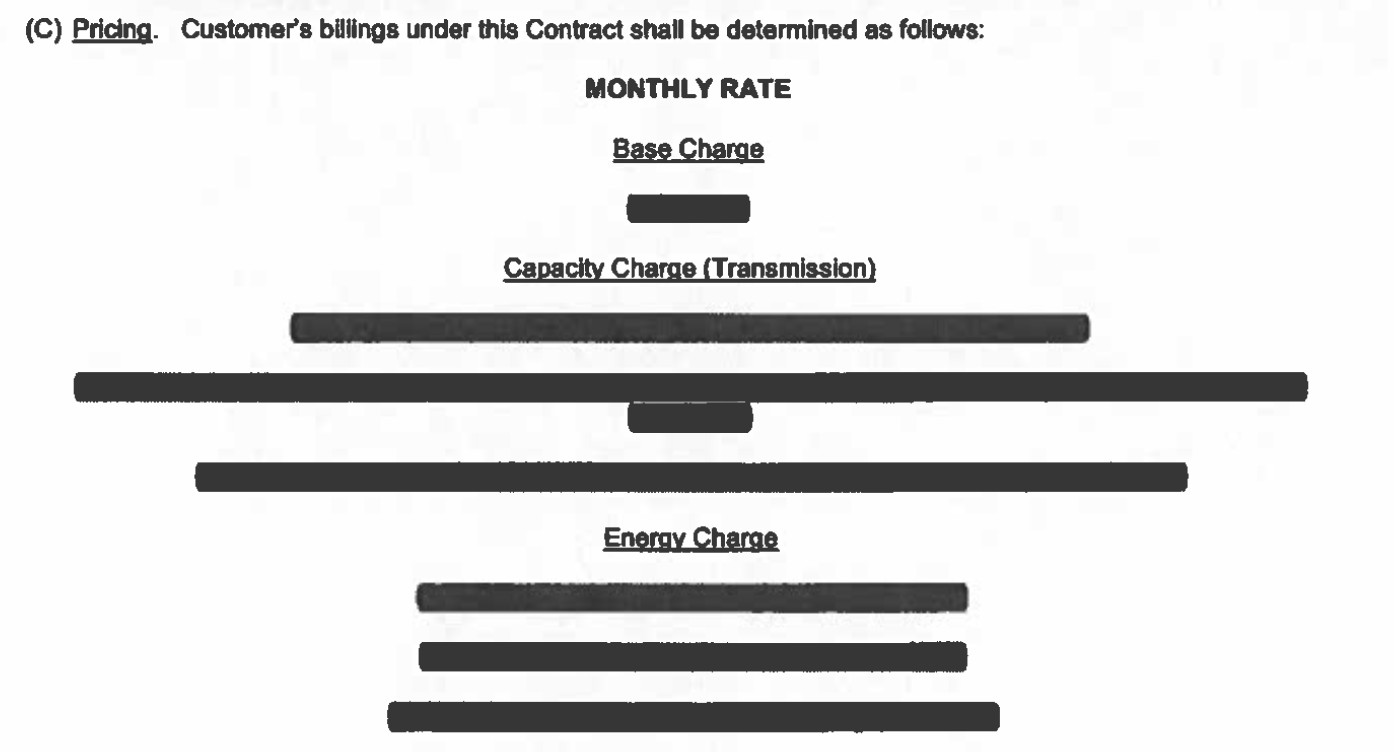
Alabama Power is telling regulators and the public that the contracts it is signing with data center developers will protect other customers from paying for costs associated with those projects, but it has redacted every key term and number in the contracts themselves that the public would need to know if that is true.
In an August 21 filing with the Alabama Public Service Commission (PSC), Alabama Power claimed its contracts with large data center customers already protect other ratepayers, and it offered two specifics in its comments: initial terms of “more than a decade” and “a billing capacity ratchet of [sic] least 80 percent.” A ratchet is a minimum bill that requires a customer to pay for a specific portion of the power it reserved on the electric system, whether or not the customer uses it.
But the rate schedule Alabama Power is asking the PSC to adopt – the only document in the proceeding that would have the force of law – specifies no minimum term and no minimum bill percentage. The only figures in the proposed tariff are a 150 MW eligibility threshold, a threshold now required by law, and a deemed 45-day review period after which, upon no vote by the PSC, data center contracts would be automatically approved.
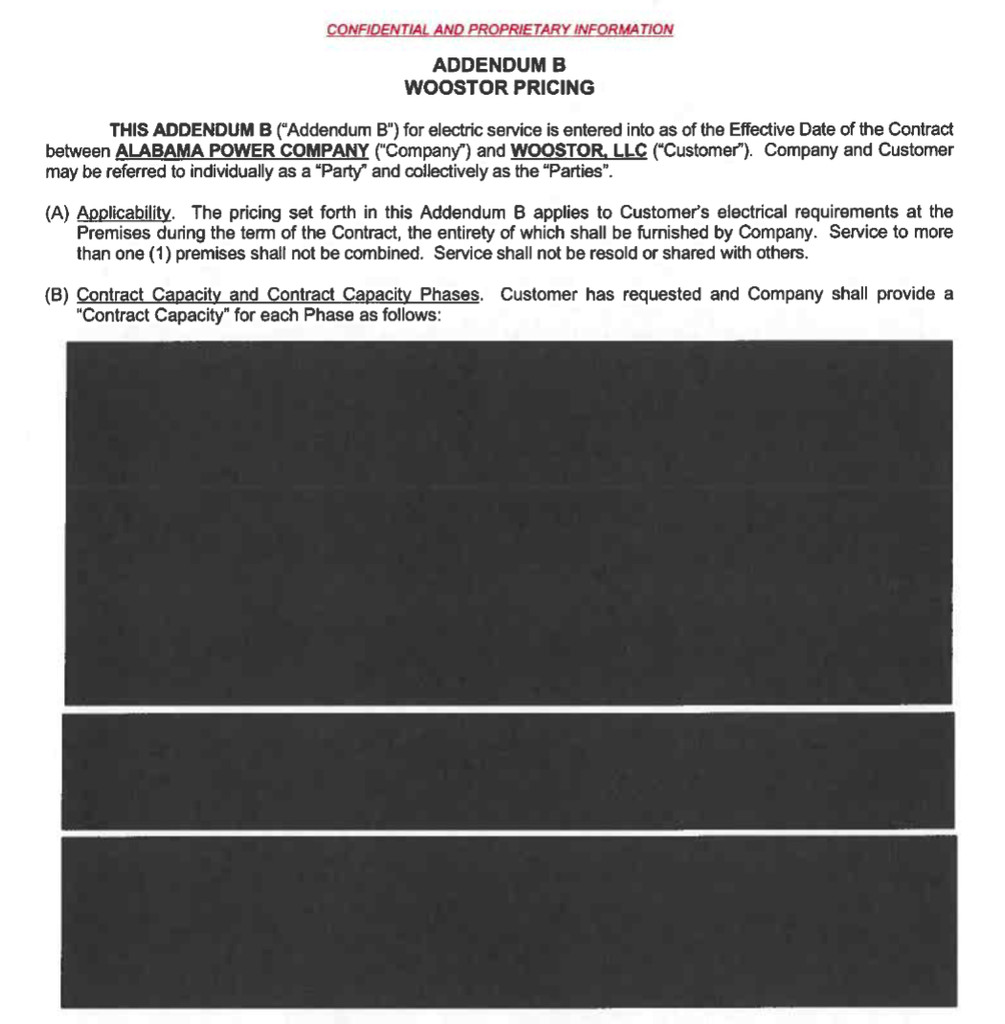
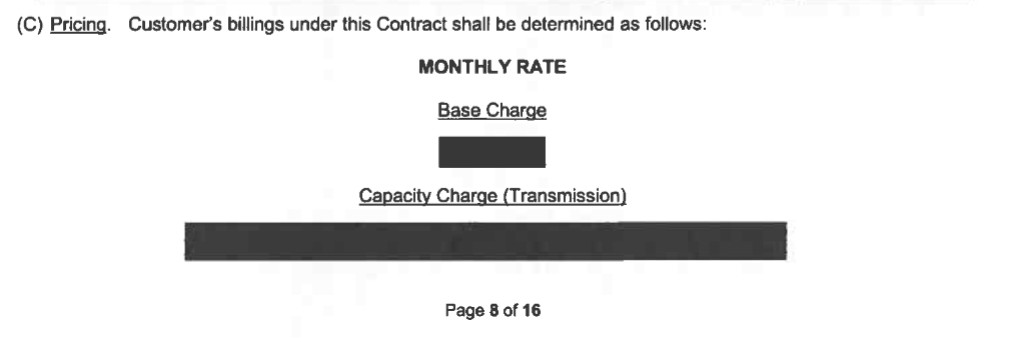
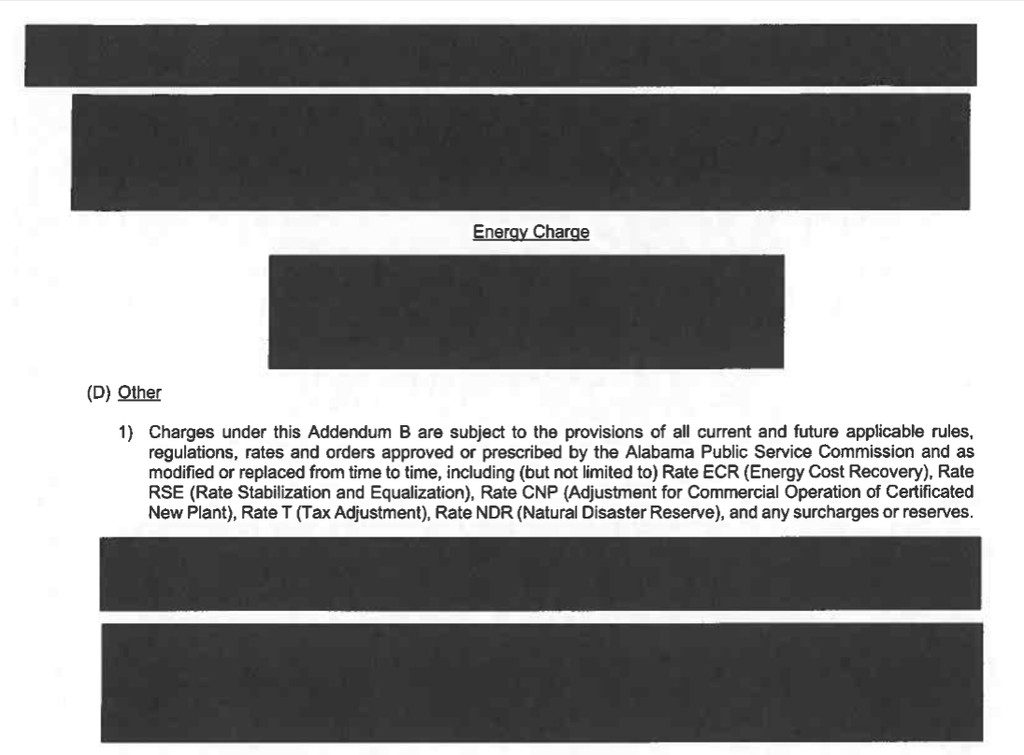
Alabama Power has filed at least three data center contracts with the PSC this year: Dotier, LLC, a subsidiary of Meta on June 18, Alabama ADC Holdings, LLC, an affiliate of Nebius on July 24, and Woostor, LLC on August 14. In each contract, Alabama Power redacted the length of the contract, the minimum billing requirement, and the pricing.
The filings are part of a generic proceeding the PSC opened on July 8, 2026, after the Legislature passed SB 270 earlier this year. The law takes effect October 1, 2026 and requires the PSC to determine whether large data center contracts recover the incremental cost of serving the customer from the customer, and whether they benefit other retail customers.
Alabama Power did not respond to questions from the Energy and Policy Institute about the company’s redactions or omissions in its filed contracts, comments, and proposed tariff.
Senator Lance Bell promoted legislation to protect consumers, now says no changes needed
Announcing the bill in February, sponsor Sen. Lance Bell (R-Pell City) said, “Alabama families and businesses should never foot the bill for someone else’s private profit. This bill ensures fairness and transparency in our energy system.” Presenting the bill in the Senate Fiscal Responsibility Committee on February 11, Bell said, “I don’t think data centers should be built on the backs of our ratepayers,” and that his bill would make the PSC “set up the framework to […] basically protect[s] the ratepayers, protect[s] our citizens”.
Six months later, in his comments in Docket 33709, Bell’s tune changed abruptly. He wrote that the PSC’s historical approach “remains effective,” that the Legislature “did nothing in SB 270 to modify” the treatment of confidential customer information, and warned against “administrative or regulatory drift.”
Opposition to data centers has intensified in Alabama, as in other parts of the country. Five members of the Bessemer City Council voted in November 2025 to rezone nearly 700 acres for Project Marvel, a 1,200 megawatt campus that an affiliate of QTS, the data center company owned by funds managed by Blackstone, purchased for $431.7 million in July 2026. In the city’s August 25, 2026 municipal elections, two of those five lost their seats, a third was forced into runoff, and a fourth held on by two votes. Mayor Kenneth Gulley, who defended the project and signed a nondisclosure agreement with the developer, faces a runoff against former state legislator Louise Alexander, who campaigned on the secrecy surrounding the deal.
Consumer protections in Alabama Power’s filings are a moving target
The three contracts Alabama Power filed, its reply comments, and its proposed tariff address the same protections in different, sometimes opposing ways:
| The three filed contracts (June 18 – August 14) | Reply comments (August 21) | Proposed Rate FCR-LLDC tariff (August 21) | |
| Contract term | “the Initial Term of this Contract shall be [redacted] years” | “a meaningful initial term length of more than a decade” (p. 8) | “Such as a minimum initial term length.” No duration given. |
| Minimum billing | “no less than the greater of (i) [redacted] … or (ii) [redacted] of the applicable Contract Capacity” | “a billing capacity ratchet of least 80 percent” [sic] (p. 8) | “minimum payments.” No percentage given. |
| Contract capacity | Redacted in all three contracts. | Not applicable. | Tariff applies at 150 MW and above. No per-contract disclosure required. |
| Pricing / demand charge | Addendum pricing paragraphs redacted in full. | Argues the protection depends on it (p. 6). | Not addressed. |
| Commission approval | Not applicable. | The Commission “could” confirm a contract at a meeting (p. 8). | Contracts become effective “upon expiration of the 45-day period, absent disapproval.” No vote required. |
Sources: Reply Comments of Alabama Power Company, Docket No. 33709 (Aug. 21, 2026), including Attachment A (proposed Rate FCR-LLDC); Contracts for Electric Service filed for Dotier, LLC (June 18, 2026), Alabama ADC Holdings, LLC (July 24, 2026), and Woostor, LLC (Aug. 14, 2026).



Alabama Power says the public is not allowed to verify protections
Minimum bills and longer contract terms for data centers exist to protect consumers from paying for infrastructure that goes unused. If Alabama Power builds generation and grid infrastructure to serve a data center based on the expected demand, but the data center does not use as much as promised, or leaves early, customers could be left paying the difference.
Alabama Power argued that a minimum bill or the length of a contract means little on its own. The utility claimed customers “are indifferent (if not better off) if the initial term of a contract is 15 years or 20 years in duration” when pricing is adjusted accordingly.
Alabama Power’s argument is that the minimum bill percentage means nothing without the price behind it. A customer paying for 80 percent of its expected power demand at a higher rate could be a better deal for other customers than one paying for 90 percent of its expected power demand at a lower rate. Consumers are protected by the combination of the percentage and the price.
If a minimum bill percentage protects other customers only when paired with an appropriately set demand charge, which is the amount the customer pays each month based on its period of highest electricity use, no one can judge whether any minimum bill is adequate without seeing the demand charge. In all three filed contracts, Alabama Power redacted the pricing paragraphs in full. Alabama Power has told the PSC that the price is the critical information to know whether retail customers are protected from cost shifts, while maintaining that it will not disclose the price.
The Alabama Attorney General’s Office says existing process likely illegal
The Office of the Attorney General has challenged the process under which the PSC has reviewed and approved contracts to this point, saying the “deemed-approved” process used since 1996 may have been illegal. Alabama Power argued the existing process is lawful and that access to unredacted terms should remain limited to the PSC and the Attorney General.
The three contracts also arrived with different levels of outside review. The June 18 Dotier and July 24 Alabama ADC Holdings transmittal letters state that the unredacted contracts were provided to and reviewed by the PSC’s Electricity Policy Division staff. The August 14 Woostor letter says the same, then adds “as well as representatives of the Office of the Attorney General.” Alabama Power began involving the Attorney General in mid-August, while this docket was pending and before any order required it. It is unclear whether the Attorney General’s office received the Dotier or Alabama ADC Holdings contracts when they were filed, or later.
Alabama Power redacts information the public needs to evaluate data center deals
Alabama Power’s redacted numbers are the ones with the highest stakes for the public. A data center’s load determines how much generation and grid infrastructure Alabama Power will build, and how large the cost shift to other customers could become, if a project falls short. The owner’s identity gives the community information about the track record of the owner in other locations.
Alabama Power argued that a large data center customer “does not relinquish its right to protect confidential information, such as the identity of its upstream corporate affiliations, simply because it is a large data center.” But for two of the three contracts Alabama Power filed since June, the data center company’s name is already publicly known. Dotier was identified as a subsidiary of Meta in filings at the PSC to approve its solar projects in December 2025. Alabama ADC Holdings has been identified as a subsidiary of Nebius since at least February 2026, according to reporting by Data Center Dynamics and the Birmingham Business Journal. Only Woostor remains unidentified in any public filing or news report reviewed by EPI.
Nebius has published some of the types of numbers Alabama Power redacts, announcing its Finnish AI facility at 310 MW in its press release and reporting its total contracted power to investors in SEC filings.
Comments filed by the Gulf States Renewable Energy Industries Association noted that the public version of the Alabama ADC Holdings contract redacted the customer’s contract capacity even though a Birmingham media outlet, WBRC, reported it as a 300-megawatt project.
In other states, it can be standard practice for consumer protections to be public information. Indiana Michigan Power’s large load tariff, the product of a 2024 settlement with Amazon, Google, and Microsoft, put its 12-year minimum term and 80 percent minimum bill in the publicly available rate sheet. The Public Utilities Commission of Ohio approved an AEP Ohio rate structure requiring large data centers to pay for at least 85 percent of their capacity for up to 12 years, also publishing the numbers publicly. In Louisiana, under Entergy’s agreement to serve Meta’s Richland Parish data center – which has drawn its own confidentiality fights – the customer’s identity and the 15-year contract term are public. In Alabama, each of those data points is redacted and would remain so under Alabama Power’s proposal.
Southern Company discloses details to investors while Alabama Power conceals them from its regulator and the public
Despite Alabama Power’s redactions of energy and capacity information in the data center contracts, Southern Company’s executives have been more specific with its investors on Wall Street. On the utility’s second quarter 2026 earnings call, Chief Executive Officer Chris Womack told investors Alabama Power “added approximately 3 gigawatts” of newly contracted data center projects in a single quarter. Chief Financial Officer David Poroch estimated that each gigawatt of capacity required to serve a data center would require roughly $2 billion of new capital. The investor presentation posted by Southern Company as part of its Q2 2026 earnings release put Alabama Power’s contracted data center load at 4 GW.
The Energy and Policy Institute is unable to confirm if the three contracts filed by Alabama Power in Docket 33709 correspond to the projects Womack described. However, the two records show Southern has disclosed capacity and capital costs to investors while its subsidiary Alabama Power has redacted the capacity and prices from the public.