
Virginia regulators could require NextEra to turn over memo alleging evidence of wrongdoing

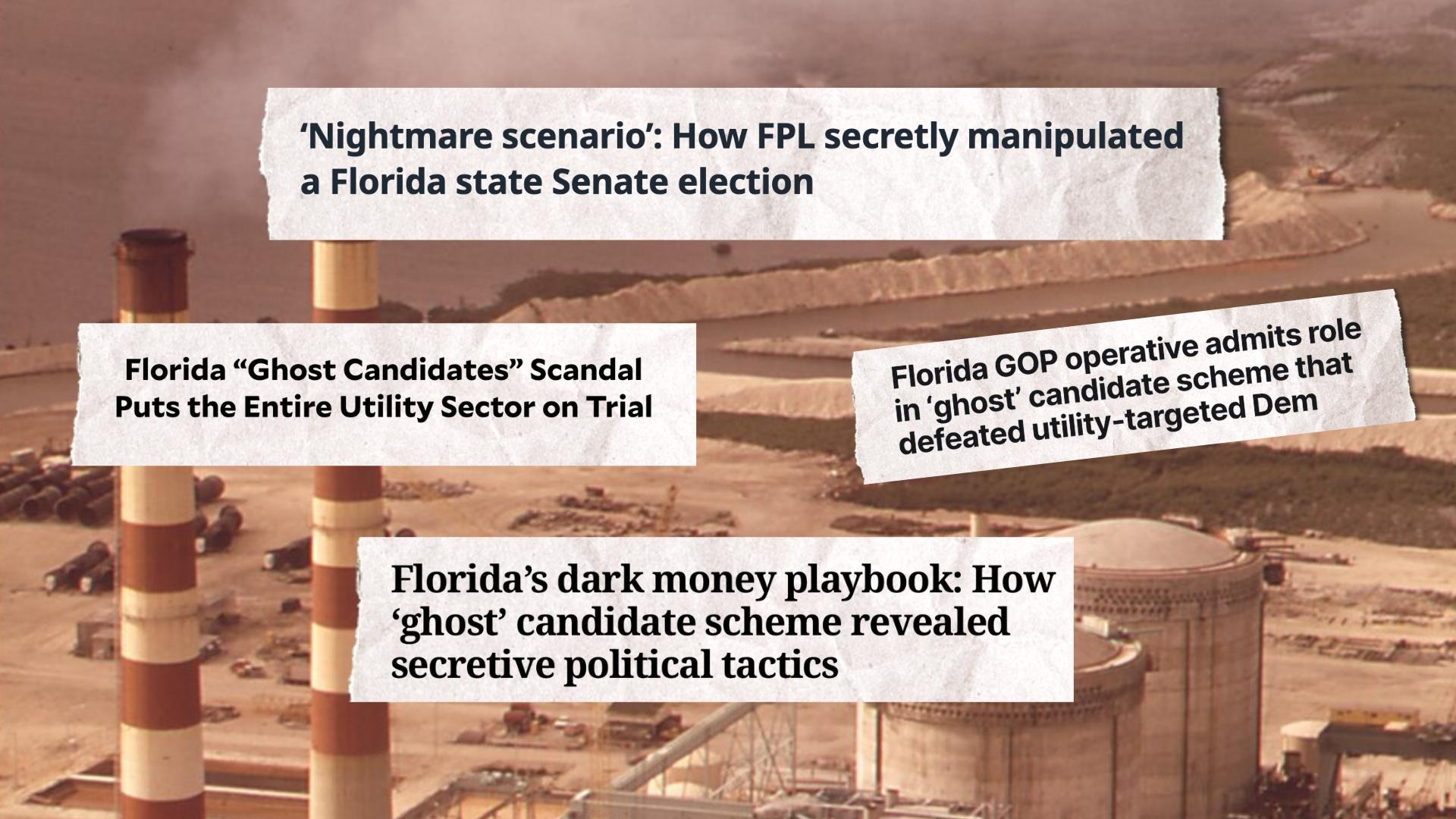
A document detailing NextEra Energy’s alleged involvement in election interference, bribery, and pay-to-play media could soon become public. The Virginia State Corporation Commission is set to hear oral arguments this Tuesday at 1 p.m. on whether NextEra must turn over the document, known as the “Robo Memorandum,” as part of the company’s $67 billion attempt to absorb Dominion Energy and become the world’s largest monopoly utility.
Complete contents of the document have not been made public. However, lead counsel of the plaintiffs suing NextEra and its former executives for fraud reviewed a redacted version of the Robo Memo and said it contains “evidence connecting [former Florida Power & Light (FPL) CEO Eric] Silagy and other FPL employees” to allegedly illicit schemes involving:
- Funding ghost candidates to siphon votes from FPL critics, such as former Florida State Senator Jose Javier Rodriguez, who lost his re-election bid by 32 votes;
- Offering employment at an FPL-funded entity to an elected official if he would resign his seat before the City Council voted on FPL’s takeover of the city utility; and
- Dictating coverage to a media outlet to produce stories that targeted journalists and elected officials that didn’t serve FPL’s political interests.
Journalists at the Miami Herald, the Orlando Sentinel, and the Florida Times-Union revealed the Robo Memo’s existence when reporting in December 2021, using memo snippets, that FPL “orchestrated a range of improper political expenditures, including potential violations of state and federal campaign finance laws,” during Florida’s 2018 and 2020 election cycles.
Named after its recipient, NextEra’s then-CEO James Robo, the Robo Memo reportedly contains “155 pages of exhibits, including emails, text messages, checks, invoices, tax records, bank statements, legal memoranda, and an internal financial ledger,” allegedly showing evidence that NextEra knew its executives had diverted corporate money to secretly fund off-the-books political campaigns. Robo denied the allegations on an investor call held in January 2022, saying “bottom line is we found no evidence of any issues … any illegality or any wrongdoing on the part of FPL or any of its employees … I feel very good that there is no basis to any of these allegations,” despite already allegedly possessing the memo. A year later, in January 2023, NextEra told investors the allegations could result in campaign finance law violations or “material adverse impact” to its reputation. FPL’s then-CEO Eric Silagy announced his retirement that same day, and NextEra’s stock price plunged 8.7%, wiping out more than $14 billion in investor value.
NextEra refused to turn over the Robo Memo when a Virginia-based intervenor in the NextEra-Dominion merger case asked for it. The companies argued the document was “not relevant” to its bid to become Dominion’s new owner.
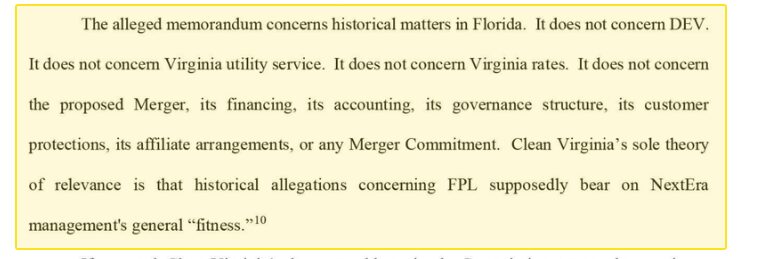
The intervenor, Clean Virginia, filed a motion to compel – asking the SCC to order NextEra to produce the document that bears “directly on the fitness of the management seeking control of Virginia’s largest utility.” In their challenge against the motion, the utilities declared that NextEra’s history in Florida of alleged political impropriety “does not concern Virginia,” its potential customers, or regulators:
Virginia’s Utility Transfers Act instructs the SCC to reject NextEra’s bid unless its purchase of Dominion will not impair or jeopardize adequate service at just and reasonable rates.
The Robo Memo allegedly details NextEra’s role in orchestrating and funding a network of dark-money groups to cripple its political opponents.
The Robo Memo allegedly details how Matrix, a political consulting firm working for FPL, outlined an orchestrated “daisy-chain of 501(c)(4) and other [dark money] entities controlled by its operatives or affiliates to conceal FPL political expenditures” aimed at extinguishing the company’s opponents, according to Jeffrey C. Block of Block & Leviton LLP, lead counsel in the shareholder lawsuit against NextEra. Block also said the Robo Memo contains references to an internal Matrix investigation that names FPL executives Eric Silagy, Daniel Martell, and Pam Rauch, along with NextEra executive Julie Holmes, as collaborators in the schemes.
FPL allegedly diverted “tens of millions of dollars” to fund these off-the-books political campaigns, described in detail below. These schemes were the subject of at least three prosecutions.
The Ghost Candidate Schemes
One of FPL’s most infamous schemes hinged on “ghost” candidates — people with names, platforms, or other qualities similar to the candidates FPL opposed, running purely to siphon off their votes in the 2020 elections. The three ghost candidates were Jestine Iannotti in Senate District 9, Alex Rodriguez in Senate District 37, and Celso Alfonso in Senate District 39.
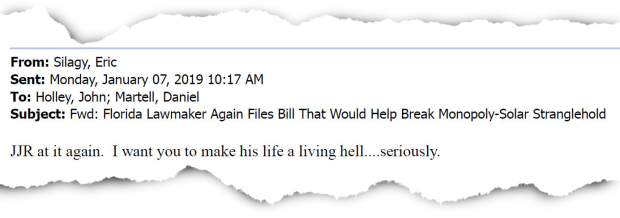
In each of the three races, FPL’s preferred candidate won; the impact of the “ghost candidate” is most obvious in the District 37 race, in which former Florida State Senator José Javier Rodríguez, a Democrat, was the incumbent. José Javier Rodríguez was the subject of an email Silagy sent to two FPL vice presidents in response to an article detailing legislation Rodríguez filed to allow “property owners to sell home-generated solar power to others”: “JJR at it again. I want you to make his life a living hell….seriously,” Silagy wrote to Martell and another FPL employee, John Holley.
The senator lost his re-election bid by 32 votes; the ghost candidate sharing the same last name won 6,382 votes.
The Robo Memo allegedly explains how FPL funneled $3 million through Grow United to the political committees “The Truth” and “Our Florida,” which spent $550,000 on mailers promoting the ghost candidates. The mailers for Iannotti reportedly featured a Black woman supportive of social justice and campaign finance reform. However, “Iannotti [is] Caucasian and at the time was planning to move to Sweden.”
Both of the committees that promoted the “ghost candidates” were run by a nonprofit that contracted former Florida State Senator Frank Artiles. Artiles offered the “ghost candidate” Rodriguez $44,000 to enter the District 37 race. A jury found Artiles guilty of coordinating the “ghost candidate” scheme and violating Florida’s campaign finance and election laws to do it. Outside the initial payment, Artiles also paid for the “ghost candidate” Rodriguez’s rent and daughter’s tuition.
Ghost candidates Rodriguez and Iannotti also faced charges related to their roles in the “ghost candidate” scheme. Rodriguez pleaded guilty to election-related charges, and Iannotti pleaded no contest. Iannotti was accused of illegally accepting an illicit $1,200 straw donation for her campaign and falsely reporting contributors who had not given her money.
An attempted bribe of an elected official against the utility’s privatization bid
The 501(c)(4) organization used to funnel funds to the committees that promoted the “ghost candidates,” Grow United, is the same entity FPL and Matrix used the previous year in an attempt to entice Jacksonville City Councilor Garrett Dennis to give up his seat as NextEra pursued the purchase of Jacksonville’s public utility, JEA.
The Robo Memo describes Grow United as “an entity funded by FP&L” and “used by [former Matrix CEO Jeff] Pitts, the other former Matrix employees, and their FP&L cohorts as a vehicle for covert financial transactions, including an apparent attempted bribe of a public official,” according to the complaint. The memo also says Grow United “served a dual purpose of creating an entity for political contributions and also an opening to allow Garrett Dennis (who was opposed to FP&L’s position on the JEA sale) to leave the City Council.” The plaintiffs allege the “apparent attempted bribe” refers to a job offer at Grow United extended to Garrett Dennis, a Jacksonville City Councilor who opposed NextEra’s $11 billion bid to buy JEA.
The job offer came from Reverend Deves Toon, who ran a group called “Fix JEA Now” and supported the sale of JEA to NextEra. According to the memo, Fix JEA Now was funded largely, and covertly, by FPL, through a network of intermediary organizations organized and controlled by employees at Matrix.
Rev. Deves Toon invited Dennis, through a shared associate, to work for Grow United advocating for marijuana decriminalization – which Dennis publicly supported. The job offer included a $180,000 annual salary and paid travel expenses but was explicitly conditioned on Dennis leaving the City Council. Dennis declined the offer, saying it struck him as “suspicious.”
After NextEra’s failed acquisition attempt, an FPL-funded news outlet published a story scolding Jacksonville for passing on NextEra.
Co-opting a media outlet
The Robo Memo lists almost $90,000 worth of contributions FPL made through a former Matrix employee, Abigail MacIver, to the Capitolist, a Florida-based pay-to-play media outlet that attacked FPL’s opponents.
According to the complaint, FPL used the “Capitolist to publish articles supporting FPL and NEE-backed priorities … while also denigrating political opponents and media outlets which had reported on the Company unfavorably.” Articles published in the Capitolist targeted many, including Miami Herald journalist Mary Ellen Klas, who was the author of several stories about FPL’s political schemes, Andrew Gillum, who was running for Florida Governor against Ron DeSantis at the time, and Alissa Jean Schafer, a former Broward County, FL Soil and Water Supervisor and researcher with the Energy and Policy Institute.
The Robo Memo also allegedly reveals, among other things, that:
- FPL paid $14.15 million to Mothers for Moderation, an organization Matrix CEO Jeff Pitts and former Matrix employee April Odom formed, “the only purpose of which appears to be obscuring the source of contributions to political campaigns and third-party vendors.” The group ran attack ads against Florida State House candidate Kayser Enneking during the 2018 election cycle. Enneking lost by roughly 2,000 votes. The spoiler candidate, Charles Goston, received about 4,300 votes. Enneking said FPL funded Goston’s run to “siphon votes off.”
- FPL covered a spoiler candidate’s rent to help him establish residency to run against FPL critic Daniella Levine Cava. Matrix CEO Jeff Pitts had recruited Johnathan Burke for the race, but Levine Cava prevailed and was re-elected to the Miami-Dade County Commission’s District 8 seat with over 60% of the vote.
NextEra’s misconduct spreads beyond Florida
In addition to its political manipulation in Florida, NextEra Energy has paid at least $30 million since 2000 in penalties and settlements on matters including market, environmental, safety, workplace, or health violations.
NextEra has faced allegations of further covert political influence spending in Maine, where it spent $20 million in 2021 on a political campaign to block a 145-mile transmission line that would have brought carbon-free hydropower electricity from Quebec to New England, making it by far the largest funder of “Mainers for Local Power,” the group that fought the transmission line. NextEra owns nuclear, oil- and gas-burning plants in New England, which stood to lose market share to cheaper Canadian hydropower or receive less money for the power its plants sold into the market. The Maine Ethics Commission found that two groups against the transmission line concealed NextEra’s financial backing and fined them a combined $210,000.
As New England states called for careful review by the Federal Energy Regulatory Commission, which will also rule on NextEra’s bid to buy Dominion, Massachusetts Governor Maura Healy warned that NextEra “has a troubling record of driving up energy bills and preventing Massachusetts from building the energy infrastructure we need to power our communities.” If the merger is approved, the combined Dominion and NextEra utility would own the region’s two remaining nuclear power plants, which supply nearly a quarter of New England’s electricity.
Escalating call for NextEra to Release the Robo Memo
The Piedmont Environmental Council backed Clean Virginia’s motion to compel, arguing Clean Virginia’s pursuit of the Robo Memo “may be relevant to NextEra’s competence, experience, and integrity when engaging in the political and regulatory process.” A grassroots group, Stop NextEra, called on Virginia Attorney General Jay Jones to do the same. Jones is the statutory advocate for Virginia’s utility customers and pledged to “aggressively” represent their interests before the SCC as an intervenor in the case.
Many Virginians oppose the acquisition. A poll conducted by Global Strategies Group found that voters “instinctively oppose the merger because they expect it to increase their electric bills.” In reference to Lieutenant Governor Ghazala Hashmi’s Charlottesville stop on her energy listening tour, a reporter said “Many of the people who stepped up to the microphone in Charlottesville were clear: they don’t want it.” The pattern holds in the SCC docket, too: a majority of public comments filed opposed the merger as of September 18, based on a review by the Energy and Policy Institute.
What happens next?
Hearing Examiner D. Mathias Roussy, Jr. will hold oral arguments on Clean Virginia’s motion to compel this Tuesday afternoon in the SCC’s Courtroom. It’s expected that the Hearing Examiner will issue his ruling shortly after the arguments conclude. NextEra issued a veiled threat suggesting that if the Commission released the Robo Memo, the “docket would predictably be overtaken” by reciprocal discovery requests related to Clean Virginia’s and other intervenors’ “public controversies, political activity, and funding sources”.