‘Man who killed offshore wind’ now pushing fossil fuels and nuclear for Koch-funded Mackinac Center in Michigan

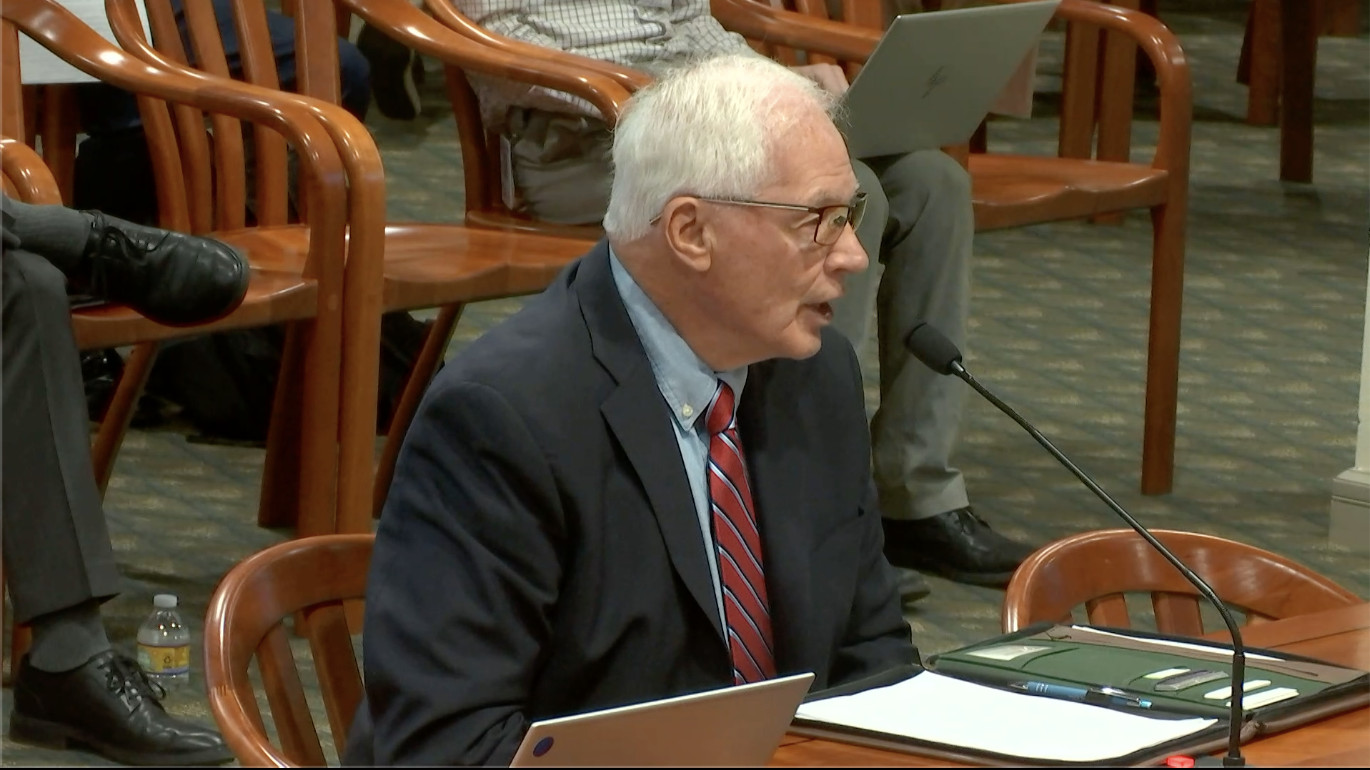
David Stevenson, who led a national campaign against offshore wind power for the Delaware-based Caesar Rodney Institute, is now fighting land-based solar and wind farms and promoting fossil fuels and nuclear power with the Michigan-based Mackinac Center for Public Policy, a group funded by the donor network of petrochemical billionaires Charles and Chase Koch.
The Caesar Rodney Institute (CRI) and Mackinac Center are both affiliated with the State Policy Network (SPN), which serves as the central hub of a 50-state network of right-leaning think tanks. SPN has long sought to derail state clean energy and climate change policies, and is funded by right-wing and corporate donors that include fossil fuel interests.
“The free-market policy approach employed by affiliated state think tanks helps to identify policies that are focused on helping all people to flourish,” SPN states in the FAQ section of its website.
SPN’s approach to energy policy contradicts its claim to promote policies based on free market principles. In 2024, SPN identified preventing states from adopting wind and solar power as one of the network’s legislative priorities. SPN further encourages politicians to pick winners and losers in the electricity sector by favoring coal, natural gas, and nuclear power.
Last year, SPN credited years of work by CRI and SPN’s Offshore Wind Working Group with laying the groundwork for the Trump administration’s efforts to halt the nation’s offshore wind boom.
Stevenson has said he resigned from his position at CRI in October over a salary dispute, after spending 14 years as Director of CRI’s Center for Energy & Environmental Policy. Stevenson landed his new job as the Mackinac Center’s Director of Energy and Environmental Policy by December. He replaced Jason Hayes, who left the Mackinac Center for the Trump-aligned America First Policy Institute.
During his first few months in Michigan, Stevenson has supported the Mackinac Center’s efforts to derail Michigan’s Healthy Climate Plan and 100% by 2040 clean energy standard, and enable fossil fuels and nuclear power to supplant renewable energy sources like wind and solar power as the Great Lakes State’s primary power sources for the future.
At the Mackinac Center, Stevenson will have at his disposal the resources of an SPN group with significantly more funding than CRI and that, unlike CRI, has received hundreds of thousands of dollars in publicly reported funding annually from Koch-led groups in recent years.
CRI reported revenue of $463,000 for 2024 in its most recent annual report to the IRS. The Mackinac Center reported revenue of over $11 million for 2024, and its lobbying arm, Mackinac Center Action, reported nearly $1.5 million in revenue.
The Kochs’ Stand Together Trust and Stand Together Fellowship organizations reported contributing close to $1.7 million to the Mackinac Center for Public Policy between 2020 and 2024.* The Koch group Americans for Prosperity contributed $550,000 to Mackinac Center Action in 2023 and 2024.
Stevenson and the Mackinac Center use their opposition to wind and solar power as leverage to push for propping up uneconomic coal plants and increasing gas and nuclear power
“Two news outlets, including Bloomberg News, declared him [Stevenson] to be the man who killed offshore wind,” Jarrett Skorup, the Mackinac Center’s Vice President for Marketing and Communications, said in an article earlier this year announcing Stevenson’s hiring.
The Bloomberg story Skorup referenced was the first to report on a policy proposal prepared by Stevenson that showed how CRI’s anti-offshore wind campaign fit into a broader policy agenda that included using the promise of emerging small modular reactor technology (SMR) as leverage for delaying the planned closure of the coal-fired Indian River power plant in Delaware.
In early January of last year, Stevenson emailed copies of a “SMR Nuclear proposal” he’d prepared for Delaware’s Governor Matt Meyer to Natalie Magdeburger, the mayor of Fenwick Island, along with a copy of a draft anti-offshore wind executive order intended for then president-elect Donald Trump. The Energy and Policy Institute obtained a copy of Stevenson’s email and the attachments through a records request to the Town of Fenwick Island.
Under Magdeburger’s leadership, the Town of Fenwick Island contributed $10,000 in taxpayer money to the CRI’s anti-offshore litigation fund, as requested by Stevenson.
“CRI is funded entirely from the voluntary contributions of individuals, foundations and corporations,” CRI says on the FAQ section of its website. “CRI neither solicits nor accepts government funding.”
State think tank affiliates of SPN must “not accept government funding,” according to SPN’s website.
The “SMR Nuclear proposal” Stevenson shared recommended that Meyer initiate a dialogue with Exelon and Delmarva Power about purchasing the Indian River coal-fired power plant in Delaware, which would close the following month. Stevenson’s proposal pointed to “headwinds” facing offshore wind, including from the incoming Trump administration, and recommended Exelon purchase the Indian River plant and eventually convert it to SMR.
“Since there is a long lead time to build SMR’s Exelon would need to operate with coal until the replacement becomes available,” Stevenson said in the proposal, which called for Exelon to sell the power from the plant to Delmarva Power, which is owned by Exelon.
Stevenson’s proposal said Delaware would also need to waive Indian Point’s compliance with the Regional Greenhouse Gas Initiative (RGGI) for the extended period when the plant would continue to burn coal. CRI has long opposed RGGI, the multi-state cap-and-trade program that’s helped reduce power sector greenhouse gas emissions in the Northeast and generated funding for energy efficiency and clean energy programs that have saved utility customers $2.7 billion as of 2023.
In 2017, Stevenson acknowledged that his consulting firm, Alternative Strategies Consulting, had worked for “utilities and large energy users” while under examination in a lawsuit where he challenged Delaware’s implementation of RGGI. Stevenson said at the time that he was required to keep the names of all of his clients confidential.
Republican state lawmakers in Delaware have since picked up on the idea of restarting the Indian River coal plant, and potentially converting it to SMR or gas. The plant’s owner, NRG, has said it closed the Indian River plant for economic reasons after two straight years of financial losses for the plant.
Earlier this year, Stevenson contributed to a report where the Mackinac Center laid out its 2026 energy policy recommendations for state lawmakers in Michigan, and called for replacing aging coal plants with nuclear, not wind and solar, power.
“… both the JH Campbell and Monroe coal-fired plants may be suitable locations for either large scale or small modular reactor units,” the Mackinac Center report said.
The report claimed that state lawmakers could save millions by delaying power plant closures, and linked to a December blog post by Stevenson defending the Trump administration’s controversial orders delaying the planned closure of the J.H. Campbell coal plant originally scheduled for May of last year. In the blog post, Stevenson pointed to a 2025 report where the Mackinac Center called for keeping the J.H. Campbell and Monroe plants running until 2040, long past their planned closure dates.
Consumers Energy, which owns the J.H. Campbell plant, has reported that the cost of complying with the Trump administration’s orders has reached $400 million. Consumers Energy is passing those costs on to electric utility customers throughout the 15-state Midcontinent Independent System Operator (MISO) regional power grid that includes Michigan. Consumers Energy had previously expected that replacing the J.H. Campbell plant with solar power and energy storage would save Michigan customers $600 million by 2040.
In March, Trump appointees at the U.S. Department of Energy and the Department of Justice cited Stevenson’s blog post in a legal brief defending the J.H. Campbell plant orders against a legal challenge by Michigan’s Attorney General Dana Nessel. Trump’s Secretary of Energy Chris Wright has issued multiple orders over the past year requiring Consumers Energy to delay closing the J.H. Campbell plant using emergency powers under Section 202(c) of the Federal Power Act.
“The Trump Administration is crying wolf over a non-existent energy emergency, while at the same time undermining every effort made to increase the efficiency, affordability, and reliability of domestic energy markets,” Nessel said last month, after Wright issued his fifth order targeting the plant for continued operation.
In his blog post, Stevenson argued that the J.H. Campbell plant should remain open at least until the Michigan Public Service Commission approves a new generation plan for Consumers Energy, and that state utility regulators should consider nuclear and natural gas as options for replacing Campbell.
The Mackinac Center wants to keep a DTE coal plant that buys petroleum coke from Koch Carbon running until 2040, rather than closing it by 2032
The Monroe coal plant is owned by DTE, which currently plans to close two of the plant’s four coal-burning units in 2028, and the remainder in 2032. DTE expects to save customers $1.4 billion by closing the plant.
Fuel receipt data compiled by the Energy Information Administration through Form 923 shows the Monroe plant buys petroleum coke from Koch Carbon, a subsidiary of Koch Industries, where Charles Koch is chairman and CEO and his son Chase is an executive vice president. Koch Carbon’s piling of petroleum coke in Detroit drew public scrutiny and protest in 2013, prompting the company to move the piles to Ohio. DTE was listed as one of the recipients of the pet coke stored at the Detroit location in Koch Carbon’s response to a request for information from the EPA’s Air Enforcement and Compliance Assurance Branch.
Stevenson and the Mackinac Center want to repeal Michigan’s landmark clean energy laws
In March, Stevenson delivered testimony in support of Michigan House Energy Committee Chair Pauline Wendzel’s “Project Lighthouse” legislation, House Bills 5710 and 5711, which would repeal Michigan’s landmark 2023 clean energy laws.
The legislation approved by Republicans in the Michigan House would slow down the “build-out of the cheapest, fastest energy, limiting Michigan’s ability to leverage federal investments and pushing the state toward more expensive, long-term fossil fuel infrastructure” if it becomes law, according to the Michigan League of Conservation Voters (LCV).
It would also remove “basic planning and reporting requirements, allowing pollution to go unreported and increasing costs as energy demand grows,” Michigan LCV said.
In his testimony in support of the legislation, Stevenson again pointed to a 2025 report prepared for the Mackinac Center by the Center for the American Experiment, a Minnesota-based SPN affiliate, and Always on Energy Research, a SPN partner. The Lignite Energy Council, a coal industry group that’s opposed 100% clean energy legislation in neighboring Minnesota, paid the Center of the American Experiment $115,000 for electrical grid and reliability modeling in 2023.
The 2025 report claimed that powering Michigan with coal, gas, large-scale nuclear, and SMR would be cheaper than transitioning to a mix of wind, solar, nuclear, and energy storage. In addition to postponing the closures of the J.H. Campbell and Monroe plants until 2040, the report called for outfitting the state’s existing coal and gas plants with carbon capture and storage (CCS). The report also claimed relying on wind, solar, and energy storage “could lead to numerous blackouts throughout the year.”
“Our study might be contested,” Stevenson acknowledged in his testimony.
SMR projects in the U.S. and globally have run into cost overruns, according to the Institute for Energy Economics and Financial Analysis. Multiple high-profile utility projects aimed at demonstrating the commercial viability of CCS for coal plants have devolved into costly economic boondoggles mired in public scandal.
Always on Energy Research has churned out similar reports for other SPN groups, including two reports focused on New England’s power grid prepared for the Americans for Prosperity Foundation and SPN groups based in Connecticut, Maine, Massachusetts, New Hampshire, and Rhode Island. The Acadia Center, an environmental group working to halve carbon emissions in the Northeast by 2030, has published rebuttals of Always on Energy Research reports on New England.
“Misleading analysis grossly inflates the cost of clean energy, selectively ignores fuel savings, and proposes highly unrealistic alternative scenarios,” the Acadia Center said of Always on Energy Research’s methodology in its latest rebuttal in January.
Stevenson received funding from SPN to lead a nuclear waste discussion group with nuclear industry contacts
Isaac Orr of Always on Energy Research noted in a presentation to state lawmakers in North Dakota in September that Stevenson had joined Always on Energy Research as the group’s Director of Nuclear Development. The presentation included a slide that listed Stevenson’s nuclear industry contacts:
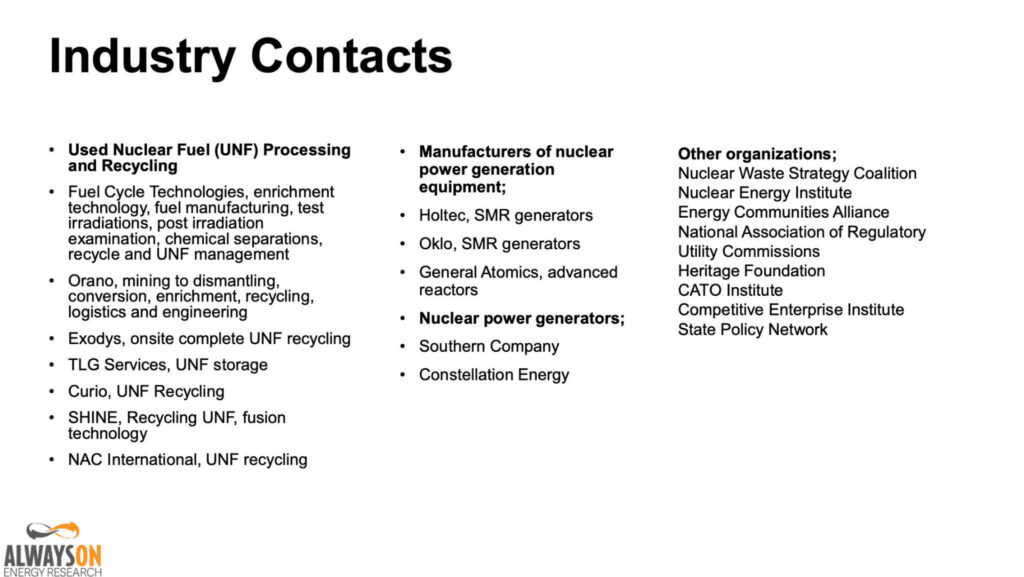
Orr’s presentation also said that Stevenson “currently chairs a discussion team to end the used nuclear fuel problem with key members of the nuclear industry, and states that may host recycling and storage through federal legislation.”
Stevenson said in an article last summer that he received a grant from SPN to form the discussion group, in which he described SPN affiliates’ work with supportive lawmakers to identify potential host-states for nuclear waste.
DonorsTrust contributed $50,000 to Always on Energy Research, $200,000 to CRI, nearly $2.9 million to the Mackinac Center, and over $9.8 million to the State Policy Network in 2024. DonorsTrust does not publicly disclose the names of its donors, but tax-exempt foundations that donate to Donor Trust are required to report those contributions publicly in their annual reports to the IRS.
Right-wing tech investor Peter Thiel’s foundation contributed $426,775 to DonorsTrust in 2024, and $1,276,111 in 2023. Thiel has backed major advanced nuclear and SMR start-ups like Oklo, Helion, and General Matters.
Stoking opposition to wind and solar farms
Last year, Stevenson sent President Trump’s political appointees to the U.S. Department of Interior a barrage of messages recommending actions the agencies could take to fulfill Trump’s campaign pledge to halt offshore wind development. EPI obtained copies of the communications through a FOIA request.
Stevenson served on Trump’s first Environmental Protection Agency transition team in 2016. The Mackinac Center has credited Stevenson’s earlier research as having “played a role” in killing the Clean Power Plan, the Obama-era EPA’s attempt to regulate greenhouse gas emissions from power plants nationally for the first time.
“Hi, I have been actively opposing offshore wind for both economic and environmental reasons since 2017, and formed a national coalition, the American Coalition for Ocean Protection, assisting a number of beach community groups organize and grow,” Stevenson said in one email sent to multiple Trump administration officials at DOI in mid-April of 2025.
Stevenson’s anti-offshore wind campaign began in Delaware with the launch of CRI’s Save Our Beach View campaign, which stoked local opposition to offshore wind projects planned off the coasts of Maryland and Delaware.
In 2021, Stevenson and CRI announced the launch of the American Coalition for Ocean Protection (ACOP) to raise money for anti-offshore wind litigation through the Ocean Environment Legal Defense Fund. Membership in ACOP included anti-offshore wind groups and SPN think tanks based along the East Coast, plus the Mackinac Center in Michigan.
The Mackinac Center has a history of opposing offshore wind power development in the Great Lakes region, but supports continued operation of Enbridge’s Line 5 oil and gas pipeline. Tribes, environmentalists, and the State of Michigan have fought for years to shut down Line 5, which runs below the Straits of Mackinac that connects Lake Michigan and Lake Huron, due the risk of a catastrophic spill.
CRI initially served as a fiscal sponsor for the anti-offshore wind group Protect Our Coast NJ.
CRI also offered to serve as a conduit to raise money for anti-offshore wind “Save the Horseshoe Crabs” ads in response to an email from Dianna Harris of Protect Our Coast Delmarva obtained from the Town of Fenwick Island.
“We are planning a zoom call next week with a wider group of about 50 people that have been paying close attention so we may raise some money then,” Stevenson said in one email to Harris.
In 2025, Stevenson and David Wojiick of the Committee for a Constructive Tomorrow served as the lead signers on a letter that called on Trump’s Secretary of the Interior Doug Burgum to revoke federal approvals for eleven offshore wind projects, including four that were already under construction. Cosigners included anti-offshore wind activists from the East and West Coasts, the Great Lakes region, and representatives of multiple SPN affiliate and partner groups.
Stevenson emailed the letter to Burgum to Trump appointees at DOI and BOEM. Laura Keehner Rigas, a White House Liaison to DOI, received a copy of the letter from Stevenson, and forwarded Stevenson’s email to four other political appointees.
“Thank you!” Deidre Kohlrus, a Senior Advisor to Burgum, responded to Rigas.
While operating out of Delaware, Stevenson signaled openness to solar and had solar panels on his roof. Upon arriving at the Mackinac Center, Stevenson quickly got to work attacking solar farms in Michigan.
“The future of electric generation is clearly nuclear, not solar, and state legislation needs to change in recognition of this reality,” Stevenson said in a January blog post for the Mackinac Center.
The Mackinac Center has for years served as a platform for promoting the views of anti-wind and anti-solar activists in Michigan, including Kevon Martis. In 2024, Martis was the public face of the Citizens for Local Choice ballot committee, which aimed to repeal a 2023 Michigan law that streamlined siting of wind and solar farms. Citizens for Local Choice failed to gather enough signatures to get the issue on the ballot, but received a $10,000 contribution from Tom Rastin, a retired gas industry executive who has bankrolled opposition to solar farms in neighboring Ohio.
“Solar projects often face resistance from local governments,” Stevenson wrote in his blog post in January.
“Recognizing local opposition, the Legislature gave the Michigan Public Service Commission authority to override local permit bans,” Stevenson said in the same blog. “Opponents to this law are attempting to repeal it through a ballot initiative.”
Citizens for Local Choice appears to be inactive, but Republican lawmakers in Michigan targeted the 2023 siting law this year as part of Project Lighthouse, as the Mackinac Center noted in another blog post.
Michigan ranked among the top 10 states for new solar additions during the first quarter of this year, according to the Solar Energy Industries Association.
* Stand Together Trust reported contributions to the Mackinac Center for Public Policy that totaled $525,000 in 2022 and $400,000 in 2023, both for general operating support, and $421,400 for 2024 for “KAP” (the Koch Associate Program). Stand Together Fellowship contributed $350,000 to the Mackinac Center for education in 2020.
Top photo is a screenshot from a Michigan House video of David Stevenson’s testimony before the Energy Committee on April 14, 2026