Pepco rate hike faces scrutiny over profits, ROE, and alleged coordinated testimony


Pepco’s latest rate hike in Maryland is drawing scrutiny from regulators and consumer advocates – not only over the size of the increase, but over the company’s profits, its parent company’s projected earnings growth, and questions about how the public process has unfolded.
In recent weeks, the case has come into focus through a series of virtual public hearings followed by days of evidentiary testimony. At issue are questions including: whether customers should fund new infrastructure like the White Flint substation, whether Pepco’s requested return on equity (ROE) is justified, and whether rising bills are aligned with the company’s financial performance.
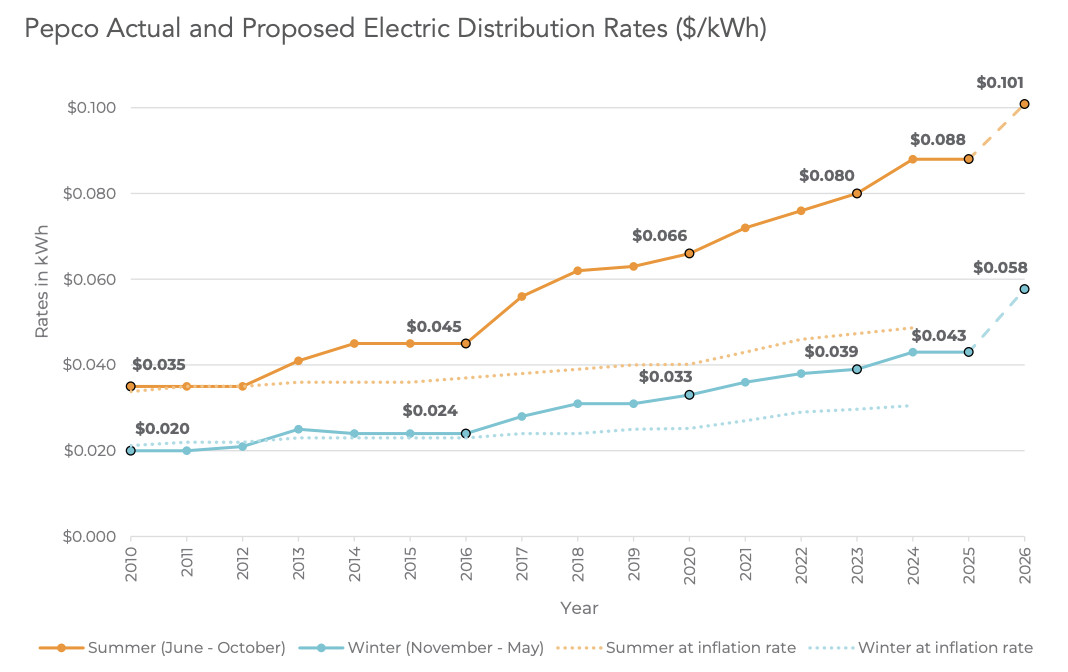
Pepco’s rate hike would increase electric distribution rates by roughly 23 percent, adding to years of increases – a cumulative rise of approximately 63 percent since 2020, and a more than doubling since 2016, which is when Pepco was acquired by Exelon Corporation.
Exelon reported nearly $2.8 billion in profits last year while Pepco, which serves customers in Montgomery and Prince George’s Counties in Maryland as well as the District of Columbia, reported $401 million in profits. Pepco’s earnings have risen by roughly $100 million, more than 30 percent, in just the past three years, continuing a steady upward trend since the Exelon acquisition.
During cross-examination in the hearings last week, the Maryland Office of People’s Counsel (OPC), a statutory agency that represents Maryland’s residential utility customers, pressed Pepco on the financial implications of the rate increase. When asked whether higher rates would increase revenue, Pepco’s Robert Leming, vice president of regulatory policy and strategy, acknowledged they would. When asked whether that could lead to higher profits, Leming said there is the potential for that to happen if the company continues managing costs effectively.
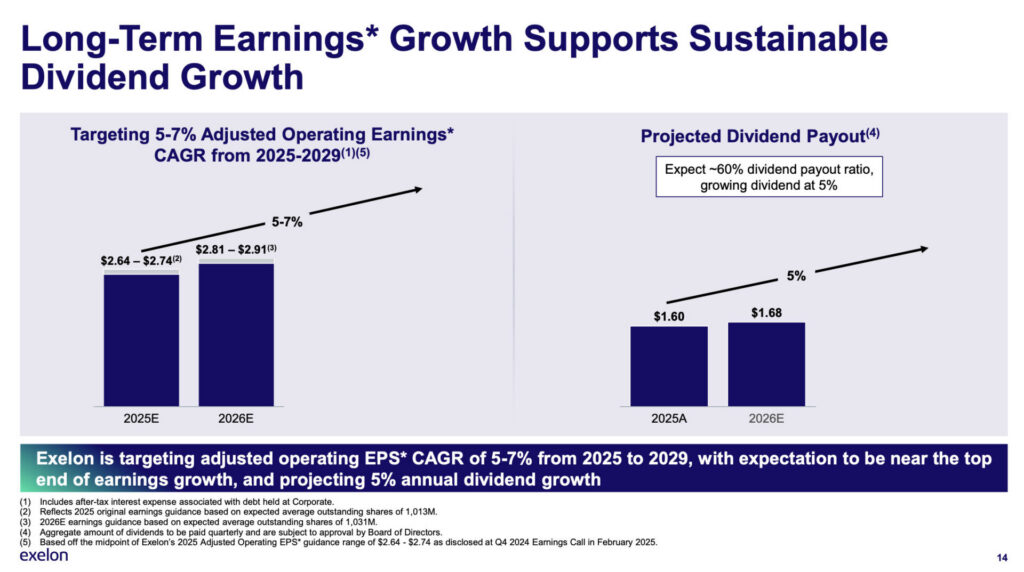
And when asked if the increase in profits will help Exelon achieve its projected higher earnings per share growth target that it has pitched to shareholders, Leming agreed that the increase in net income for Pepco will contribute to Exelon’s net income. Exelon has signaled to Wall St. plans of continued earnings and increasing dividend payouts.
Moments later during the cross examination, OPC asked if the $119 million increase in the revenue requirement is absolutely necessary after Pepco has seen its profits increase by nearly $100 million in recent years and with Exelon issuing hundreds of millions of dollars in dividends. Pepco’s Lemming answered by saying, “We do not take what is going on with customers lightly, but we ultimately need to ensure that we have a viable utility to continue to offer them service over the coming years.” The witness warned that customers would suffer in terms of reliability and understaffing at the company if it didn’t have the necessary cash flow, and ultimately there will be an increased cost to customers in the long term.
ROE debate highlights broader questions about utility profits
A key factor determining Pepco’s profits is its allowed return on equity (ROE). ROE describes the percentage return shareholders are allowed to earn on the equity they invest in the utility’s capital expenditures. Even small changes to the ROE can have significant impacts on customers’ bills over time.
Pepco hired as its ROE witness Adrien McKenzie of Financial Concepts and Applications, Inc. (FINCAP), who argued that the commission should increase the utility’s ROE from 9.5 percent to 10.5 percent. McKenzie regularly testifies on behalf of utilities and has argued for high ROEs in rate cases across the country. In just the past few months, McKenzie has recommended a 10.5 percent ROE for Black Hills Power in South Dakota, Black Hills Energy in Arkansas, Public Service Company of Oklahoma, and Kentucky Power Company; and a 10.4 percent ROE for Texas-New Mexico Power Company, and Entergy Arkansas.
In several of those cases, the utilities themselves requested lower ROEs than McKenzie recommended. Kentucky Power requested a 10 percent ROE as a compromise between rate increases and adequate investor compensation, while Entergy Arkansas requested 9.9 percent to mitigate rate increases during a period of major capital expansion and load growth.
In Maryland, McKenzie testified that Pepco’s requested 10.5 percent ROE is necessary to attract investment and maintain reliability. During the hearing, he argued that Pepco’s current 9.5 percent ROE is too low and rejected claims raised by intervenors that regulators across the country have long authorized utility ROEs above the true cost of equity.
“I think given the attention that this receives in regulatory proceedings, the volume of expert witness testimony from witnesses from various parties that are interested in the outcome, and the professionalism of regulators, I don’t believe that this is a logical position to take,” McKenzie said.
McKenzie likely aimed that comment at OPC’s ROE testimony, authored by David Garrett of the firm Resolve Utility Consulting, who argued that authorized utility returns have failed to track the actual market-based cost of capital. Garrett wrote that the cost of capital can be estimated through financial models used by firms, investors, and academics, but that “with respect to regulated utilities, there has been a trend in which awarded returns fail to closely track with actual market-based cost of capital.” The result, Garrett said, is “detrimental to ratepayers and the state’s economy.”
In other words, OPC argues that regulators have consistently approved utility returns above what investors actually require. Garrett recommended a 7.7 percent ROE for Pepco.
Other parties raised similar concerns about how utilities estimate risk and justify higher returns. The Maryland Energy Administration identified a range of 7.7 to 9.2 percent, but recommended 9 percent after accounting for the regulatory principle of gradualism – or not making large regulatory changes rapidly. The Apartment and Office Building Association of Metropolitan Washington (AOBA) recommended 9.4 percent, while Commission staff recommended keeping Pepco’s ROE unchanged at 9.5 percent.
The concern over high ROE has garnered headlines in recent months, particularly after an analysis from the American Economic Liberties Project estimated that regulators are approving excessive ROEs that cost customers approximately $50 billion per year, or roughly $300 per household annually.
When high utility ROEs are challenged, utilities often warn regulators that the investment community may view the state negatively or that credit rating agencies could downgrade the company. Commissioner Linton asked Garrett whether commissions should weigh that concern in their deliberations. Garrett argued that utilities and credit rating agencies are aligned with the same goals in mind – more revenue and less risk – and that the commission must set fair rates.
“The narrative from the utility is they present a witness like this pretty much in every case where they highlight credit ratings and things like that,” Garret said. I think for the commission it is important to understand that the utilities and the credit rating agencies are on the same side of the issue.”
“Basically they both say, ‘more money and less risk for us would be good for us.’ Well, I could have told you that, anyone can conclude that. So will they see something that goes in the other direction as negative? Of course. They want to maximize profits … Moody’s and all the others are not interested in that. So they are simply going to tell you what is in the best interest of their clients. And the companies pay the credit rating agencies so there is a conflict of interest. They are on the same side of the issue … But if you are setting fair rates, I would suggest to push back against that narrative.”
Questions emerge over Pepco’s role in supportive testimony
Before evidentiary hearings began, customers had the opportunity to weigh in during two virtual public comment sessions on April 14 and April 17. Dozens urged regulators to reject the rate increase, citing rising bills and affordability concerns. One customer spoke about their bill tripling over the years, another questioned why customers must shoulder the increase in costs while Pepco and Exelon see an increase in profits, while others expressed their worry for retirees and low income householders.
Yet throughout the two nights, some individuals joined to express support for the rate hike, generally speaking favorably about Pepco’s charitable contributions and community partnerships, or specifically asking for the recovery of costs for the White Flint Substation costs. Those who spoke in favor were individuals representing various chambers of commerce or economic development committees, charitable nonprofits, and faith leaders.
Documents obtained through OPC data requests revealed that some of the supportive testimony was encouraged by Pepco itself.
For example, Marji Graf of the Greater Rockville Chamber of Commerce was the second person to speak on April 14 and spent three minutes discussing the benefits of the White Flint substation.
Days later, Pastor Jason Jones of the Collective Empowerment Group joined the hearing to urge the regulators to approve Pepco’s rate case. Jones said, “We don’t see Pepco as just a utility provider. We see them as an anchor institution whose infrastructure investments are linked to the economic health of the almost 600,000 Maryland customers that it serves. So why are we here? The Collective Empowerment Group supports the transition to a fully forecasted test year methodology. Historically, regulatory lag meant that rates were spent on past spending. However, with the shift of Maryland’s climate goals … it’s going to require a forward looking approach.”
Jones went on to say that while the group understands that there will be “some bill impact for the average resident,” there are ways to “cushion that blow” and mentioned the utility’s customer relief fund and energy efficiency programs.
Ariana Ross of the nonprofit Story Tapestries also spoke in favor of Pepco’s rate case that night. Ross said, “I’m writing to express our support for Pepco’s fully forecasted rate case filings … the proposed filing includes investments that benefit our community, like grid modernization, resilience measures, improving reliability, reducing outages, support for low-income and vulnerable houses – including expanded bill assistance and community outreach, advancements in clean energy and beneficial electrification, and workforce development initiatives.”
During evidentiary hearings, Pepco Vice President of Governmental and External Affairs Amber Perry confirmed that the company had contacted individuals who spoke in favor on April 14. In one instance, she acknowledged Pepco provided a template letter, encouraged participation in the public hearing, and offered to affix a supporter’s signature using one already on file.
Perry further confirmed that Pepco had financially contributed to the Greater Rockville Chamber of Commerce in 2024 and 2025.
Asked by EPI whether Pepco also contacted the organizations who spoke on April 17 to request or encourage their comments, Pepco Senior Communications Manager Addie Kauzlarich provided the following statement: “Participation in public comment hearings is entirely voluntary. Individuals and organizations decide independently whether to engage and what views to express. Pepco’s outreach ahead of public comment hearings is routine and consistent with standard practice in regulatory proceedings, as reflected in our sworn testimony. Like all parties in a rate case, we engage a broad range of stakeholders to ensure they are aware of opportunities to participate in an open, transparent process.”
Collective Empowerment Group and Story Tapestries are each listed in Exelon’s “grant listing” report.
Utilities elsewhere have leaned on community and faith leaders to support their positions in front of lawmakers and regulators. EPI documented in a 2019 report how utilities use their charitable giving to manipulate politics, policies and regulation in ways designed to increase shareholder profits, often at the expense of low-income communities whose communities are more likely to bear the brunt of utility policies.
Mounting pressure across Exelon’s footprint
The outcome of Pepco’s Maryland rate case will be decided by regulators in the coming months. The issues raised – particularly rising utility profits alongside customers’ growing bills – are creating pressure for Exelon across the region.
In Pennsylvania, PECO withdrew a $510 million rate hike that included a 10.95 percent ROE request following criticism from state leaders. Governor Josh Shapiro called the proposal “pure greed.” In Delaware, the Division of the Public Advocate urged Delmarva Power to follow PECO’s move and withdraw the rate hike. In Washington, D.C., a court recently vacated Pepco’s 2024 multi-year, $123 million rate increase for 2025 and 2026, with mayoral candidates seizing on high utility bills as a political issue.
And Maryland regulators may not be done with Exelon. Baltimore Gas and Electric is expected to file a new rate case, as its current rates expire at the end of the year.