Duke Energy’s dark money backed Phil Berger’s losing primary

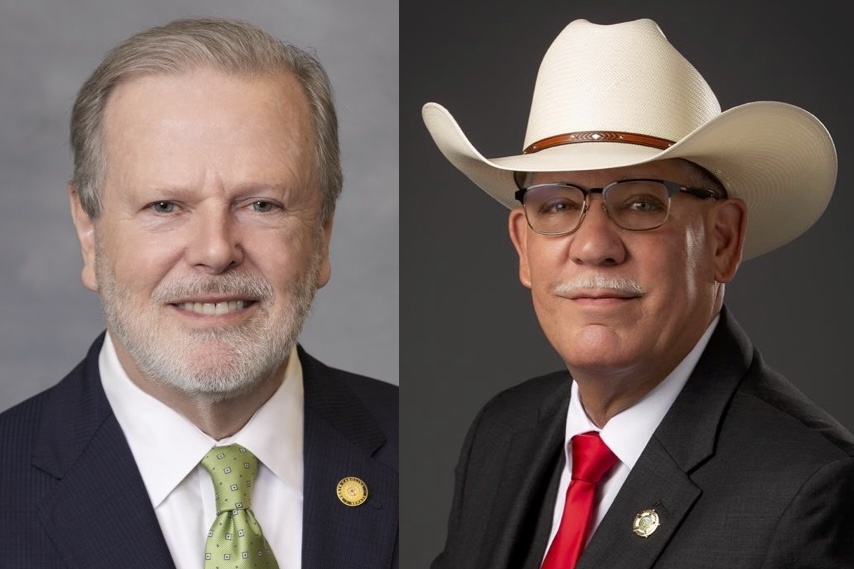
A super PAC that spent at least $333,000 on television ads supporting North Carolina Senate President Pro Tem Phil Berger’s unsuccessful primary campaign received $200,000 from a nonprofit funded entirely by Duke Energy Carolinas, the regulated utility subsidiary serving much of the Piedmont and western parts of the state.
The money trail — documented in IRS filings, NC State Board of Elections disclosures, and Duke Energy’s own corporate political expenditure reports — runs from Duke Energy Carolinas’ corporate treasury through a political nonprofit called Citizens for a Responsible Energy Future (CREF) that has been funded solely by Duke Energy, then into a super PAC launched this year by business interests to support Berger against Rockingham County Sheriff Sam Page, who won by 23 votes.
The money transfer happened in January 2026, within days of the formation of the Citizens for NC Jobs Action PAC. The super PAC shares an address down to the suite number with the NC Chamber, where Duke Energy is a top-tier “Pinnacle” member.
The spending in the Berger race, fueled by the Duke-funded CREF, came as the company has active regulatory interests in the district. In October 2025, Duke submitted its Resource Plan exploring two gas peaker plants on the Rockingham County side of its Belews Creek facility; on Jan. 8, two weeks before the PAC formed, Duke filed an interconnection study agreement for those generators with the NC Utilities Commission.
What we already knew about pro-Berger spending
The scale of outside spending in the Berger-Page primary was unheard of for a North Carolina state legislative race.
A February analysis by North Carolina campaign finance expert Bob Hall traced the dominant pro-Berger outside money — more than $2.8 million spent by NC True Conservatives — to the Republican State Leadership Committee and GOPAC, both national vehicles for corporate political spending at the state level. Duke Energy’s corporate treasury has contributed about $1.76 million to GOPAC and RSLC combined since July 2021, according to the company’s own semi-annual corporate political expenditure reports. Duke contributed $365,000 to GOPAC in 2025, and $27,500 to RSLC.
The $200,000 that Duke Energy routed through Citizens for a Responsible Energy Future to help Berger was another stream in the primary spending flow. Bryan Anderson of The Assembly reported in March that Berger’s campaign and allied groups appeared on track to spend more than $10 million on the race — an investment one political scientist called “an extreme outlier” for legislative contests that typically draw only about 20,000 voters.
The Assembly story noted the involvement in the race of Citizens for NC Jobs Action PAC, and its affiliation with the NC Chamber. However, the first-quarter disclosure revealing the PAC’s funding sources was not available when the story was published.
Duke’s vehicle: Citizens for a Responsible Energy Future
Duke Energy Carolinas has contributed $850,000 to Citizens for a Responsible Energy Future since the tax-exempt organization’s founding in 2020, according to CREF’s IRS Form 8872 filings available through ProPublica’s 527 Explorer.
Duke is the sole disclosed donor across all of CREF’s filing periods. The contributions arrived in three tranches:
- $500,000 in the first quarter of 2020 — immediately deployed by CREF into that year’s North Carolina primary.
- $150,000 in the first half of 2021 — confirmed in both CREF’s mid-year IRS report and Duke’s corporate political expenditure report for the period.
- $200,000 in the second half of 2023 — confirmed in both CREF’s end-of-year IRS report and Duke’s corporate political expenditure report.
The 2023 contribution sat mostly untouched for two years. CREF’s records show only $2,573 spent in all of 2024 and $5,627 in 2025 — maintenance-level activity. Then, in late January 2026, the $200,000 moved.
CREF is led by Scott Gardner, identified in IRS filings as the organization’s sole officer of record, serving simultaneously as president, director, secretary, and treasurer. Gardner is a former Duke Energy regional director for state government affairs.
Gardner co-founded the group with Antonio “Tony” Almeida, who spent more than 30 years at Duke Energy, ultimately serving as vice president of economic development and later as an economic advisor to Republican Gov. Pat McCrory. Almeida died in 2025.
Reached for comment, Duke Energy defended its use of 527 groups and minimized its role in the spending vehicles.
“The company contributes to various 527 organizations, all of which are disclosed both through the organizations’ required reporting and on the company’s website,” said spokesperson Bill Norton. “However, those organizations are independent, and the way they operate is also independent from their donors. The costs are fully funded by shareholders in accordance with the law.”
The destination: Citizens for NC Jobs Action PAC
Citizens for NC Jobs Action PAC was organized on Jan. 22, 2026, according to its NC State Board of Elections (NCSBE) registration — a week before it got the contribution from the Duke Energy-funded Citizens for a Responsible Energy Future. The PAC’s treasurer is Jake Cashion, vice president of government affairs for the NC Chamber, and its assistant treasurer is Collin McMichael, whose email domain belongs to CM&Co, a political consulting and compliance firm. The firm appears as an expenditure recipient in CREF’s own IRS filings for both 2021 and 2023.
The PAC opened a checking account at Truist Bank, and within days of its formation received its first contribution. On Jan. 29, 2026, CREF transferred $200,000 to it by check. This transaction is documented in both CREF’s 2026 IRS Form 8872 and the PAC’s first-quarter 2026 disclosure report to the NCSBE.
That disclosure shows total receipts of $515,000, with four contributions in all. Besides the donation from the Duke Energy-funded CREF, there’s another $200,000 from Citizens for NC Jobs, a 501(c)(4) nonprofit that also uses the NC Chamber’s Raleigh address. Last year the nonprofit ran a direct mail campaign pressuring Democratic legislators ahead of the veto override vote on Senate Bill 266, legislation that repealed Duke Energy’s near-term climate goals and made it easier for the company to require customers to pay in advance for expensive new projects. The bill ultimately became law with key Democratic support.
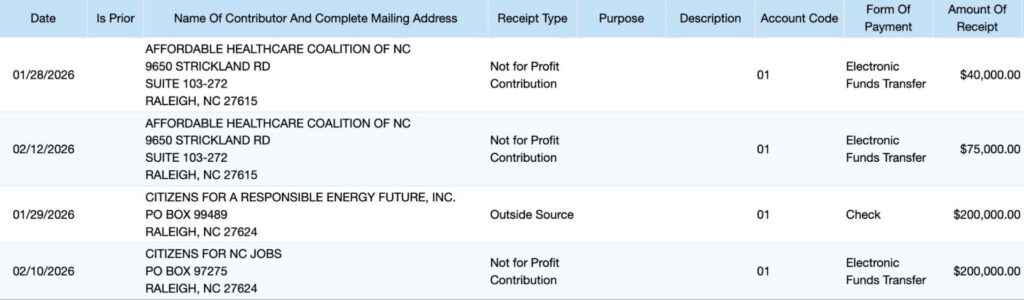
The pro-Berger PAC also got two contributions from the Affordable Healthcare Coalition of North Carolina, for a total of $115,000. That group describes itself as a statewide nonprofit focused on lowering health care costs in North Carolina. Its board of directors includes Gary Salamido, president and CEO of the NC Chamber, as well as representatives of Blue Cross Blue Shield of NC, NC Association of Health Plans, the NC Farm Bureau, and FastMed, one of the state’s largest urgent care providers.
NCSBE records show Salamido contributed $1,800 personally to Berger’s campaign committee on Jan. 10, 2026 — 12 days before Citizens for NC Jobs Action PAC was formed.
Duke PAC also helped Berger
The corporate spending through Citizens for a Responsible Energy Future is separate from Duke Energy’s employee PAC activity, which is disclosed through the Federal Elections Commission (FEC). Duke’s PAC has contributed more than $1.4 million to North Carolina state legislative candidates and caucuses since the 2021-2022 election cycle, according to FEC Schedule B disbursements and NCSBE records.
Duke’s PAC contributed directly to Phil Berger’s campaign committee six times between April 2022 and September 2025, totaling $30,800 in net contributions. The most recent contribution, $6,800 in September 2025, was the maximum amount permitted under North Carolina law. Berger was one of the PAC’s top recipients in the state over the period. EPI’s review of FEC records found no contributions from Duke’s PAC to Page’s campaign.
Duke Energy CEO Harry Sideris also contributed personally to Berger’s primary campaign, according to NCSBE records. On Feb. 11, 2026, about two weeks after CREF transferred $200,000 to Citizens for NC Jobs Action PAC, Sideris gave the maximum legal individual contribution of $6,800.
(Source note: This analysis draws on IRS Form 8872 filings, NC Secretary of State incorporation records, NC State Board of Elections disclosure reports, FEC Schedule B disbursements, and Duke Energy’s voluntarily published semi-annual Corporate Political Expenditure Reports. EPI has tracked Citizens for a Responsible Energy Future since 2020 as part of its ongoing research into utility industry front groups.)