Pro-Husted Super PACs received $2 million this year from 501(c)(4) groups once secretly funded by FirstEnergy


Super PACs backing Republican incumbent Jon Husted in Ohio’s U.S. Senate races received $2 million this year from two 501(c)(4) groups that FirstEnergy secretly funded during the 2018 elections to support Republican candidates for Senate and Ohio Secretary of State.
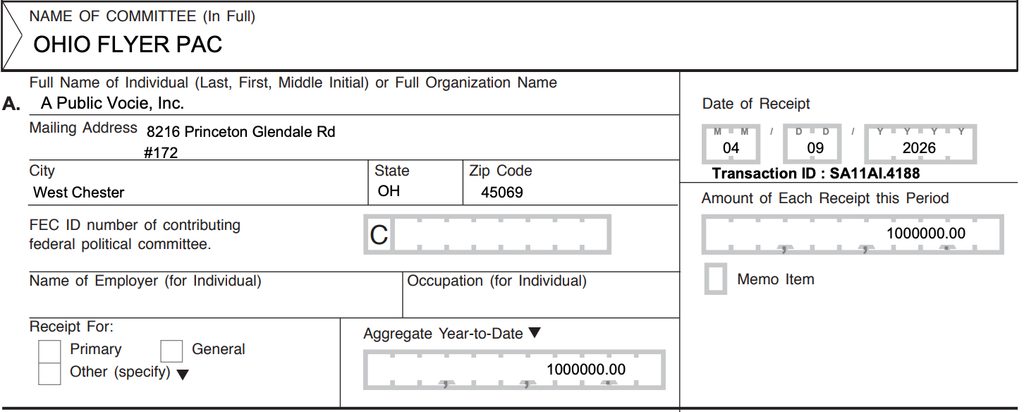
The Ohio Flyer PAC, which has spent millions of dollars in 2026 on ads supporting Husted and opposing his Democratic opponent Sherrod Brown, received $1 million from A Public Voice, Inc. in April. The SLF PAC, which has spent hundreds of millions of dollars supporting Husted and other Republicans for the U.S. Senate, received $1 million from the American Policy Coalition.
Internal FirstEnergy documents first made public in 2024 show FirstEnergy paid $115,000 to A Public Voice in 2018 with “Renacci” listed as the “Reason” for the money. Republican Jim Renacci mounted a failed bid that year to replace Brown as one of Ohio’s two U.S. Senators. Brown won re-election before losing his Senate seat to Republican Bernie Moreno in 2024 and is now running to replace Husted. Gov. Mike DeWine appointed Husted to replace Vice President J.D. Vance in the Senate in 2024, after Husted had served as DeWine’s lieutenant governor since 2019.
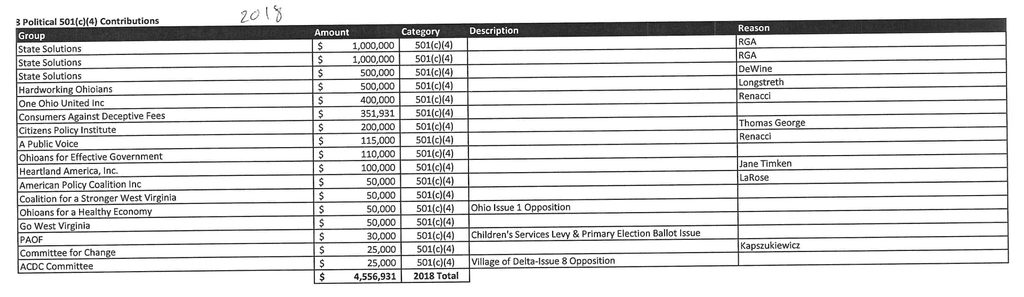
The documents also show FirstEnergy paid $7,500 to the American Policy Coalition in 2017, and $50,000 to the same group in 2018 with “LaRose” listed as the “Reason” for the contribution. Republican Frank LaRose was elected as Ohio’s Secretary of State in 2018, a position responsible for administering Ohio’s elections and overseeing compliance with the state’s campaign finance laws. LaRose is now running for State Auditor.
The Public Utilities Commission of Ohio (PUCO) and Ohio Consumers Counsel (OCC) obtained these and voluminous sets of other internal records from FirstEnergy through discovery in four PUCO cases that involved more than five years of on-and-off investigation into FirstEnergy’s multi-million dollar bribery and corruption schemes in Ohio. In January, FirstEnergy agreed to pay $275 million in ratepayer refunds and fines to settle those cases. The settlement came after the PUCO found that FirstEnergy violated Ohio law and mischarged customers.
The PUCO and OCC first released the documents that revealed FirstEnergy’s payments to A Public Voice and the American Policy Coalition in 2024 in response to Open Records Law requests from the Energy and Policy Institute and journalists. Info about the relatively small payments FirstEnergy made to the two groups has gone largely overlooked before now, as public attention focused on new details that emerged from PUCO and OCC’s document releases about millions of dollars in once-secret payments FirstEnergy made to 501(c)(4)s aligned with Husted and DeWine, as well as other prominent elected officials like Donald Trump in 2017-2020.
A Public Voice and the American Policy Coalition are part of a broader network of 501(c)(4) groups that had already contributed $33.1 million to Super PACs during the current election cycle as of August, as the nonprofit government watchdog group Citizens for Responsibility and Ethics in Washington (CREW) first reported. The groups are connected through their ties to the Clark Fork Group and Cap Square Solutions, two Ohio-based Republican political consulting firms long known for their roles in perpetuating the use of dark money in elections, as campaign finance journalist Robbie Jaeger recently detailed on his PolitiFi Substack.
“Since the nonprofits, which are organized under section 501(c)(4) of the tax code, can spend money on elections without disclosing their donors, the true source of the funds remains secret,” Matt Corley, chief investigator for CREW, wrote in CREW’s article from August. “This lack of disclosure is why such politically-active nonprofits are commonly referred to as dark money groups.”
FirstEnergy secretly paid $1 million to Freedom Frontier in May of 2017 to support Husted, who at the time was Ohio’s Secretary of State and a contender for the Republican nomination for governor. CREW has described Freedom Frontier as part of the same dark-money network as A Public Voice and the American Policy Coalition. Freedom Frontier paid $120,000 to Cap Square Solutions in 2017 and $121,000 to the Government Integrity Fund, another 501(c)(4) helmed at the time by Joel Riter of the Clark Fork Group. Freedom Frontier dissolved in November of 2018, after the election was over and CREW filed a complaint with the IRS alleging the 501(c)(4) violated the tax code.
In 2021, FirstEnergy admitted as part of a deferred prosecution agreement with federal prosecutors that it secretly paid $60 million in bribes between 2017 and 2020 to influence the Republican Speaker of the Ohio House, Larry Householder, and secure a since-repealed $1 billion ratepayer bailout through Ohio’s House Bill 6 in 2019. The money was routed through 501(c)(4)s to conceal FirstEnergy’s role in funding Householder’s criminal operation.
FirstEnergy also agreed to report quarterly on its contributions to 501(c)(4)s and other “entities known by FirstEnergy to be operating for the benefit of a public official” as part of the agreement. FirstEnergy last updated that reporting in August, and it has not reported making contributions to any of the 501(c)(4)s mentioned in this article since that reporting began in 2021. Where exactly A Public Voice and the American Policy Coalition got the money they contributed this year to the Ohio Flyer PAC and SLF PAC remains a mystery.
Householder is now serving a 20-year prison sentence for his role in the H.B. 6 scheme, after being convicted of racketeering at a separate trial in 2023. Generation Now, a 501(c)(4) controlled by Householder, pleaded guilty earlier on in that case, as did Householder’s chief political operative Jeff Longstreth. Prosecutors had recommended that a 16-to-20 year prison sentence for Householder would serve as a needed deterrent to further corruption in Ohio.
“Here, the [Householder] enterprise used a 501(c)(4) to fund Householder’s political rise, as recommended by FirstEnergy, because it was the ideal mechanism for receiving unlimited and unreported payments—in other words, a 501(c)(4) is the perfect vehicle for bribery,” prosecutors said in a sentencing memo filed in the Householder case. “This is important because the trial evidence referenced multiple other public officials in Ohio who were coordinating with and using 501(c)(4) entities to receive financial payments.”
“And yet, despite the jury’s verdict in this case, 501(c)(4)s remain a tool for Ohio politicians to receive unlimited payments – which are hidden from the public’s view – and potential vehicles for bribery,” prosecutors also said in the memo.
The millions of dollars that FirstEnergy secretly paid to 501(c)(4)s to support DeWine and Husted during the 2018 election have come back to haunt Husted this year, as the subject of ads from Brown campaign and Democratic and environmental groups. In March, Husted testified as a defense witness at the state criminal trial of FirstEnergy’s former CEO Charles Jones and top lobbyist Michael Dowling, which ended in a hung jury.* Jones and Dowling face a second state trial in 2027 and a federal criminal trial after that.
Aside from FirstEnergy, Jones, Dowling, Householder, Longstreth, and Generation Now, none of the individuals or entities mentioned in this article have been charged with a crime.
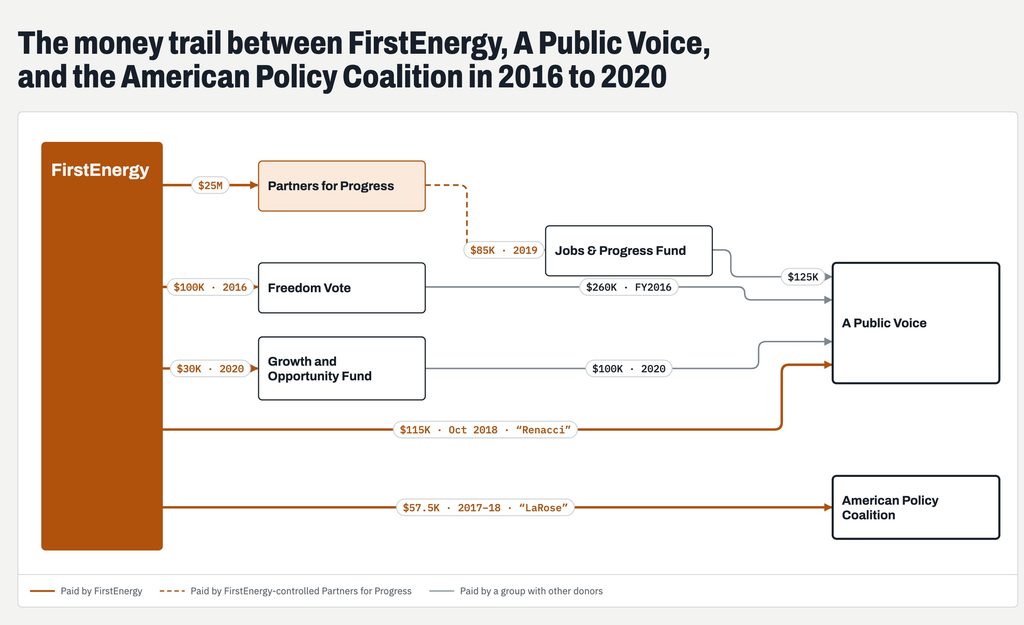
FirstEnergy contributed $115,000 to A Public Voice, and also contributed money to other 501(c)(4)s that gave money to A Public Voice between 2016 and 2020
Federal Super PACs had reported receiving over $2.1 million in contributions from A Public Voice this election cycle by the end of July, according to contributions data from the Federal Elections Commission. The Ohio Flyer PAC reported receipt of a $1 million contribution in April from “A Public Vocie, Inc.” [sic].
Working papers from a 2024 PUCO audit of FirstEnergy’s political and charitable spending show the $115,000 FirstEnergy contributed to A Public Voice to support Renacci was paid in two installments in October of 2018. The first payment for $100,000 was posted on October 10, and the second for $15,000 posted two days later on October 12. Those details are not mentioned in the PUCO’s public-facing audit report, which does not mention the $115,000 FirstEnergy paid to A Public Voice. EPI had to file a records request to obtain copies of the audit working papers from the PUCO.
Renacci, who in 2018 represented Ohio’s 16th District in Congress, launched his failed bid to replace Brown in the Senate that January, after initially running in the Republican primary for governor.
A Public Voice later reported that it paid $295,000 to MeToo Ohio, a Super PAC that supported Renacci, on its annual report to the IRS for 2018. MeToo Ohio reported to the Federal Election Commission that it spent a total of $129,000 on independent expenditures opposing Brown on October 12 and October 15, 2018.
“From Renacci 5 minutes ago,” Jones texted Dowling a few days earlier on October 4. “Chuck…..thank you for having Dowling reach out to Tom Whatman….I truly appreciate your help and need your support in a big way.”
Whatman is the Chief Strategist for Majority Strategies, a GOP consulting firm employed by MeToo Ohio and the Renacci campaign, according to a complaint the Campaign Legal Center filed with the FEC that November.
“MeToo Ohio has made illegal, excessive, and unreported in-kind contributions to Renacci for U.S. Senate by financing coordinated communications through the use of a common vendor, Majority Strategies, LLC,” the complaint alleged.
Text messages sent to Jones by Dowling on October 9 also mentioned “the $100,000 for Renacci.”
In 2021, Renacci called for an investigation of FirstEnergy’s spending in support of DeWine during the 2018 election. Renacci was running for governor against DeWine in the Republican primary at the time.
In addition to the $115,000 FirstEnergy directly contributed to A Public Voice in 2018, the utility also gave money to other 501(c)(4) groups that funded A Public Voice between 2018 and 2020.
In 2020, FirstEnergy paid $30,000 to the Growth and Opportunity Fund, according to the working papers from the PUCO audit. The Pennsylvania-based 501(c)(4) later reported to the IRS that it contributed $100,000 to A Public Voice that year.
A 501(c)(4) named Partners for Progress that was funded and controlled by FirstEnergy contributed $85,000 to the Jobs & Progress Fund in 2019, bank statements prosecutors presented as evidence during Householder’s trial show. The first installment came in the form of a cashier’s check for $50,000 dated June 4, 2019. The Jobs and Progress Fund reported to the IRS that it paid $50,000 to A Public Voice on its Form 990 for that fiscal year. The second installment of $35,000 was paid on October 30, 2019, and the Jobs and Progress Fund reported it gave $75,000 to A Public Voice that fiscal year.
FirstEnergy agreed to the forfeiture of nearly $6.5 million in Partners for Progress assets as part of its 2021 agreement with federal prosecutors.
“FirstEnergy Corp. hereby acknowledges that the subject property constitutes or is derived from proceeds traceable to conspiracy to commit honest services wire fraud…” the agreement said of the forfeited Partners for Progress funds, before it pointed to a statement of facts that FirstEnergy admitted to as part of the agreement.
The statement of facts described how Partners for Progress funnelled $15 million of the $25 million in funding it received from FirstEnergy into Householder’s Generation Now.
The Jobs and Progress Fund dissolved in 2021, several months after CREW filed a complaint against the group with the FEC. The name of Tom Morris, the founder of Cap Square Solutions and co-owner of the Clark Fork Group, appeared as the president of the Jobs and Progress Fund on the 501(c)(4)’s initial annual reports to the IRS covering 2012 to 2014, the group’s initial years of operation.
In August 2016, FirstEnergy contributed $100,000 to a 501(c)(4) named Freedom Vote, the working papers from the 2024 PUCO audit also revealed. Freedom Vote reported to the IRS that it contributed $260,000 to A Public Voice on its Form 990 for that fiscal year. Freedom Vote dissolved in 2019, after CREW filed multiple complaints against it and the group was the subject of an FEC investigation and IRS audit.
FirstEnergy contributed $57,500 to the American Policy Coalition in the 2018 cycle to support Frank LaRose, Ohio’s current Secretary of State and a candidate for State Auditor
The American Policy Coalition has contributed over $2 million to Super PACs during the 2026 elections, $1 million of which went to the SLF PAC in June. NBC News reported earlier this month that the SLF PAC’s spending in support of Husted had reached $93 million.
FirstEnergy contributed a total of $57,500 to the American Policy Coalition in 2017 and 2018, according to the PUCO’s audit report on FirstEnergy’s HB 6-related political spending. The audit report said that the total included $7,500 contribution made in 2017 to support Republican Frank Larose for Secretary of State, and $50,000 paid in 2018 that FirstEnergy represented to the auditors “was for a sponsorship related to state legislative affairs advertising and marketing.”
The PUCO’s audit report concluded FirstEnergy “contributions to American Policy Coalition, Inc. appear to have been made in support of LaRose’s campaign for Ohio Secretary of State.”
LaRose’s cousin Ben LaRocco and Riter of the Clark Fork Group emailed with FirstEnergy lobbyist Joel Bailey in 2017 to request FirstEnergy support LaRose through a contribution to the American Policy Coalition. Bailey was “separated” from FirstEnergy in 2021 for his involvement with Householder, Generation Now, and Partners for Progress.
“Finally, as requested I’m passing along the name of the 501(c)4 [sic] organization that engaged in activity in 2016 in support of issues important to the coal industry,” Riter wrote to Bailey at FirstEnergy in one email from November of 2017. “That organization is called Citizens for a Working America.
In Householder’s racketeering case, prosecutors detailed how $400,000 of the money paid by FirstEnergy to support Householder during the 2018 election was routed through two 501(c)(4)s, One Ohio United and Citizens for a Working America. The money ultimately landed at the Hardworking Americans Super PAC, which paid for ads that alleged Householder’s Republican primary opponent Kevin Black was “bankrolled by dark money special interests.”
Riter was listed as the president of Citizens for A Working America on both of the groups’ annual reports to the IRS for the fiscal years that included portions of 2018.
Citizens for a Working America dissolved in September of 2020, about two months after the federal criminal complaint against Householder was first made public. The group disclosed on its last Form 990 that the dissolution included distribution of just over $125,000 in assets that month to organizations with tax ID numbers that matched those of the American Policy Coalition and A Public Voice.
*The author also testified at Jones and Dowling’s trial in February as a witness called by the prosecution
Top photo by Tracy O via Flickr. Creative Commons Attribution-Share Alike 2.0 Generic.