Utility money to political groups hits a record, led by NextEra’s $2.5 million check

Utility companies and their trade associations have contributed $12.7 million to seven major partisan political groups focused on state-level races so far this year. It is the largest amount of money utilities have contributed in any year to the seven political groups – known as “527s” – according to an Energy and Policy Institute analysis of IRS filings dating back to 2002. The previous record was $11 million, set in 2025. The 2025-2026 cycle also set a record at $23.7 million, surpassing the previous cycle’s $18.9 million. Fourth-quarter data, which usually brings even more utility donations, has yet to be reported.
What are 527 political groups?
The partisan groups include the Republican Governors Association (RGA), Republican Attorneys General Association (RAGA), Republican State Leadership Committee (RSLC), GOPAC, Democratic Governors Association (DGA), Democratic Attorneys General Association (DAGA), and Democratic Legislative Campaign Committee (DLCC).
These seven groups are political organizations known as “527s,” and can raise and spend unlimited funds to influence elections, including gubernatorial elections, attorneys general races, and state legislative campaigns. The elected officials who hold those offices determine policies that shape a utility’s bottom line. Governors appoint the utility regulators on the Public Utility Commission (PUC) in 38 states. Attorneys general often intervene in rate and merger cases. Legislatures write the laws that PUCs implement and enforce, impacting utility business operations.
NextEra leads in giving to 527 groups this year
NextEra Energy leads the utility industry in giving to the seven groups so far this year with $4.26 million, well above its previous high of $2.57 million in 2018. No utility parent company has given more in a single year, according to EPI’s database.
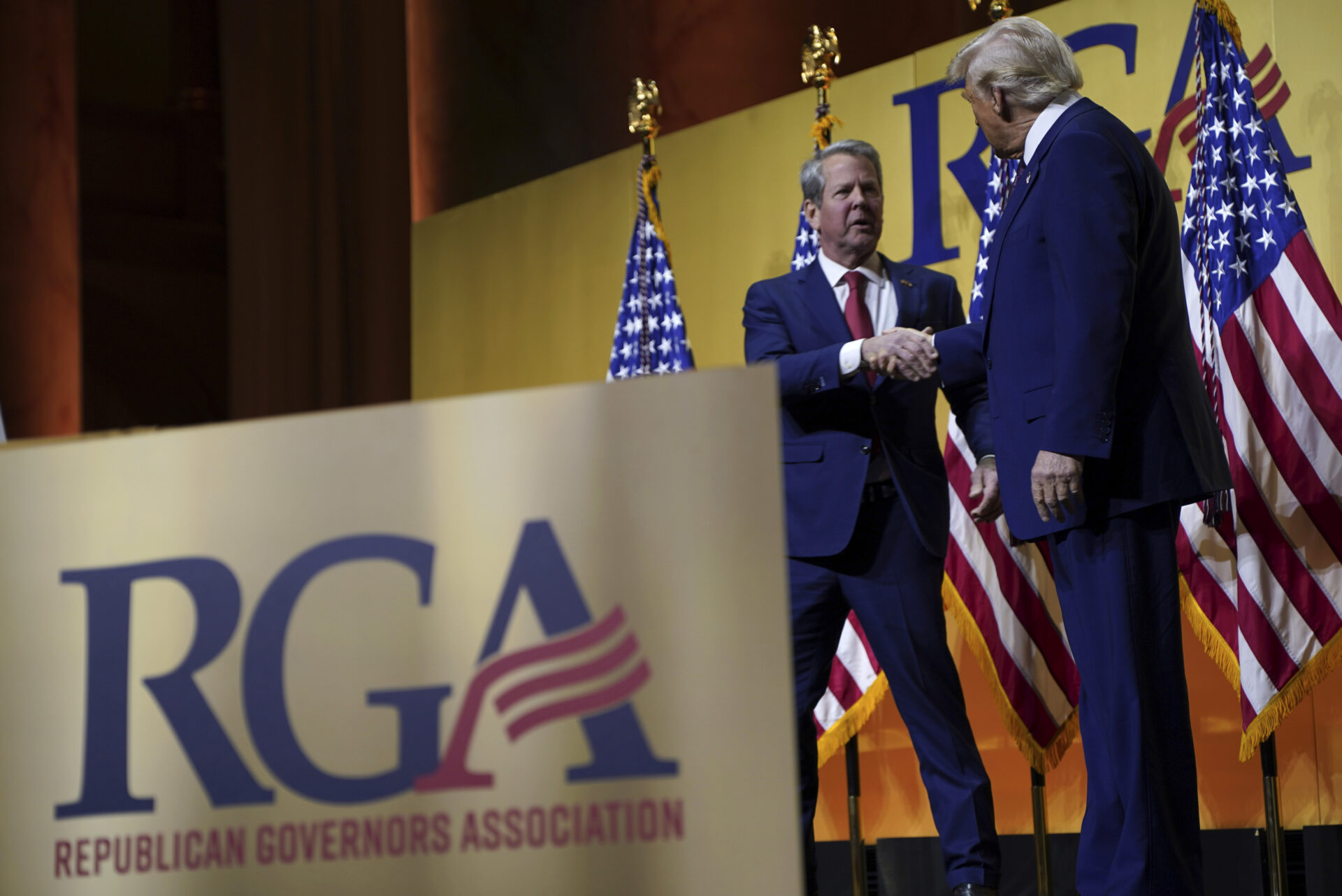
Most of that came in one check: a $2.5 million donation to the Republican Governors Association on September 21 from its Florida subsidiary, Florida Power & Light. It was the largest single contribution RGA has received from any company since at least 2023, and the largest from a utility to any of the seven groups in EPI’s database, which goes back to 2002.

NextEra has a lot riding on two political decisions: who becomes Florida’s next governor, and whether regulators approve its acquisition of Dominion Energy. Florida’s governor appoints FPL’s regulators to the Public Service Commission from a list vetted by a nominating council. In November 2025, the PSC approved FPL’s $6.9 billion, four-year rate hike settlement, the utility’s third increase since 2021 and likely the largest in U.S. history.
But most pressing for NextEra is its attempted acquisition of Virginia-based Dominion. Virginia’s and South Carolina’s regulators are scheduled to rule separately in January 2027. Virginia Democratic Governor Abigail Spanberger has intervened in Virginia and recently recommended that regulators reject the merger unless the companies agree to a six-year rate freeze on residential base rates and triple their promised monthly credits for customers. Virginia Democratic Attorney General Jay Jones and Lt. Governor Ghazala Hashmi also spoke out against the merger. The commission’s staff recommended rejecting the merger as proposed.
In South Carolina, House Speaker Murrell Smith and Senate President Thomas Alexander, both Republicans, have petitioned to join the case in their state. South Carolina’s attorney general, Alan Wilson, is the Republican nominee for governor. Wilson recently released an affordability agenda that includes lowering utility rates and holding energy companies accountable.
Dominion Energy is the second-largest utility donor this cycle, with $3.77 million through September, its most in any cycle. Part of that reflects Virginia’s 2025 elections for governor, attorney general, and the House of Delegates, when Dominion gave $2.35 million. But Dominion has increased its giving in even years too. Its giving jumped in 2019, the year it acquired SCANA and expanded its business in South Carolina.
Both Virginia and South Carolina legislatures elect the utility regulators. NextEra contributed $965,000 to RSLC, $281,000 to GOPAC, and $75,000 to DLCC this cycle while Dominion has given RSLC $450,000 and GOPAC $475,000.
Other large monopoly utilities, along with large independent power producers and the industry’s trade group, the Edison Electric Institute, are also top contributors this cycle.
Avangrid’s giving has increased in recent years
Avangrid, the parent company of Central Maine Power, New York State Electric & Gas, Rochester Gas and Electric, and Connecticut’s United Illuminating, and itself owned by Spain’s Iberdrola, contributed $1.29 million to the seven 527 entities this cycle. More than half went to DGA ($685,000). The rest went to RSLC ($205,000), RGA ($200,000), and DLCC ($200,000). That’s up from $55,000 in the 2017-18 cycle and nothing in the 2019-20 cycle.
The increase coincides with the utility’s fights with public officials and backlash to high bills across its service territory. Avangrid spent years attacking former Connecticut Public Utilities Regulatory Authority Chair Marissa Gillett over her attempts to institute new mechanisms to hold utilities accountable and reduce rates, while also facing a legislature and Democratic Attorney General William Tong focused on rate hikes and unnecessary spending.
Voters in Maine rejected a ballot initiative to buy CMP and Versant Power in 2023 and create a consumer-owned utility run by an elected board, but they have remained frustrated with high bills. Similarly, in New York, elected officials urged regulators to rein in NYSEG’s rate hike earlier this year.
More utility money flowing to Democratic groups; Republicans still take more
Utility contributions to the three Democratic groups (DGA, DAGA, and DLCC) reached $3.9 million through September, more than at this point in 2025 or 2024. The groups received a combined $8.8 million this election cycle, already surpassing any previous cycle. Dominion nearly tripled its giving to Democratic groups, to $1.49 million from $500,000 last cycle. Southern Company nearly doubled its contributions, from $355,000 to $645,675. Pinnacle West, the parent company of Arizona Public Service, went from $50,000 to $290,000 this cycle.
Republican groups still take far more from utilities. RGA, RAGA, RSLC, and GOPAC have received $14.9 million from utilities this cycle – up 34% from $11.1 million last cycle.
GOPAC receiving more utility money
GOPAC, a Republican group focused on state legislators, received $92,500 from utilities in 2018. That amount has risen almost every year – reaching a record $1.08 million so far this year. The top contributors in 2026 include: Pinnacle West ($255,000), the parent company of Arizona Public Service, Duke Energy ($250,000), Dominion ($200,000), and NextEra Energy ($171,000).
A Washington Post investigation from August, citing EPI records, revealed how GOPAC, which describes itself as “the Republican Party’s premier organization for educating and electing a new generation of leaders,” launched the Regulators Roundtable. This little-known organization connects Republican state utility commissioners with companies and trade associations that have interests before the regulators, and raises money from those companies and groups.
Since 2025, the Regulators Roundtable has built a network of entities, including a political action committee to defend Republican commissioners in elections and an affiliated media platform that publishes utility and energy-related articles and op-eds. It has organized private meetings between regulators and corporate “investors,” helped commissioners communicate with the Trump administration, drafted policy comments, provided political and communications training, and advanced the interests of incumbent fossil generators and monopoly utilities.
Data: EPI’s full dataset of utility contributions to the seven groups, updated weekly from IRS filings, is available on GitHub. Charts and a searchable table are on EPI’s 527 contributions page. The IRS filings are also accessible at ProPublica’s 527 explorer page.