Six Ohio utilities contributed $2 million to DGA and RGA as Amy Acton and Vivek Ramaswamy campaigned on lowering energy bills

Six of Ohio’s largest investor-owned electric and gas utilities contributed more than $2 million to the Republican Governors Association and Democratic Governors Association since January of last year, in an election cycle where Republican Vivek Ramaswamy and Democrat Amy Acton have both campaigned on lowering energy bills for Ohioans if elected as governor.
The six utilities are American Electric Power, AES, CenterPoint, Duke Energy, NiSource, and Vistra Corp. The Energy and Policy Institute reviewed contributions the utilities made to DGA and RGA using ProPublica’s 527 Explorer for this analysis.
Ninety-four percent of Ohio voters view energy costs as an extremely or somewhat important issue, a recent poll by EMC Research conducted for the Ohio Environmental Council found.
With polls showing a tight race between Acton and Ramaswamy, DGA and RGA will likely heavily target Ohio with election spending between now and November, much as the groups did in last year’s hotly contested governor’s races in New Jersey and Virginia. DGA attributed Democratic wins in New Jersey and Virginia to the candidates being “laser-focused” on affordability issues, including lowering energy costs.
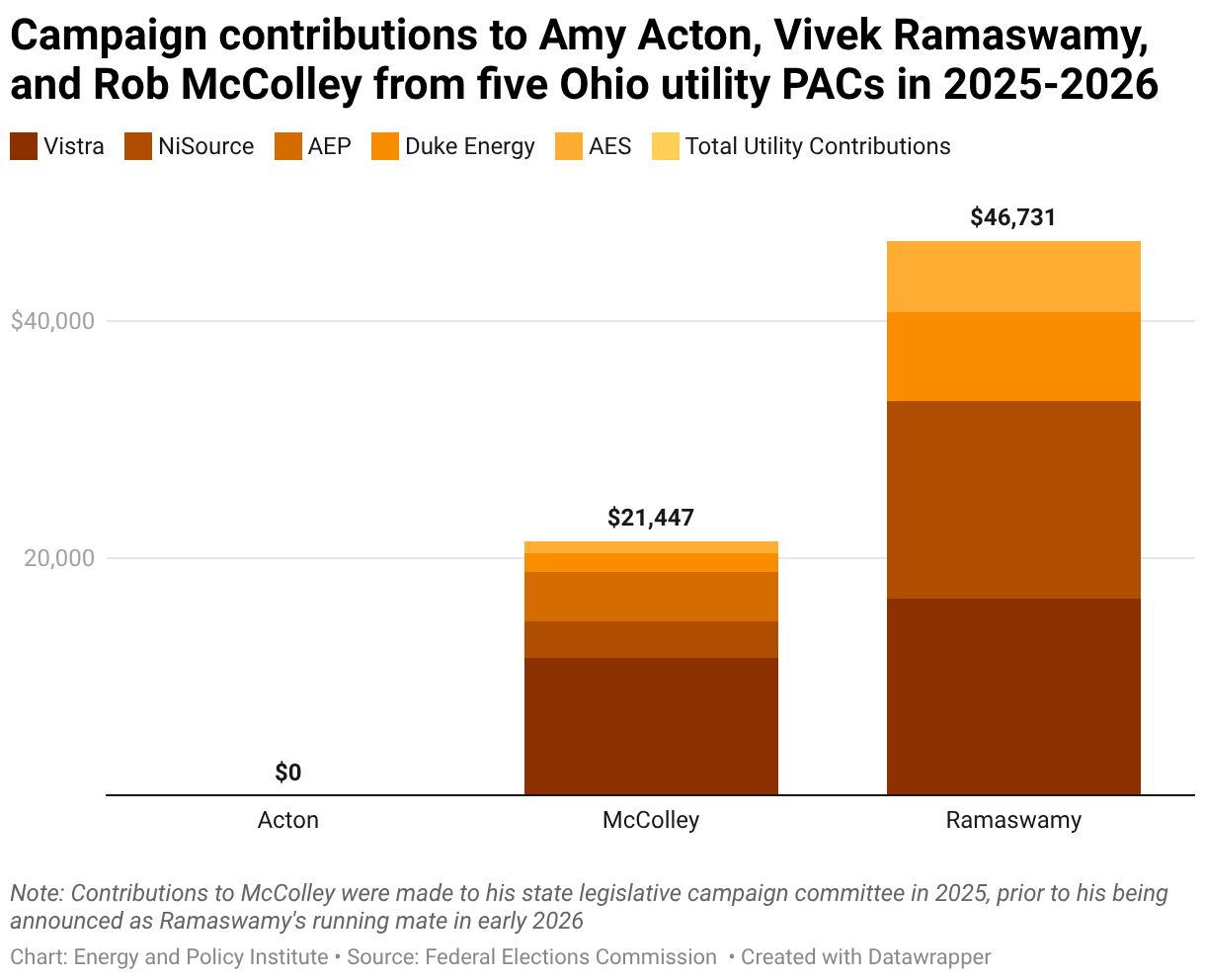
Corporate PACs for five of the six utilities also gave over $68,000 directly to the campaigns of Ramaswamy and/or his running mate, Ohio Senate President Rob McColley, since January of 2025. Acton’s campaign received zero dollars from the utilities’ PACs.
Ohio law limits the amount that PACs can contribute to statewide candidates to $16,615.67 per election cycle. DGA and RGA are exempt from Ohio’s campaign contribution limits as 527 political organizations, enabling donors to make unlimited contributions, which the groups are required to publicly report in quarterly filings with the IRS. The two groups often influence elections through spending by affiliated Super PACs that must disclose their donors in public filings with the Federal Elections Commission, and by affiliated 501(c)(4) political nonprofits that are not required to publicly list their donors in their annual reports to the IRS.
Ohio’s incumbent Governor Mike Dewine, a Republican, is term-limited and not seeking re-election. DeWine was first elected governor in 2018, with the help of millions of dollars in secret utility money that flowed through one of RGA’s 501(c)(4) affiliates, State Solutions Inc. Evidence documenting the full extent of utilities’ support for DeWine during the 2018 election only began to surface years later, and has left DeWine’s legacy tainted by Ohio’s House Bill 6 utility corruption scandal.
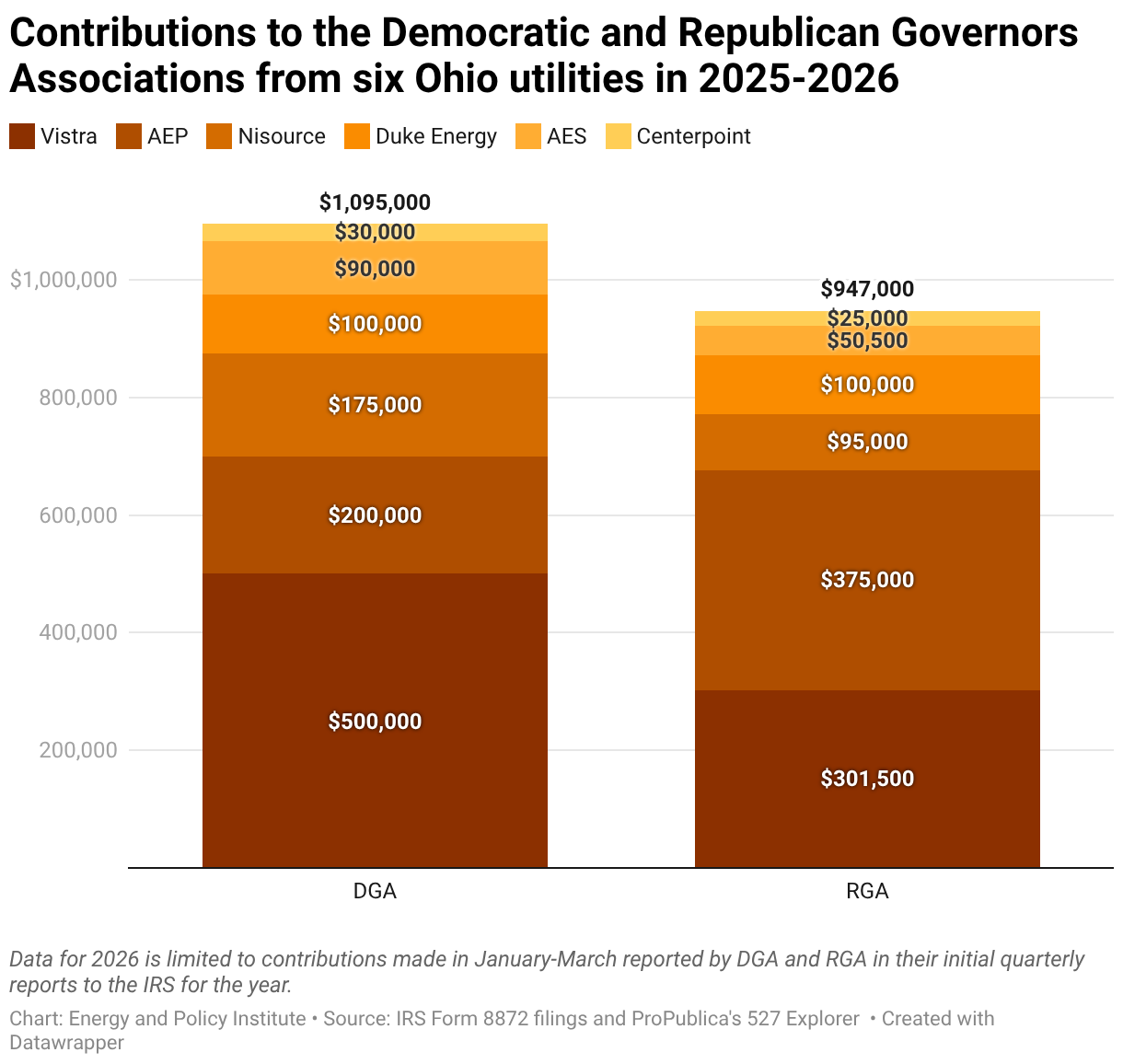
DGA pulled in over $1 million from the six Ohio utilities, plus $10,000 from FirstEnergy’s CEO
In April, DGA promoted Acton’s new “Affordability Agenda for Ohio,” which includes a multi-step plan for tackling high energy bills. DGA also attacked Ramaswamy last month for dismissing Democrats’ focus on affordability as a “buzzword” in an interview with the New York Times.
Vistra Corp., which owns coal, oil, gas, and nuclear power plants in Ohio, contributed $500,000 to DGA from its corporate headquarters in Irving, Texas. Vistra also operates as a retail electric provider in Ohio, meaning it’s one of the competitive power companies that Ohioans can choose from to supply their electricity. Vistra expanded its holdings in Ohio in 2024, when it completed its acquisition of Energy Harbor, the company that emerged from the bankruptcy restructuring of FirstEnergy Solutions.
DGA received $575,000 from regulated electric and gas distribution utilities with monopoly control over customers located in service territories authorized by the Public Utilities Commission of Ohio.
On the electric distribution side, American Electric Power gave $200,000 to DGA, and AES contributed over $90,000.
Duke Energy, which distributes electricity and gas, contributed $100,000 to DGA.
On the gas distribution side, NiSource and its Columbus Gas utilities gave $175,000 to DGA, and CenterPoint contributed $30,000.
In addition to the corporate contributions DGA received from the six utilities, FirstEnergy’s CEO Brian Tierney contributed $10,000 to DGA last year. FirstEnergy and its executives have otherwise abstained from making contributions to 527 groups since 2020, when federal prosecutors subpoenaed FirstEnergy as part of a long-running investigation into utility corruption in Ohio. FirstEnergy later admitted to bribing ex-Republican Ohio House Speaker Larry Householder and DeWine’s former Public Utilities Commission of Ohio Chairman Samuel Randazzo in connection with the passage of House Bill 6, which included over $1 billion in since-repealed ratepayer-funded bailouts for FirstEnergy. FirstEnergy has since been forced to pay hundreds of millions of dollars in related penalties and customer refunds.
FirstEnergy played both sides in the 2018 Ohio governor’s race, when bankrupt FirstEnergy Solutions contributed $350,000 to DGA and its outside lobbyists plied Democratic candidate Richard Cordroy with campaign cash as they sought ratepayer bailouts for nuclear power plants later bailed out by HB 6.
RGA raked in $947,000 in contributions from the six utilities
“Vivek’s promise to Ohio families is simple: lower costs, bigger paychecks, and a world class education for Ohio’s kids,” RGA Chair and Montana Governor Greg Gianforte said earlier this month after Ramaswamy secured his party’s nomination with a win over his Republican primary opponent Casey Putsch.
Ramaswamy’s plan for Ohio includes a pledge to “Expand natural gas and deploy innovative energy technologies to strengthen Ohio’s energy supply and reduce electric bills for every family.”
RGA received $375,000 from American Electric Power and over $300,000 from Vistra. Duke Energy followed with $100,000 in contributions to RGA, and AES kicked in over $50,000.
NiSource gave $95,000 to RGA, and CenterPoint contributed $25,000.
RGA and pro-Ramaswamy entities paid over $3.2 million to Brooke Bodney, a former fundraiser for convicted ex-Ohio House Speaker Larry Householder, and Bodney’s firm since 2018
RGA paid Brooke Bodney, an Ohio-based Republican fundraiser, $12,000 for “Finance Support Services” in 2025.
During the federal trial that sent Householder to federal prison for 20 years in 2023, FBI agent Blane Wetzel laid out for the jury how Bodney was paid $575,000 to fundraise for Householder’s political operation between 2017 and 2020, when Householder participated in a racketeering conspiracy that involved $60 million in bribes secretly paid by FirstEnergy through a murky network of nonprofit 501(c)(4)s and for-profit entities. Bodney has not been charged with any crime.
Bodney was separately paid $282,821 by RGA in 2018, and received $307,500 that year from RGA’s 501(c)(4) affiliate, State Solutions Inc. RGA also paid Bodney a total of $510,350 between 2019 and 2025, and State Solutions paid Bodney another $222,240 for fundraising for its fiscal years ending in 2019, 2020, and 2022. The money RGA and State Solutions paid to Bodney was publicly reported in the groups’ filings with the IRS.
FirstEnergy secretly contributed $2.5 million to State Solutions Inc. in 2018. FirstEnergy Solutions gave $500,000 that year to RGA, which publicly reported the money in its filings with the IRS. The money helped propel DeWine and his running mate Jon Husted to victory in Ohio’s 2018 governors’ race, as the Columbus Dispatch previously reported.
Empowering Ohio’s Economy, a group secretly funded and controlled by AEP, also contributed $525,000 to State Solutions in 2018. AEP, Duke Energy and AES all contributed money that year to RGA.
The following year, DeWine signed HB 6 into law, and put Ohio ratepayers on the hook for costly bailouts of money-losing coal and nuclear power plants that FirstEnergy, AEP, AES, and Duke Energy had long lobbied for.
No one has been charged with a crime in connection with contributions the utilities made to RGA and State Solutions.
At a recent town hall, Ramaswamy pointed to the FirstEnergy bribery scandal as the reason why there haven’t been changes to energy policy in Ohio, and said he would “clean house” if elected, as the Toledo Blade reported.
The American Exceptionalism PAC that backed Ramaswamy’s failed campaign for president paid $1,627,336 to a Republican fundraising firm called the Greyjoy Group in 2023 and 2024. The Greyjoy Group received another $273,660 for fundraising in 2023 to 2024 from the American Exceptionalism Public Policy Committee, a 501(c)(4) group that funneled $300,000 into the American Exceptionalism PAC.
The Greyjoy Group has been identified as Bodney’s employer in campaign finance reports, and a real estate document listed Bodney’s name in association with the lease for the firm’s Columbus office space. Bodney’s name and the same office suite appeared on fundraising materials for Householder’s 501(c)(4) Generation Now from 2019 made public in a PUCO investigation of FirstEnergy. Generation Now pleaded guilty in Householder’s racketeering case in 2021.
In December 2024, the American Exceptionalism PAC transferred $116,816.18 to Make America Greater, which became V-PAC: Victors Not Victims, the Super PAC that’s now supporting Ramaswamy’s bid for Ohio governor.
Ramaswamy and McColley’s campaign committees raised over $68,000 from corporate PACs for AEP, AES, Duke Energy, NiSource, and Vistra Corp.
Corporate PACs for AES, Duke Energy, NiSource, and Vistra contributed nearly $47,000 to Ramswamy’s campaign since he announced his candidacy for governor last year.
NiSource’s PAC gave a total of $16,615.57 to Ramaswamy’s campaign, the maximum amount allowed by Ohio law. Vistra’s PAC made a single $16,615 contribution to Ramswamy last summer.
AES Ohio’s PAC gave $6,000 to Ramswamy’s campaign, and Duke Energy’s PAC contributed $7,500.
McColley’s campaign committee also raised nearly $21,500 collectively from corporate PACs for AES, AEP, Duke Energy, NiSource, and Vistra last year prior to his announcement as Ramaswamy’s running mate. McColley’s committee transferred approximately $290,000 to the Ramaswamy-McColley campaign in January.
Vistra’s PAC contributed $11,600 to McColley’s campaign last summer. AEP’s PAC provided another $4,115.67, and NiSource’s PAC followed with $3115.67. Duke Energy PAC gave $1615.67, and AES Ohio’s PAC contributed $1000.
Acton has pledged to appoint Public Utilities Commission of Ohio members who will “focus on consumer costs” – Ramaswamy doesn’t mention the PUCO in his plan for lowering energy bills
As governor, Acton and Ramswamy would play a key role in appointing members of the Public Utilities Commission of Ohio, which approves the rates and bill riders paid by customers of Ohio’s regulated electric and gas distribution utilities. The PUCO also approves the return on equity, which drives utility shareholder profits, on infrastructure investments those utilities can collect from customers.
Acton has promised to appoint members of the Public Utilities Commission of Ohio who will “focus on consumer costs and quality services, and provide incentives and tough oversight for utilities–so that they perform efficiently and don’t just pad profits through higher rates.”
“I will appoint PUCO commissioners who put ratepayers first and are not beholden to utility companies,” Acton said in her affordability agenda.
Acton also wants to strengthen the Ohio Consumers Counsel, to “give households a stronger advocate in rate increase cases, ensuring families — not just utilities — have a seat at the table.”
She says she will “restore the budget of the Office of the Consumers’ Counsel so that we can better protect consumers against excessive rate hikes and predatory practices.”
Ramaswamy’s two-bullet plan for lowering energy bills doesn’t mention the PUCO or the OCC.
The PUCO is expected to see a slew of new requests to raise rates as electric and gas utilities seek to benefit from the new multi-year rate plans enabled by the passage of Ohio House Bill 15 in 2025 and House Bill 103 earlier this year.
The Ohio Consumers’ Counsel warned in testimony last year that “authorizing the electric utilities to forecast their test years in rate cases will encourage higher projected costs and lower projected revenues, leading to an increase in customers’ bills.”
Acton promises to expand energy assistance programs for Ohioans in need, in contrast to Ramaswamy’s record at DOGE
Acton’s affordability plan includes expanding “access to cost-saving programs such as Ohio’s Home Energy Assistance Program, the Percentage of Income Payment Plan (PIPP), and Home Weatherization Assistance Program, and makes sure these programs continue to deliver for Ohioans in the face of attacks from Washington.”
“We will explore expanding state-level emergency relief funds to support high-need populations,” Acton has also said.
First Focus on Children warned in January of last year that federal budget cuts proposed by President Trump’s Department of Government Efficiency would eliminate hundreds of millions of dollars in funding for the federal Low Income Home Energy Assistance Program. Ramaswamy and Elon Musk led DOGE at the time the cuts were proposed.
“These cuts would represent an unconscionable attack on federal support for children,” First Focus on Children said of DOGE’s cuts to LIHEAP and other federal programs that benefit poor kids on its website.
President Trump’s federal budget proposal for 2027 calls for eliminating LIHEAP funding.
Acton and Ramaswamy agree that data centers should pay for their own energy costs to protect Ohio consumers
Acton and Ramaswamy have both attributed rising electricity bills paid by Ohio consumers to increased demand for power from data centers for AI and cryptocurrency. They’ve both pledged to ensure data centers pay for their own energy costs.
A Bowling Green State University poll in April found 60 percent of Ohio voters believe data centers are bad for home energy costs.
“All additional costs for electricity, gas, water, environmental protection, and other services must be covered by the data centers and investors, and not Ohio taxpayers and communities,” Acton said in an affordability agenda rolled out by her campaign in April.
“In Ohio, I’ll ensure that hyperscalers pay for their own energy usage, and we’ll produce more energy too, to bring down costs for consumers,” Ramawsmy said on X in February, after President Trump discussed the issue in his State of the Union address.
A group called Conserve Ohio is gathering signatures to put a constitutional amendment on the ballot that would prohibit new data center construction in Ohio. Acton and Ramaswamy have both said they would not support a ban, according to the Toledo Blade.
Both candidates say regional grid operator PJM is a part of the problem
Vistra Corp. saw its stock price increase multiple times over the past two years after electricity capacity auctions run by the regional grid operator PJM resulted in record-high prices, driven largely by rising electricity demand from data centers. The record auction prices contributed to a jump in electricity bills paid by ratepayers in Ohio and the twelve other states that participate in PJM.
In December, Vistra Corp. reported that it cleared 10,566 megawatts in the latest PJM capacity auction at an average clearing price of $333.44 per MW-day. The clearing price was up from a recent-year low of $28.92 MW-day in 2023.
“I will join other governors to demand that PJM undertake needed reform to enhance transparency and lower costs, while improving the energy planning process,” Acton said in a Substack post last year, in which she shared how her own electricity bill had jumped by over $150 over one month last summer.
“On my watch, Ohio will work with the 12 other states in PJM to advocate for affordable reliable power for all Ohioans,” Acton said more recently in her affordability agenda.
Ramaswamy has attributed the rise in PJM power prices to a string of coal-fired power plant closures in Ohio since 2014, and to obstacles facing new energy projects trying to come online.
“Attempts to build new capacity are often mired in red tape and bureaucracy,” Ramaswamy wrote in an op-ed last year. “Since 2014, only 7% of proposed new energy projects in PJM have been completed. In Ohio, it averages over a year for the Power Siting Board to approve a new project. Bureaucracy isn’t a nature-made problem — it’s a manmade problem.”
Acton supports an “All of the Above” approach to energy that includes renewable energy and energy efficiency, while Ramaswamy wants to prioritize fossil fuels and nuclear, and is critical of wind power
Ramaswamy and Acton agree on the need to address growing demand for electricity in Ohio and the PJM region, but the two candidates differ on how they would approach the problem.
Acton plans to “lower costs for Ohio families through an all-of-the-above energy strategy” that’s focused on “the lowest-cost and cleanest sources of energy readily available.”
Acton wants to reinstate “pro-consumer programs gutted under HB6, including Energy Efficiency, Demand Response and Renewable Portfolio Standards to give consumers and Ohio’s small businesses the tools they need to reduce their bills.”
Ramaswamy said that the “climate change agenda is a hoax” while running for president in 2023. The combination of rising summer temperatures and higher electricity prices is expected to result in higher electricity bills for Ohio consumers this summer.
Ramaswamy has been critical of wind power, and opposes offshore wind on Lake Erie, but has said that “the attitude toward solar by the state has been short sighted.”
McColley was a primary sponsor of Senate Bill 52, the 2021 Ohio law that has enabled dozens of counties to ban new wind and solar farms, while leaving fossil fuel projects beyond the siting control of county officials. Ramaswamy wants to “streamline energy project permits and remove unnecessary regulations so projects get built on time and on budget.”
“Ohio politicians have made it nearly impossible to advance zero marginal cost generation such as wind and solar, forcing Ohio to generate energy through unnecessarily high cost means,” Acton has said.
“We’re seeing an AI data center boom (which is good), right at the time when we face supply constraints on baseload power generation,” Ramaswamy posted on X last year. “I’ll unshackle energy production in Ohio, from fossil fuels to nuclear energy, without apology.”
AEP is pushing new legislation that would partially reregulate Ohio’s competitive electricity market by allowing regulated utilities to build and own nuclear power plants. The cost would initially be covered by large new customers like data centers, but could eventually be passed on to other AEP Ohio customers, based on a draft of the legislation. The bill is part of a broader push for re-regulation by AEP and other utilities throughout the PJM region.
“Fossil fuels are a requirement for modern human flourishing & we shouldn’t apologize for that,” Ramaswamy said on social media in November. “One key reason electric bills are going up is the war on coal which weakens base load power generation.”
In an op-ed published in the Sandusky Register last spring, Ramaswamy praised President Trump for “issuing three executive orders to revive the coal industry — keeping aging coal plants online, accelerating mining leases on federal lands, and rolling back burdensome climate regulations.”
One of those executive orders effectively called on Trump’s Secretary of Energy Chris Wright to use the Department of Energy’s emergency authorities under Section 202(c) to prevent the closure of coal-fired power plants. The move was a throwback to the early years of Trump’s first term in the White House, when FirstEnergy targeted the Trump administration with millions of dollars in secret political spending as it lobbied unsuccessfully for a Section 202(c) bailout of struggling coal and nuclear power plants that could have cost consumers billions.
Ramaswamy’s pro-coal op-ed was published last year, as state lawmakers worked to pass the bipartisan legislation that repealed the corruption-tainted HB 6 ratepayer bailout of the OVEC coal plants. McColley co-sponsored HB 15, which repealed the coal plant subsidies that forced Ohio ratepayers to hand over hundreds of millions of dollars to AEP, AES, and Duke Energy through riders on their electricity bills.
The OVEC coal plants are now proving to be a drain on federal taxpayers. In February, the Trump administration announced plans to provide $33 million in Department of Energy funding to OVEC’s Kyger Creek plant in Ohio as part of a larger $175 million federal funding package aimed at extending the life of generating units at six coal-fired power plants in Ohio, North Carolina, Virginia, and West Virginia.
Top image by Ɱ from Wikipedia Commons. Creative Commons Attribution-Share Alike 4.0 International